Angelica Tree
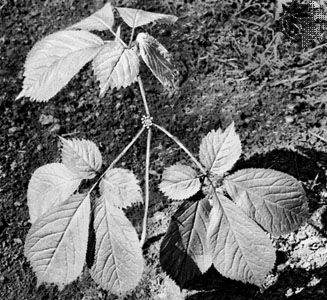
The angelica tree (Aralia spinosa), also known as devil’s walkingstick or Hercules'-club, is a prickly-stemmed shrub or tree belonging to the ginseng family.
What is angelica tree?
The angelica tree (Aralia spinosa), also known as devil’s walkingstick or Hercules’-club, is a prickly-stemmed shrub or tree belonging to the ginseng family1.12
Capable of reaching heights of up to 15 meters (about 50 feet), the plant is characterized by its large, often prickly, feather-like compound leaves. It is native to low-lying regions of the United States, ranging from Delaware to Indiana, extending south to Florida and west to Texas.32
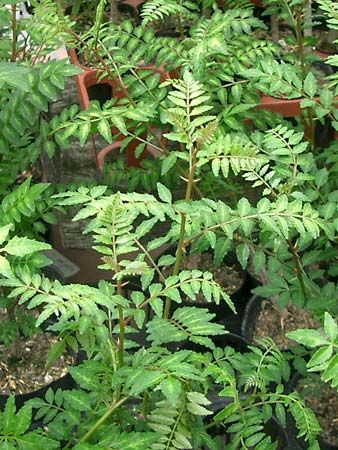
While the angelica tree is sometimes colloquially referred to as “prickly ash,” it is botanically unrelated to the true prickly ash (Zanthoxylum), which belongs to the rue family (Rutaceae).1
Why is the angelica tree also called devil’s walking stick?
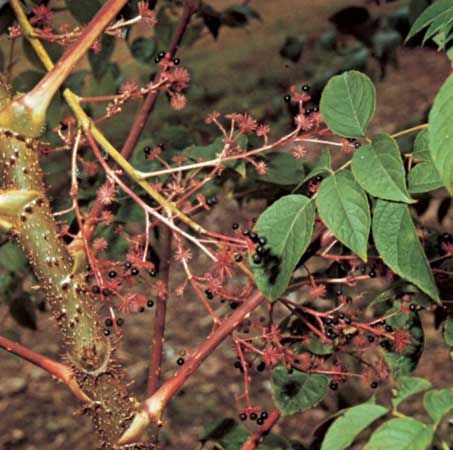
The angelica tree (Aralia spinosa) is commonly called “devil’s walking stick” due to its distinct physical appearance. The plant features a tall, slender, and unbranched stem that is covered in sharp, woody prickles, giving it the appearance of a formidable or “devilish” cane or walking stick.1
It is important to note that the angelica tree is a member of the ginseng family and is distinct from the genus Angelica, which consists of aromatic herbs in the Apiaceae family.14
What are some other plants in the ginseng family?
The Araliaceae family, commonly known as the ginseng family, includes approximately 1,450 species of flowering plants, most of which are shrubs or trees. Beyond the angelica tree, several other notable plants belong to this family:56
- Ginseng: The genus Panax includes medicinal herbs such as Panax ginseng (Asian ginseng) and Panax quinquefolius (American ginseng), both valued for their roots.576
- Ivies: The genus Hedera consists of evergreen woody vines, including the popular ornamental English ivy (Hedera helix).568
- Rice-paper plant: Known scientifically as Tetrapanax papyriferum, this plant is the traditional source of rice paper.56
- Wild sarsaparilla: Aralia nudicaulis is a herbaceous member of the family with an aromatic root used as a substitute for sarsaparilla.56
- Schefflera: This is the largest genus in the family, containing about 1,600 species, including popular houseplants like the umbrella tree (S. actinophylla) and false aralia (S. elegantissima).6
- Castor aralia: Also known as Hari-giri (Acanthopanax ricinifolius), this species is utilized in Japan for timber and furniture making.5
How do thorns help protect trees and shrubs?
Thorns, along with related structures like prickles and spines, serve as essential physical defense mechanisms for trees and shrubs, primarily functioning to deter herbivores from consuming the plant’s tissues.101112
These structures protect plants in several ways:
- Deterrence: Their sharp, “stabby” nature makes it physically difficult or painful for animals to browse on the plant, effectively shielding leaves, stems, and shoots from being eaten.11
- Structural Defense: In environments like deserts, spines serve a dual purpose: they defend succulent stems against hungry animals while also providing shade to protect the plant from intense sun exposure.11
- Mutualism: Some plants, such as certain acacia trees, use specialized, swollen thorns as housing for aggressive ants. In exchange for this shelter and food, the ants fiercely defend the tree against any encroaching threats, including other animals or competing vegetation.11
While often grouped together, these structures differ in origin: thorns are modified branches or stems, prickles are outgrowths of the epidermis, and spines are modified leaves or stipules.1112
Sources
- angelica tree — Encyclopædia Britannica
- prickly ash — Encyclopædia Britannica
- angelica tree — Merriam-Webster
- angelica — Encyclopædia Britannica
- Araliaceae — Encyclopædia Britannica
- Araliaceae — Merriam-Webster
- ginseng — Encyclopædia Britannica
- Apiales — Encyclopædia Britannica
- ivy — Encyclopædia Britannica
- Eating the rainforest — Encyclopædia Britannica
- Botanical Barbarity: 9 Plant Defense Mechanisms — Encyclopædia Britannica
- rose: Top Questions — Encyclopædia Britannica
Published on · 2 min read