Beaver Island
The economy of Beaver Island has shifted significantly over time, moving from its historical roots in fishing to a modern reliance almost entirely on tourism.
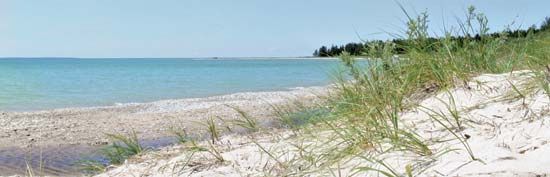
How has tourism impacted the island’s economy and way of life?
The economy of Beaver Island has shifted significantly over time, moving from its historical roots in fishing to a modern reliance almost entirely on tourism.
This transition has shaped the island’s current way of life, as the area has become a popular destination for anglers, hunters, and boaters who utilize its natural resources. While the island maintains connections to the mainland via air and ferry services to Charlevoix, its infrastructure remains modest, with few paved roads outside of the village of St. James. Additionally, the island preserves its history through remaining Mormon-era buildings, while a substantial portion of the land is dedicated to a state wildlife research area, balancing recreational use with environmental conservation.1
What is the history of Native American presence on Beaver Island?
Sorry, the Britannica knowledge base does not contain information regarding the history of Native American presence on Beaver Island. The available records focus on French exploration, the 19th-century Mormon colony led by James Jesse Strang, and the subsequent arrival of Irish fishermen.1
How does Beaver Island’s ecosystem differ from mainland Michigan?
Beaver Island’s ecosystem is characterized by its status as an isolated landmass within Lake Michigan, which influences its species diversity compared to the mainland. According to the theory of island biogeography, the number of species on an island is generally proportional to its size and inversely proportional to its distance from the mainland, as these factors dictate rates of colonization and extinction.1
While the broader Michigan region is known for diverse hardwood forests and a wide array of mammals such as deer, bears, and various fur-bearing species, Beaver Island maintains a distinct ecological profile. Approximately one-third of the island is designated as a state wildlife research area, which helps preserve its natural environment amidst its primary economic reliance on tourism1. Unlike the mainland, where human development is more extensive, the island’s limited infrastructure—with few paved roads outside the village of St. James—contributes to a more contained and monitored habitat for local flora and fauna.34
How did James Strang’s Mormon kingdom impact the island’s history?
James Jesse Strang’s arrival on Beaver Island in 1847 fundamentally transformed the island’s history by establishing a short-lived but significant religious colony. After relocating his followers from Wisconsin, Strang founded the city of St. James, which served as the capital of his sect.61
Strang’s leadership was marked by both spiritual and temporal authority. In 1850, he claimed a divine revelation that sanctioned his coronation as “King James I,” and he introduced practices such as polygyny. His rule was characterized by a blend of puritanical social control and political maneuvering, which included his election to the Michigan legislature in 1852 and 1854.61
However, his tyrannical governance and religious practices incited deep resentment among both his followers and mainland residents. This tension culminated in his assassination in 1856 by two former members of his sect. Following his death, the “kingdom” rapidly disintegrated; mainland fishermen forcibly expelled the remaining 2,000 Strangites, clearing the way for Irish fishermen to settle the island. Today, some buildings from this era still stand in St. James as remnants of this unique period.61
Sources
- Beaver Island — Encyclopædia Britannica
- Lake Michigan — Encyclopædia Britannica
- Michigan - Plant and animal life — Encyclopædia Britannica
- Michigan - Drainage — Encyclopædia Britannica
- community ecology - Biogeographic aspects of diversity — Encyclopædia Britannica
- James Jesse Strang — Encyclopædia Britannica
Published on · 2 min read