Blackberry Lily
The blackberry lily (Iris domestica, formerly known as Belamcanda chinensis) is a perennial flowering plant belonging to the iris family (Iridaceae). Despite…
What is Blackberry lily?
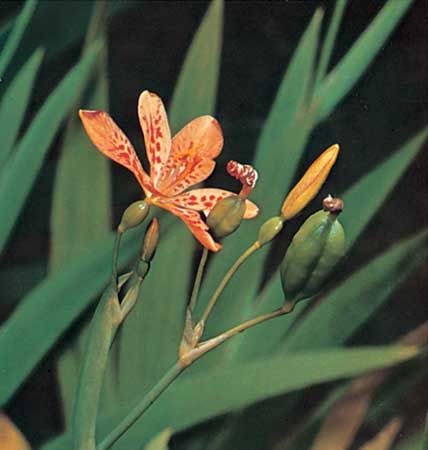
The blackberry lily (Iris domestica, formerly known as Belamcanda chinensis) is a perennial flowering plant belonging to the iris family (Iridaceae). Despite its common name, it is not a true lily Despite its common name, it is not a true lily.12
Native to East Asia and naturalized in parts of North America, the plant is a popular garden ornamental characterized by its branching stems, grassy foliage, and stout rhizomatous rootstalk. It produces showy, red-spotted orange flowers with six petallike segments.132
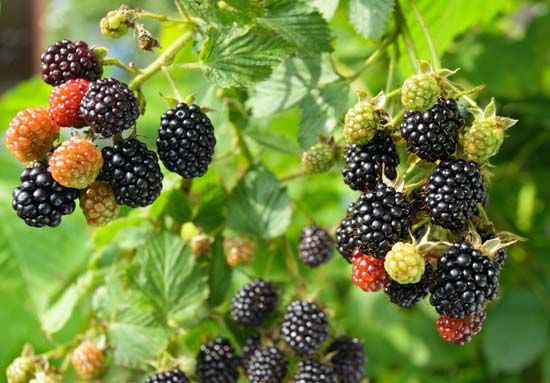
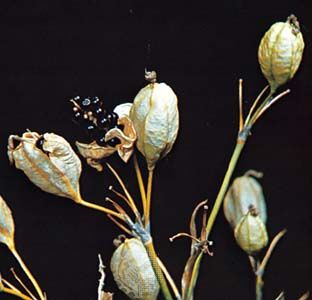
The plant earns its name from its fruit: as the capsule wall matures, it recurves to reveal a cluster of shiny black seeds that closely resemble a blackberry.12
What are some other common plants in the Iridaceae family?
The Iridaceae family, commonly known as the iris family, includes approximately 66 genera and 2,200 species of perennial herbs. Beyond the well-known Iris genus, several other genera are widely cultivated for their ornamental value or economic utility:
- Gladiolus: This genus comprises about 300 species and is highly valued in horticulture for its showy, often branched flower clusters and as a popular cut flower.3
- Crocus: Known for both spring- and autumn-blooming varieties, this genus includes about 75 species. Notably, the stigmas of Crocus sativus are the source of saffron, a prized culinary spice and medicinal ingredient.3
- Blue-eyed grasses (Sisyrinchium): Containing about 200 species native to the Western Hemisphere, these are frequently used in naturalistic garden settings.3
- Freesia: These plants are grown extensively on a commercial scale, primarily for use as fragrant cut flowers.3
How do rhizomes help plants like the blackberry lily survive?
Rhizomes are horizontal, underground stems that play a critical role in the survival and propagation of plants like the blackberry lily. These modified stems help the plant survive in several key ways:
- Food and Water Storage: Rhizomes function as storage organs for starches and proteins. This stored energy allows the plant to perennate, meaning it can survive through extended winters or periods of drought when conditions are unfavorable for growth above ground.67
- Vegetative Reproduction: Rhizomes enable the plant to propagate asexually. By sending up new shoots from nodes along the underground stem, the plant can spread and form a colony, effectively cloning itself without the need for seeds.67
- Structural Support: As a stout, rhizomatous rootstalk, the rhizome provides a stable base for the plant’s branching stems and foliage, allowing it to regenerate new growth each season.71
What are the differences between a true lily and an iris?
While both true lilies and irises are popular ornamental flowering plants, they belong to distinct botanical families and possess significant structural differences.
Taxonomic Classification
- True Lilies: Belong to the genus Lilium within the family Liliaceae, which is part of the order Liliales.
- Irises: Belong to the genus Iris within the family Iridaceae, which is part of the order Asparagales.
Key Physical Differences
Feature
True Lily (
Lilium
)
Iris (
Iris
)
Flower Structure
Six petal-like segments (tepals) that are often undifferentiated.
Three sepals (falls) and three petals (standards), with broad stigma branches.
Ovary Position
Can be superior or inferior.
Consistently inferior (located below the flower parts).
Underground Organs
Primarily scaly [bulbs].
Either
rhizomes
or bulbs
.
Fruit Type
Not specified as a capsule in the same manner as Iridaceae.
Dry
capsule
that splits to release seeds.
It is important to note that the common name “lily” is frequently applied to plants outside the genus Lilium—such as the daylily or the blackberry lily—which can lead to confusion regarding their true botanical identity.54
Sources
- blackberry lily — Encyclopædia Britannica
- blackberry lily — Merriam-Webster
- Iridaceae — Encyclopædia Britannica
- iris — Encyclopædia Britannica
- Iridaceae — Merriam-Webster
- Rhizome — Encyclopædia Britannica
- Angiosperm - Shoot system modifications — Encyclopædia Britannica
- Liliales — Encyclopædia Britannica
- lily — Encyclopædia Britannica
Published on · 3 min read