Candiru
The candiru (Vandellia cirrhosa) is a small, translucent, and eellike parasitic catfish belonging to the family Trichomycteridae, native to the Amazon River…
What is candiru?
The candiru (Vandellia cirrhosa) is a small, translucent, and eellike parasitic catfish belonging to the family Trichomycteridae, native to the Amazon River region.12
Typically measuring about 2.5 cm (1 inch) in length, this fish primarily feeds on the blood of other fish by lodging itself within their gill cavities. While rare, the candiru is known to attack humans and other swimming animals by entering the urethra. Once inside, the fish erects short spines located on its gill covers, which can lead to severe inflammation, hemorrhage, and in some cases, death for the victim.12
What other types of parasitic fish exist in the Amazon?
The provided search results do not identify other fish species in the Amazon that share the specific parasitic, blood-feeding behavior of the candiru.
While the Amazon River is home to approximately 2,500 identified fish species—including various catfish, piranhas, and tambaqui—these other species are generally categorized as scavengers, predators, or seed-dispersers rather than parasites that feed on the blood of other fish in the manner of Vandellia cirrhosa.123
How do scientists study the behavior of small river fish?
Scientists study the behavior of river fish through a combination of direct observation, morphological analysis, and specialized technology.
For many species, particularly those that are active and swift-moving like trout and salmon, researchers rely on direct observation to understand their life cycles and movements. This includes studying their homing instincts, which allow them to return to their natal streams for reproduction, and their social behaviors, such as schooling or territorial aggression. When direct observation is not possible—such as with deep-sea species—scientists often infer behavior by examining the fish’s morphology and anatomy fish’s morphology and anatomy.17
Technological tools are also essential for studying fish in their natural environments:
- Underwater Photography: Researchers use specialized watertight cameras or pressure-resistant housings to document fish behavior. Because water absorbs red and yellow light, artificial lighting is often required to capture full-color images. These systems must account for the refractive index of water, which makes objects appear closer than they are and alters the lens’s angle of view.6
- Fishery Methods: While primarily used for harvesting, various fishing techniques—such as the use of traps, gill nets, and scoop nets—can provide researchers with specimens for study.7
What are some other dangerous animals found in the Amazon River?
The Amazon River basin is home to several animals that can be dangerous to humans and other wildlife. Beyond the well-known piranha, which is notorious for its razor-sharp teeth and ability to strip a carcass in minutes, the river hosts several other formidable predators.39
Dangerous Aquatic Predators
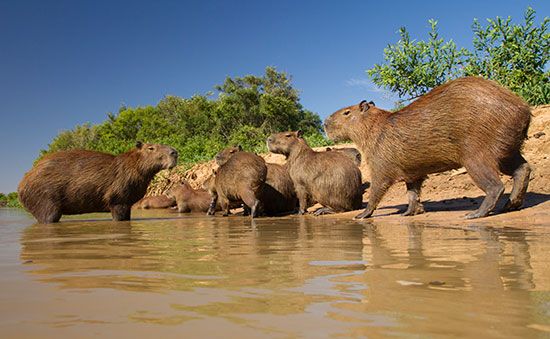
- Black Caiman: As the largest predator in the Amazon River basin, the black caiman can grow up to 6 meters (20 feet) in length. They are apex predators that hunt at night, feeding on fish, capybaras, and occasionally livestock or humans.10
- Electric Eel: Despite their name, electric eels are a type of knifefish. They possess specialized organs that can discharge up to 860 volts, a shock powerful enough to stun prey or cause intense pain and muscle contractions in humans.1112
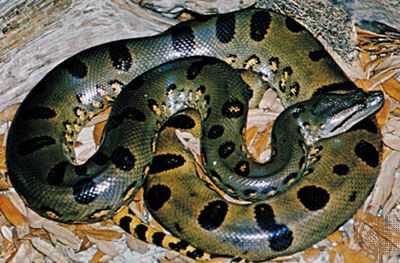
- Anacondas: These large, constricting snakes are apex predators that ambush prey from the water. While encounters with humans are rare, their massive size and strength allow them to consume large vertebrates, including caimans and deer.13
Other Hazards
The Amazon is also home to numerous insects that pose significant health risks. Myriads of mosquitoes in the region are known to transmit serious diseases, including malaria and yellow fever.9
Sources
- candiru — Encyclopædia Britannica
- 10 of the World’s Most Dangerous Fish - Candiru — Encyclopædia Britannica
- Amazon River: Top Questions — Encyclopædia Britannica
- catfish — Encyclopædia Britannica
- Vegetarian piranhas — Encyclopædia Britannica
- commercial fishing - Methods — Encyclopædia Britannica
- protacanthopterygian - Behaviour and locomotion — Encyclopædia Britannica
- technology of photography - Underwater photography — Encyclopædia Britannica
- 7 Crocodilian Species That Are Dangerous to Humans — Encyclopædia Britannica
- anaconda — Encyclopædia Britannica
- black caiman — Encyclopædia Britannica
- Amazon River - Animal life — Encyclopædia Britannica
- 10 of the World’s Most Dangerous Fish - Electric Eel — Encyclopædia Britannica
- electric eel — Encyclopædia Britannica
Published on · 3 min read