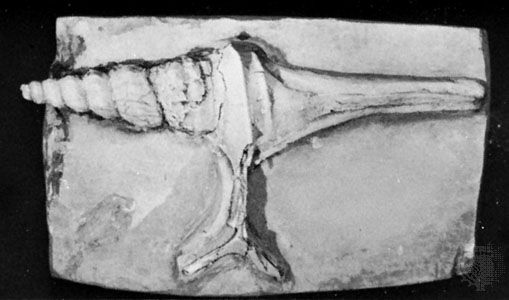
Cardioceras
Cardioceras is a genus of extinct ammonoid cephalopods that lived during the Late Jurassic Period, approximately 161 million to 146 million years ago. These…
What is Cardioceras?
Cardioceras is a genus of extinct ammonoid cephalopods that lived during the Late Jurassic Period, approximately 161 million to 146 million years ago. These marine animals are related to the modern pearly nautilus1.12
The shell of Cardioceras is distinctively circular in outline and features a prominent crest along its outer margin, along with a ribbed surface. Because of their wide geographic distribution and easily recognizable physical characteristics, these fossils serve as excellent index, or guide, fossils. They are highly valuable to geologists for correlating Jurassic rock layers across widely separated regions.12
What are index fossils and why are they important to geologists?
An index fossil—also known as a guide fossil—is any plant or animal preserved in the rock record that is characteristic of a specific span of geologic time or environment.34
To be considered a useful index fossil, a specimen should ideally possess the following characteristics:
- Short temporal range: The species existed for only a brief moment in geologic history, allowing for precise dating.34
- Wide geographic distribution: The organism was cosmopolitan, meaning it can be found in many different regions, which helps correlate separated rock layers.34
- Abundance: The fossils are common enough that discovery is highly probable.34
- Distinctive appearance: They are easily recognizable, which prevents misidentification.34
These fossils are essential to geologists because they serve as the primary basis for defining boundaries in the geologic time scale and for the stratigraphic correlation of rock layers across different locations. By identifying the same index fossils in separated outcrops, geologists can establish that the rocks were formed during the same time interval.34
How do ammonites differ from modern nautiluses?
While ammonites and modern nautiluses are both shelled cephalopods that relied on external shells for protection, they are distinct groups with key anatomical differences.
The most significant diagnostic difference lies in their internal shell structure. Ammonites are distinguished from nautiloids by the complex, highly crenulated suture patterns where their internal partitioning walls meet the outer shell. In contrast, nautiloids possess much simpler suture patterns.2
Additionally, there are physiological differences in their anatomy:
- Circulatory System: While both have primitive circulatory features compared to modern coleoids (like squids and octopuses), the nautilus has a partly lacunar circulatory system.6
- Excretion: The nautilus possesses four kidneys, whereas other cephalopod groups typically have two.6
- Sensory Organs: The eyes of the modern Nautilus are simple open pits that lack lenses, whereas other cephalopods have evolved highly efficient, complex eyes.6
Ammonites went extinct at the end of the Cretaceous Period, while the nautilus remains a living representative of these ancient, less-specialized forms.26
What caused the extinction of ammonoids at the end of the Cretaceous Period?
The extinction of ammonoids at the end of the Cretaceous Period (approximately 66 million years ago) is widely attributed to the K–T extinction event, which likely had multiple, compounding causes.27
Strong evidence supports the theory that a massive asteroid impact—evidenced by the Chicxulub crater in the Yucatán Peninsula—played a significant role. This impact ejected vast quantities of debris into the atmosphere, blocking sunlight for months or years. This global darkness halted photosynthesis, causing a collapse in the food chain that particularly devastated plankton populations. Because ammonoid survival was closely tied to the availability of plankton, the sudden decline of these organisms likely triggered the ammonoids’ demise.782
Additionally, the environment was already under stress due to terrestrial factors, including:
Sources
- Cardioceras — Encyclopædia Britannica
- ammonoid — Encyclopædia Britannica
- index fossil — Encyclopædia Britannica
- dating - Principles and techniques — Encyclopædia Britannica
- Cambrian Period - Correlation of Cambrian strata — Encyclopædia Britannica
- cephalopod - Form and function — Encyclopædia Britannica
- Mesozoic Era - Mesozoic life — Encyclopædia Britannica
- Cretaceous Period - Mass extinction — Encyclopædia Britannica
- end-Triassic extinction — Encyclopædia Britannica
- Pangea: Top Questions — Encyclopædia Britannica
- What Happened to the Dinosaurs? — Encyclopædia Britannica
Published on · 3 min read