Chamois
Chamois are goatlike animals native to the mountainous regions of Europe and the Middle East. Their distribution is divided between two primary species:
Where are chamois primarily found in the wild?
Chamois are goatlike animals native to the mountainous regions of Europe and the Middle East. Their distribution is divided between two primary species:1
- Pyrenean chamois (Rupicapra pyrenaica): Found in the Cantabrian Mountains, the Pyrenees, and the central Apennines.1
- Chamois (Rupicapra rupicapra): Distributed from the western Alps and the Tatra Mountains across to the Caucasus and northern Turkey.1
While they were introduced to New Zealand in the 20th century, they are not native to that region and have been managed due to their impact on local vegetation. These agile animals are known for their ability to navigate steep cliffs and meadows, often ascending to the snowline during the summer months.1
How has chamois leather been used historically and in modern times?
Historically, the soft, pliant skin of the chamois was used to create the original “chammy” or “shammy” leather. This material is produced through an oil-tanning process, an ancient method where fish oil or other fatty substances are pounded into the dried hide to replace its natural moisture.23
In modern times, this process remains the primary method for producing authentic chamois leather, which is valued for being soft, porous, and capable of being repeatedly wetted and dried without sustaining damage. Because of these properties, it is frequently used for cleaning and polishing delicate surfaces, such as automotive finishes or glass.3
It is important to note that the term “chamois” is also applied to “chamois cloth,” which is a soft fabric manufactured to imitate the texture and utility of genuine chamois leather. While the term is often used interchangeably in casual conversation, the cloth version is a synthetic or textile alternative rather than a product derived from the animal’s hide.1
What are the physical characteristics of chamois?
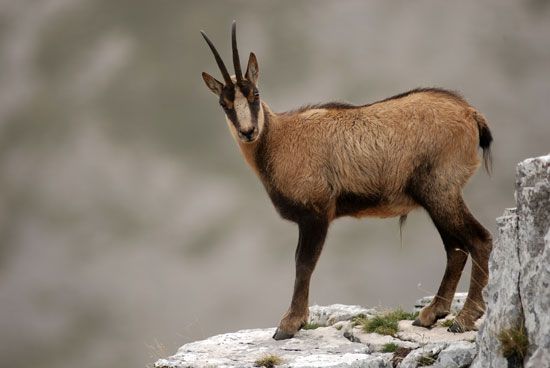
The chamois is a goatlike animal belonging to the Bovidae family, characterized by its agility and adaptation to rugged mountain environments. Physically, they stand approximately 80 cm (31 inches) tall at the shoulder and typically weigh between 25 and 50 kg (55–110 pounds), with males being slightly larger than females.1
Key physical features include:
- Horns: Both sexes possess vertical horns that hook sharply backward at the tips.1
- Coat and Coloration: Their coat color varies by season, shifting from chestnut brown or black in winter to pale brown in summer. All subspecies feature distinct black and white face markings, along with a black tail and legs. During winter, they develop a thick underfur for insulation.1
- Specific Markings: The Pyrenean chamois is notable for having two large whitish shoulder patches and a large pale rump patch in winter, appearing reddish brown during the summer months.1
- Skull Structure: Unlike goats or sheep, the chamois skull is fragile and not suited for head-on clashing.1
What is the taxonomic classification of chamois within the animal kingdom?
The chamois belongs to the genus Rupicapra within the family Bovidae and the order Artiodactyla.14
There are two recognized species within this genus:
Sources
- chamois — Encyclopædia Britannica
- chamois cloth — Merriam-Webster
- leather - Modern leather making — Encyclopædia Britannica
- Rupicapra — Merriam-Webster
Published on · 2 min read