Clingfish
A clingfish is any of more than 150 species of small fish belonging to the family Gobiesocidae. These fish are easily identified by a strong suction disk on…
What is clingfish?
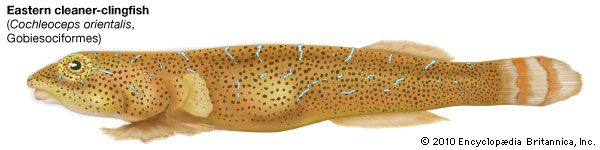
A clingfish is any of more than 150 species of small fish belonging to the family Gobiesocidae. These fish are easily identified by a strong suction disk on their undersurface, which is formed by their pelvic fins and surrounding folds of flesh. This unique adaptation allows them to anchor themselves firmly to objects like stones, coral reefs, or the sea floor.12
Clingfishes are typically scaleless with wide, flattened heads. While most species measure 7.5 cm (3 inches) or less, some, such as the South African Chorisochismus dentex, can reach lengths of up to 30 cm (12 inches). Although a few species in the genus Gobiesox are found in rapid freshwater streams, the vast majority inhabit marine environments, particularly the intertidal zone.1
How does the suction disk function?
The suction disk of a clingfish is a specialized anatomical structure located on the fish’s undersurface. It is formed by the modification of the pelvic fins and the surrounding folds of flesh. By utilizing this disk, the fish can create a vacuum-like seal against surfaces, allowing it to anchor itself firmly to objects such as stones, coral reefs, or the sea floor, even in environments with strong currents like the intertidal zone.1
While the provided search results confirm that the disk is formed by the pelvic fins and adjacent flesh to maintain a hold on the bottom, they do not detail the specific physiological mechanics of how the vacuum is generated or maintained.
What is the intertidal zone?
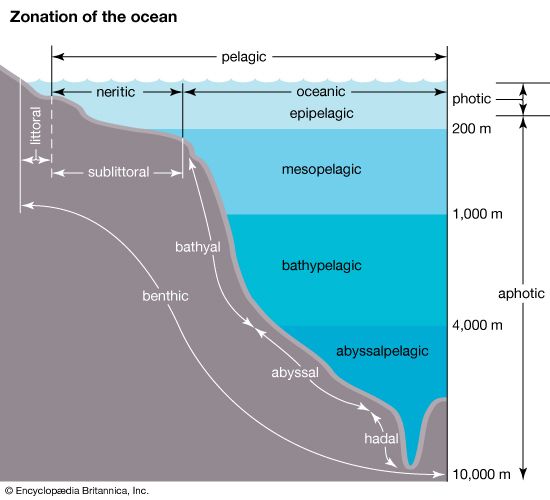
The intertidal zone, also known as the littoral zone, is the marine environment that extends from the high-tide mark—the maximum elevation reached by the tide—to the shallow, offshore waters.4
This area is defined by the alternating submergence and exposure of the shoreline caused by the rise and fall of the tides. Because of this cycle, the zone experiences significant physical fluctuations in temperature, salinity, and acidity, as well as the impact of breaking waves and longshore currents.56
The biological character of the intertidal zone is highly varied and depends on the nature of the shoreline:
- Rocky shores: Organisms in these wave-swept areas are typically firmly cemented or anchored to the substratum to survive the intense water motion.5
- Sandy and muddy bottoms: These areas, often found in protected bays or inlets, support diverse populations of burrowing animals, such as mollusks, worms, and echinoderms.56
- Disturbances: The zone is subject to frequent ecological disturbances, such as debris battering or the overturning of boulders by wave stress, which play a critical role in shaping local biodiversity.7
What do clingfish eat in their natural habitat?
The provided search results do not contain information regarding the specific diet of clingfish in their natural habitat. While the articles describe the physical characteristics and habitats of clingfish, such as their intertidal zone distribution and use of suction disks, they do not detail their feeding habits.1
Please note that while the search results provide information on the carnivorous diet of gobies, clingfish belong to a different family (Gobiesocidae) and should not be confused with them.19
Sources
- clingfish — Encyclopædia Britannica
- clingfish — Merriam-Webster
- clupeiform - Distinguishing characteristics — Encyclopædia Britannica
- littoral zone — Encyclopædia Britannica
- Marine ecosystem - Geography, oceanography, and topography — Encyclopædia Britannica
- tidal flat — Encyclopædia Britannica
- Marine ecosystem - Physical and chemical properties of seawater — Encyclopædia Britannica
- ecological disturbance - Disturbance and biodiversity in intertidal zones — Encyclopædia Britannica
- goby — Encyclopædia Britannica
Published on · 2 min read