Snailfish
A snailfish is any of approximately 115 species of marine fish belonging to the family Liparidae (sometimes classified within the family Cyclopteridae).…
What is snailfish?
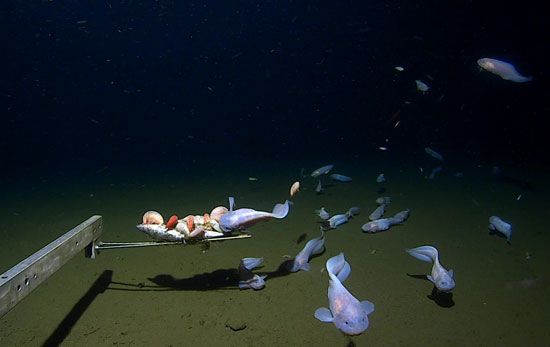
A snailfish is any of approximately 115 species of marine fish belonging to the family Liparidae (sometimes classified within the family Cyclopteridae). These fish are characterized by their elongated, tadpole-like bodies, which typically reach a maximum length of about 30 centimeters (12 inches). They possess soft, scaleless skin—though some species may be prickly—and a long dorsal fin. Most species feature a specialized sucking disk located beneath the head, formed from their pelvic fins, which allows them to attach to the ocean floor.1
Snailfish are adapted to cold environments and are found in the North Atlantic, North Pacific, as well as the Arctic and Antarctic seas. Their habitats vary significantly; for instance, the sea snail (Liparis liparis) is commonly found in shore waters, while other species, such as those in the genus Careproctus, are known to inhabit the deep sea.1
How do deep-sea fish survive extreme water pressure?
Deep-sea fish have evolved specialized physiological adaptations to survive the extreme hydrostatic pressure found at depths of up to 8,370 meters (27,500 feet), where pressure can reach hundreds of atmospheres.34
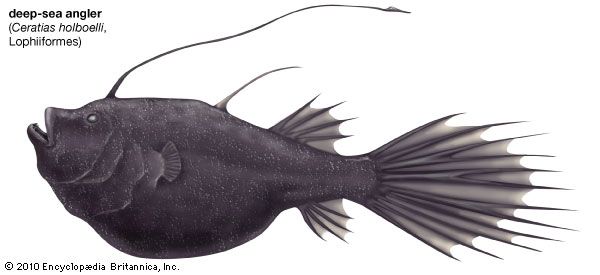
The primary strategy for surviving these conditions is the absence of air-filled compartments. Unlike many surface-dwelling bony fish, deep-sea species typically lack a swim bladder—a gas-filled organ used for buoyancy—or have one that is significantly reduced or absent. Because gas is highly compressible, an air-filled bladder would collapse under the immense pressure of the deep ocean; by eliminating these air spaces, deep-sea fish avoid the structural damage that would otherwise occur.546
While surface-dwelling animals that dive to great depths must manage the compression of air in their lungs and the risk of decompression sickness, deep-sea fish are permanently adapted to their high-pressure environment. These evolutionary traits, alongside other specialized features like modified metabolic processes and body structures, allow them to thrive in an environment defined by darkness, cold, and intense pressure.437
What are some other animals that live in the deepest parts of the ocean?
Beyond the specialized fish that inhabit the deepest parts of the ocean, a variety of other organisms have adapted to the extreme pressure, darkness, and cold of the abyssal and hadal zones. These creatures often rely on organic matter drifting down from the surface or on chemical energy produced at hydrothermal vents.31011
Key groups of deep-sea animals include:
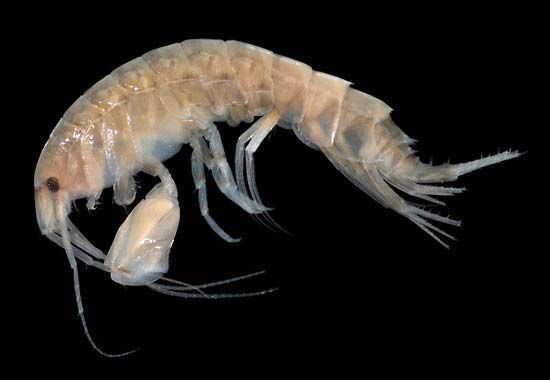
- Crustaceans: Amphipods, which are small, shrimp-like invertebrates, have been discovered at depths exceeding 9,100 meters (30,000 feet). Various crabs, such as the brachyuran and galatheid species, are frequently found congregating around hydrothermal vents.1211
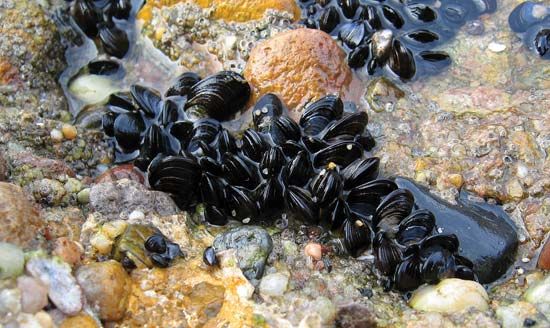
- Mollusks: Large bivalve clams and mussels thrive in vent communities, often maintaining symbiotic relationships with bacteria to survive.11
- Worms: Vestimentiferan worms are prominent members of the megafauna found at deep-sea vents, where they rely on chemoautotrophic bacteria for nutrition.11
- Other Invertebrates: Ciliates and large sea anemones are also recovered from extreme depths, where they occupy niches as scavengers or predators.311
These organisms often exhibit unique physical traits, such as delicate, unstreamlined bodies or long appendages that help them navigate soft sediment bottoms.10
How do sucking disks help fish survive in their environment?
Sucking disks are specialized anatomical structures that allow certain fish to anchor themselves securely to surfaces in their environment. These disks are typically formed by modified pelvic fins and adjacent folds of flesh located on the underside of the fish.151
By using these disks, fish can maintain a stable position against strong currents or wave action. For example, many clingfish inhabit the intertidal zone, where they use their suction disks to hold onto the bottom despite the turbulent movement of water. Similarly, snailfish utilize a disk below the head to attach themselves to the seafloor, which is particularly useful for species living in various marine environments ranging from shore waters to the deep sea.151
While some fish use these disks throughout their lives, other organisms possess transient adhesive organs during their larval stages to serve as a temporary means of attachment to the sea bottom.16
Sources
- snailfish — Encyclopædia Britannica
- Liparidae — Merriam-Webster
- deep-sea fish — Encyclopædia Britannica
- muscle - Jawed fishes — Encyclopædia Britannica
- swim bladder — Encyclopædia Britannica
- Biosphere - Hydrostatic pressure — Encyclopædia Britannica
- fish - The respiratory system — Encyclopædia Britannica
- fish - Structural diversity — Encyclopædia Britannica
- atheriniform - Natural history — Encyclopædia Britannica
- amphipod — Encyclopædia Britannica
- life - Temperature and desiccation — Encyclopædia Britannica
- abyssal zone — Encyclopædia Britannica
- Cretaceous Period - Marine life — Encyclopædia Britannica
- Marine ecosystem - Organisms of the deep-sea vents — Encyclopædia Britannica
- clingfish — Encyclopædia Britannica
- adhesive organ — Merriam-Webster
Published on · 3 min read