Great Barrier Reef
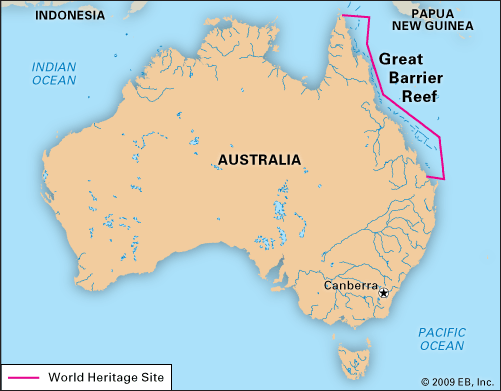
The Great Barrier Reef is the world’s largest and longest reef complex, extending over 1,250 miles (2,000 km) along the northeastern coast of Australia. It…
How large is the Great Barrier Reef and what types of ecosystems does it contain?
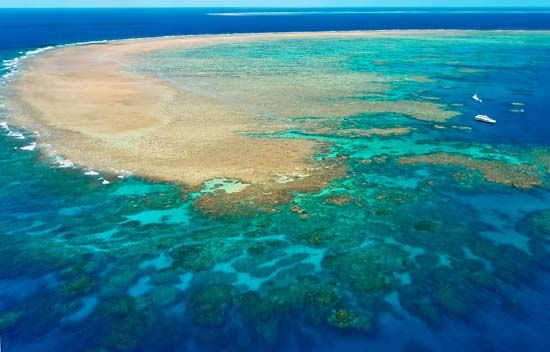
The Great Barrier Reef is the world’s largest and longest reef complex, extending over 1,250 miles (2,000 km) along the northeastern coast of Australia. It covers an area of approximately 135,000 square miles (350,000 square km) and consists of about 2,100 individual reefs and 800 fringing reefs.1
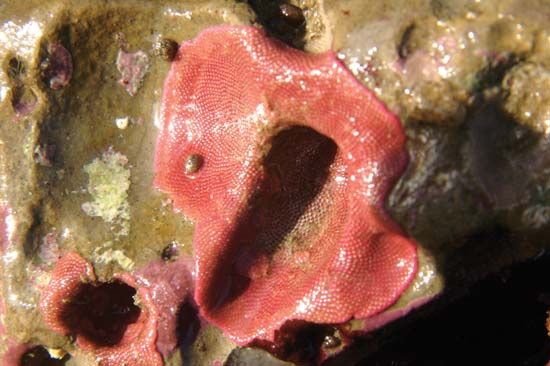
The reef is a complex aquatic ecosystem built over millions of years by coral polyps and bound together by coralline algae and bryozoans. It supports a vast array of life, including:
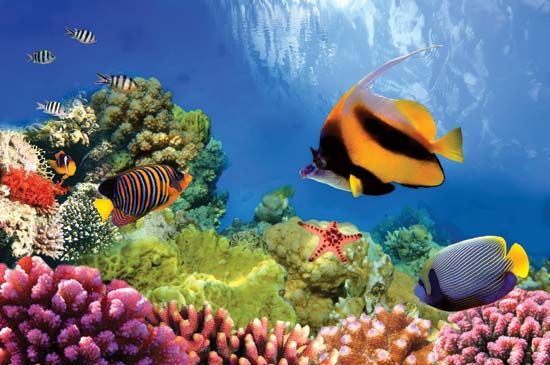
- Marine Life: Over 450 species of hard coral, more than 1,500 species of fishes, and various crustaceans, mollusks, and sea turtles.1
- Flora: While plant life on the cays is limited, mangroves are found in northern areas, and algae play a critical role in the reef’s structure and food web.12
What role do coral polyps play in the formation and maintenance of the reef?
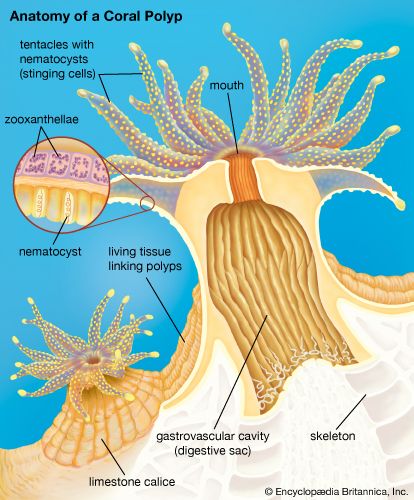
Coral polyps are the fundamental architects of coral reefs, acting as the primary biological agents in both their formation and ongoing maintenance.45
Role in Formation
- Structural Framework: Polyps are small, colonial animals that secrete a hard, protective exoskeleton made of calcium carbonate (limestone). These skeletons serve as the “bricks” of the reef, providing the rigid framework upon which the entire ecosystem is built.165
- Colonial Growth: Through a process of budding, polyps create new individuals that remain attached to the original colony. Over millions of years, the continuous growth and accumulation of these skeletons—along with the skeletal waste of other organisms—form the massive structures known as reefs.56
Role in Maintenance
- Symbiotic Partnership: Polyps maintain a vital symbiotic relationship with photosynthetic algae called zooxanthellae that live within their tissues.78
- Accelerated Calcification: The zooxanthellae provide the polyps with essential nutrients and energy through photosynthesis. By removing metabolic waste products like carbon dioxide, these algae significantly increase the speed at which the polyp can deposit calcium carbonate, thereby accelerating the growth and maintenance of the reef structure.78
How did the Great Barrier Reef form, and how old is it?
The Great Barrier Reef formed on the shallow continental shelf fringing the Australian continent, where warm water temperatures—consistently above 21 °C (70 °F)—have allowed corals to flourish over millions of years.4
Formation
The reef is a massive, complex structure built from the calcium carbonate skeletons of coral polyps and hydrocorals. These organisms act as the “bricks” of the reef, while coralline algae and bryozoans serve as the “cement” that binds the framework together. Over time, the gaps in this structure have been filled by skeletal waste produced by wave action and boring organisms.4
Age
While geological borings have confirmed that reefs were growing on the continental shelf as early as the Miocene Epoch (23.0 million to 5.3 million years ago), the specific growth of the modern Great Barrier Reef off the Queensland coast began during the Quaternary Period, which encompasses the past 2.6 million years.41
What is the Great Barrier Reef and where is it located?
The Great Barrier Reef is the world’s largest and longest coral reef complex. Located in the Pacific Ocean off the northeastern coast of Australia, it stretches more than 1,250 miles (2,000 km) along the coast of Queensland.12
The complex is vast, covering an area of approximately 135,000 square miles (350,000 square km). It is composed of roughly 2,100 individual reefs and 800 fringing reefs, which have formed over millions of years from the calcium carbonate skeletons of coral polyps and other marine organisms. The reef thrives in the shallow waters of the Australian continental shelf, where warm temperatures—consistently above 70 °F (21 °C)—support a diverse ecosystem of fishes, sea turtles, and other marine life.1
Recognized for its immense ecological significance, the area is largely protected as the Great Barrier Reef Marine Park and was designated a UNESCO World Heritage site in 1981.1
Sources
- Great Barrier Reef — Encyclopædia Britannica
- Great Barrier Reef — Merriam-Webster
- coral reef - Tropical water conditions — Encyclopædia Britannica
- coral reef - Corals and other reef-building organisms — Encyclopædia Britannica
- 14 Questions About Aquatic Animals Answered - Is coral a plant or an animal? — Encyclopædia Britannica
- coral — Encyclopædia Britannica
- Coral Bleaching: A Threat to Our Reefs — Encyclopædia Britannica
- coral reef - Biological factors — Encyclopædia Britannica
- Australia - The Mesozoic and Cenozoic eras — Encyclopædia Britannica
- sea level — Encyclopædia Britannica
Published on · 3 min read