Purple Sail
The term "purple sail" refers to the purple sail, which is the common name for any animal in the genus Velella. These floating marine organisms are typically…
What is purple sail?
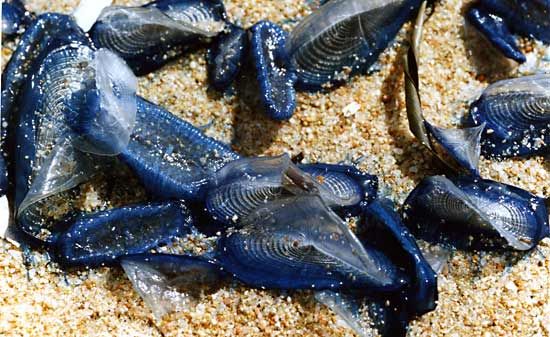
The term “purple sail” refers to the purple sail, which is the common name for any animal in the genus Velella. These floating marine organisms are typically classified within the order Siphonophora and the class Hydrozoa.1
A Velella is characterized by a saillike structure known as a pneumatophore, which is a gas-filled float that allows the animal to drift across the surface of warm seas. Below this sail, the organism features various specialized structures, including tentacles equipped with stinging cells (nematocysts), reproductive gonozooids, and a central gastrozooid used for feeding and digestion. Because of their oblique crest, these animals are often pushed by the wind to coastal areas far from their native habitats.12
It is important to note that “purple sail” is distinct from the “black sail” mentioned in the legend of the Greek hero Theseus. In that myth, Theseus promised his father, Aegeus, that he would replace his ship’s black sail with a white one upon returning successfully from Crete, a promise he tragically forgot to keep.3
How do Velella velella move across the ocean surface?
Velella velella moves across the ocean surface primarily through passive drift, driven by the wind. These organisms possess an oblique crest on their gas-filled float, or pneumatophore, which functions as a sail. Because of this structure, they are pushed across the surface of warm seas by wind currents, which often results in them being carried to coastal areas far from their original habitats.12
What are siphonophores and how do they function as a colony?
Siphonophores are an order of free-swimming or floating marine hydrozoans that exist as complex, colonial organisms. While they may appear to be single animals, they are actually composed of numerous specialized, genetically identical individuals known as [zooids]6.456
How They Function as a Colony
These colonies function through a high degree of polymorphism, where each zooid is structurally and physiologically modified to perform a specific task necessary for the survival of the entire unit. Because these members work in unison, the colony acts as a single, integrated organism.54
Common specialized zooids within a siphonophore colony include:
- Gastrozooids: Specialized for feeding, these zooids capture planktonic prey using tentacles equipped with stinging cells.45
- Nectophores: These pulsating, bell-shaped structures are responsible for locomotion, allowing the colony to swim actively.56
- Pneumatophores: Many species possess these gas-filled floats, which keep the colony buoyant at the surface.56
- Phyllozooids (or bracts): These flattened individuals serve a protective function for the colony.5
By delegating these vital life functions to specialized members, siphonophores can thrive as delicate, transparent predators in the open sea.46
What other marine animals are often mistaken for jellyfish?
Several marine animals are frequently mistaken for jellyfish due to their transparent, gelatinous, or bell-shaped appearances. While they may share a superficial resemblance, they are often biologically distinct from true jellyfish, which belong to the classes Scyphozoa or Cubozoa.
Commonly confused animals include:
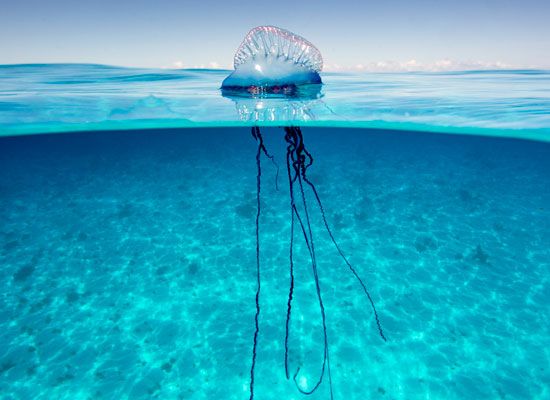
- Siphonophores: Often called “compound jellyfish,” these are colonial organisms made up of specialized, genetically identical individuals called zooids. The most famous example is the Portuguese man-of-war, which features a gas-filled float that acts as a sail, allowing it to drift on the ocean surface.101112
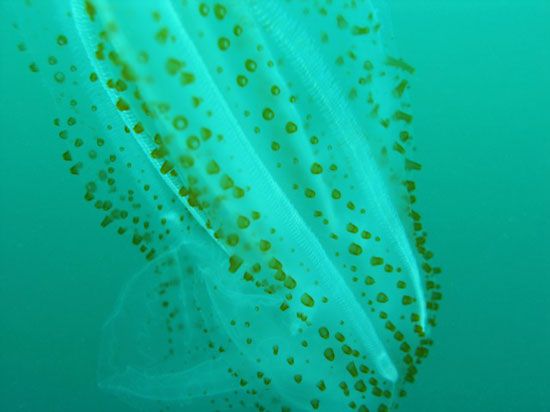
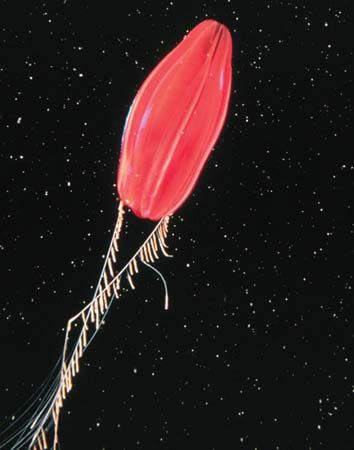
- Ctenophores: Also known as comb jellies, these marine invertebrates are often transparent and float freely in the water. Unlike jellyfish, they lack stinging cells (nematocysts) and instead use adhesive cells called colloblasts to capture prey. They are distinguished by eight rows of ciliary plates that they use for locomotion.101314
- Salps: These are small, barrel-shaped, gelatinous invertebrates belonging to the phylum Chordata. They move by pumping water through their bodies and are often found in long, chain-like colonies.102
Sources
- purple sail — Encyclopædia Britannica
- velella — Merriam-Webster
- Theseus — Encyclopædia Britannica
- siphonozooid — Merriam-Webster
- siphonophore — Merriam-Webster
- cnidarian - Reproduction and life cycles — Encyclopædia Britannica
- Siphonophora — Merriam-Webster
- moss animal - Zooids — Encyclopædia Britannica
- moss animal - Size range and diversity of structure — Encyclopædia Britannica
- jellyfish — Encyclopædia Britannica
- Portuguese man-of-war — Encyclopædia Britannica
- ctenophore — Encyclopædia Britannica
- ctenophore — Merriam-Webster
- salp — Encyclopædia Britannica
- compound jellyfish — Merriam-Webster
- How many tentacles does a jellyfish have? — Encyclopædia Britannica
Published on · 3 min read