Slender-billed Curlew
The slender-billed curlew (Numenius tenuirostris) was a migratory shorebird that formerly inhabited regions across Eurasia and Africa. Smaller than its…
What is Slender-billed curlew?
The slender-billed curlew (Numenius tenuirostris) was a migratory shorebird that formerly inhabited regions across Eurasia and Africa. Smaller than its relatives, the species typically measured 36 to 41 cm in length and featured white plumage with grayish-brown streaks and distinctive heart-shaped spots on its underside.12
While the International Union for Conservation of Nature (IUCN) still classifies the bird as critically endangered, several major conservation organizations—including BirdLife International and the Natural History Museum in London—formally declared the species extinct in 2024. This conclusion follows a lack of confirmed sightings since 1995 and a 2024 population study that estimated a 96 percent probability of extinction. The species’ decline was driven by extensive hunting during the 20th century, as well as widespread habitat loss resulting from the drainage of wetlands and the conversion of steppes for agriculture.12
What are some other bird species that have recently gone extinct?
Several bird species have faced extinction in recent history due to factors such as habitat destruction, hunting, and the introduction of invasive species. Notable examples include:
- Passenger pigeon: Once abundant in North America, this species was driven to extinction by extensive hunting and habitat loss following European settlement.3
- Carolina parakeet: Another North American species documented by John James Audubon that succumbed to the widespread clearing of forests.3
- Bachman’s warbler: A species native to the forests of eastern North America that is now considered extinct.3
- Mamo and Black mamo: These nectar-feeding Hawaiian honeycreepers went extinct, likely due to a combination of habitat destruction and the loss of specialized nectar-producing plants.4
- Guam forest birds: The introduction of the brown tree snake to Guam resulted in the systematic extinction of several native land birds, including the Guam flycatcher and the Mariana crow, while others like the Guam rail and Micronesian kingfisher now survive only in captivity.1
The loss of these species highlights the critical importance of preserving biodiversity and protecting natural habitats from further degradation.
How does the loss of wetlands impact migratory birds?
The loss of wetlands has severe consequences for migratory birds, particularly for waterfowl and shorebirds that rely on these ecosystems throughout their annual cycles. Wetlands serve as essential habitats where these birds congregate to feed, rest, and breed, often exploiting seasonal productivity fluctuations that are critical for their survival.89
When these habitats are destroyed, polluted, or converted for other uses, migratory populations lose the capacity to sustain themselves. Because many migratory species depend on a chain of favorable environments across vast distances, the degradation of even a single site along their route can disrupt their entire life cycle. For instance, waterfowl populations are increasingly unable to withstand commercial exploitation or environmental pressures when their essential wetland homes are diminished.109
To mitigate these impacts, international cooperation is paramount, as bird migrations cross national boundaries. Conservation efforts, such as those led by organizations like The Wildfowl & Wetlands Trust, focus on protecting and restoring these vital areas to ensure that migratory species have the necessary resources to thrive.10
What is the difference between being classified as critically endangered and extinct?
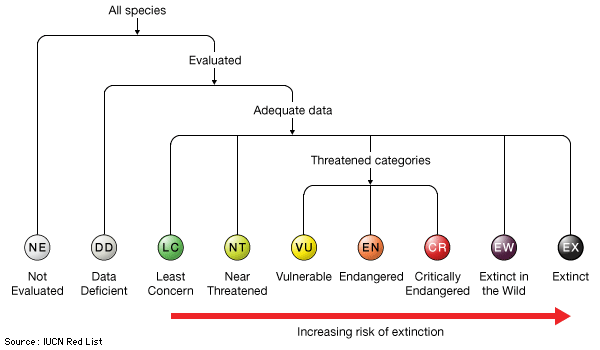
The International Union for Conservation of Nature (IUCN) uses specific criteria to classify the status of species based on their risk of extinction. The primary difference between being classified as “critically endangered” and “extinct” lies in whether any individuals of the species are known to remain alive.111
Extinct (EX)
A species is classified as Extinct when there is no reasonable doubt that the last individual has died. This status is assigned when systematic, time-appropriate surveys have failed to record a single individual in its known or expected habitat.11
Critically Endangered (CR)
A species is classified as Critically Endangered when it faces an extremely high risk of extinction in the wild. This is the most serious category for a living species, sitting one step below “Extinct in the Wild.” Criteria for this status include:1
- A population decline of 80 to more than 90 percent over the previous 10 years or three generations.111
- A current population size of fewer than 50 mature individuals.11
- A very restricted geographic range or habitat.1
While “critically endangered” species are on the brink of disappearing, they are still considered extant (living), whereas “extinct” species are gone forever.1112
Sources
- Slender-billed curlew — Encyclopædia Britannica
- Curlew — Encyclopædia Britannica
- conservation - Secondary extinctions — Encyclopædia Britannica
- conservation - Predictions of extinctions based on habitat loss — Encyclopædia Britannica
- conservation - Introduced species — Encyclopædia Britannica
- conservation - Predicting future rates of extinction — Encyclopædia Britannica
- conservation - Surviving but threatened small populations — Encyclopædia Britannica
- Migration - Ecological significance of migration — Encyclopædia Britannica
- Taiga - Birds — Encyclopædia Britannica
- Anseriform - Importance to humans — Encyclopædia Britannica
- endangered species - IUCN Red List of Threatened Species — Encyclopædia Britannica
- critically endangered species — Encyclopædia Britannica
- extinction: Top Questions — Encyclopædia Britannica
- extinct — Merriam-Webster
Published on · 3 min read