Cycadophyte
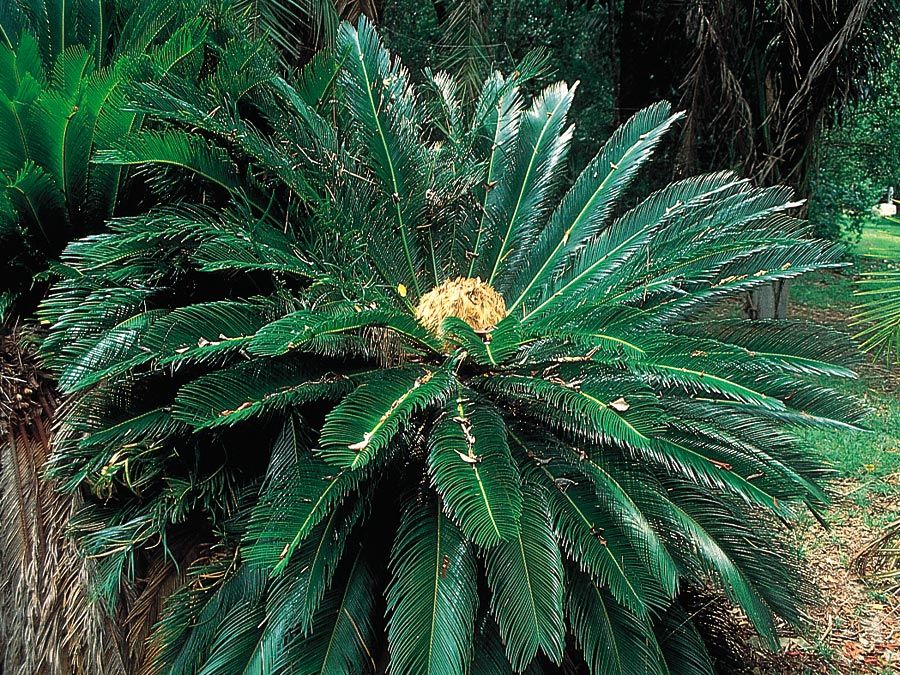
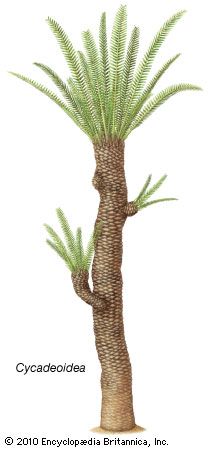
Cycadophytes are a diverse group of primitive gymnospermous plants that include seed ferns, the extinct Cycadeoidophyta, and the extant Cycadales (cycads).
What is the evolutionary history of cycadophytes and how long have they existed?
Cycadophytes are a diverse group of primitive gymnospermous plants that include seed ferns, the extinct Cycadeoidophyta, and the extant Cycadales (cycads).12
Evolutionary History
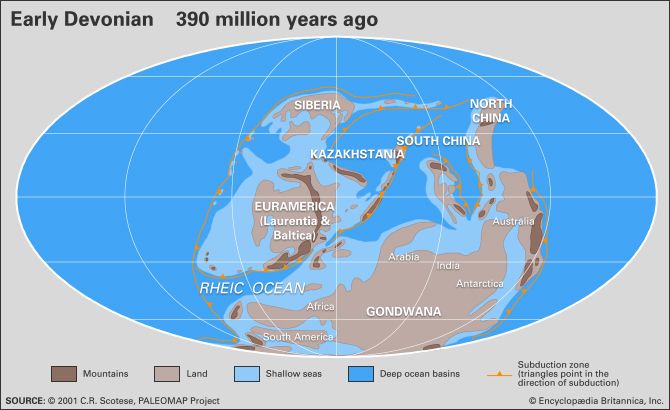
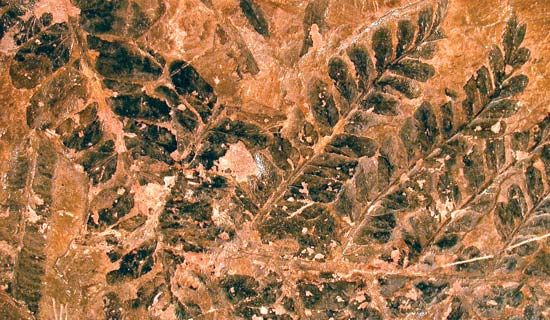
Botanists generally trace the origins of cycadophytes to the Devonian Period (419.2 to 358.9 million years ago), likely arising from primitive, non-seed-bearing progymnosperms such as the Aneurophytaceae. While seed ferns were primarily Paleozoic, the Mesozoic Era saw the rise of cycadeoids and cycads, both of which are presumed to have descended from a seed-fern ancestor.13
Cycadeoids flourished during the Mesozoic, particularly in the Jurassic Period—often called the “Age of Cycads”—before becoming extinct during the Cretaceous Period. In contrast, the order Cycadales has persisted from the late Paleozoic or early Mesozoic to the present day.341
Timeline
Cycadophytes have existed for hundreds of millions of years. Their lineage began in the Devonian, with undisputed fossil remains of cycads appearing in the Triassic Period (251.9 to 201.3 million years ago), though some problematic forms date back to the Paleozoic.51
How do cycadophytes differ from other plant groups like angiosperms or conifers?
Cycadophytes, which include modern cycads, are distinct from angiosperms and conifers in several key reproductive and structural features.
Differences from Angiosperms
- Seed Exposure: Unlike angiosperms, which enclose their ovules within an ovary, cycads are gymnosperms; their ovules are exposed to the air at the time of pollination.7
- Fertilization: Angiosperms undergo double fertilization, a process that produces endosperm as a food-storage tissue. Cycads lack this process and instead rely on a multicellular female gametophyte for seed nutrition.7
- Vascular Tissue: Angiosperms possess complex conducting tissues, including vessels in the xylem and companion cells in the phloem. Cycads lack these specialized structures, possessing less-specialized sieve cells instead.7
- Sperm Motility: Cycads produce large, multiflagellate, motile sperm cells, a primitive trait not found in angiosperms.89
Differences from Conifers
- Strobili Structure: While both groups produce strobili (cones), cycads bear simple strobili. Conifers typically produce more complex, compound strobili where ovules are borne on specialized scales.108
- Dioecy: Cycads are universally dioecious, meaning male and female reproductive structures occur on separate plants. Many conifers, such as pines, are monoecious, bearing both types of cones on the same tree.811
What are some examples of well-known cycadophyte species, and how are they used by humans?
Cycadophytes, particularly the order Cycadales, include several well-known species that have been utilized by humans for centuries. Because many of these plants contain toxic compounds like cycasin, they must be processed carefully before consumption.13
Well-Known Species
- Sago Palm (Cycas revoluta): Perhaps the most recognizable cycad, it is widely cultivated as a houseplant and outdoor ornamental.1415
- Australian Nut Palm (Cycas media): A notable species native to Australia that bears edible seeds.1415
- Queen Sago (Cycas circinalis): A fern palm native to the Malaysian region, also known for its edible seeds.1415
- Cardboard Palm (Zamia furfuracea): A popular ornamental species often found in conservatories.15
- Coontie (Zamia integrifolia): Native to the southeastern United States and the West Indies, its roots have historically served as a source of starch.15
- Giant Dioon (Dioon spinulosum) and Chestnut Dioon (Dioon edule): Both are common ornamental species, with the latter also providing edible seeds.15
Human Uses
- Food Source: The pithy stems of various species, such as Cycas revoluta, are a source of sago, a food starch. Additionally, the seeds and young leaves of several species are edible, provided they are thoroughly cooked to remove toxic alkaloids.14152
- Ornamental and Ceremonial: Due to their attractive, palmlike appearance, many cycads are prized as ornamental plants in gardens and conservatories. The leaves of the sago palm are also frequently used as ceremonial “palms” in floriculture.15214
Due to their popularity, many species have faced overharvesting in the wild, leading to protected status under international conservation laws.15
What are the main characteristics that define cycadophytes?
Cycadophytes are a diverse group of primitive gymnospermous plants, historically including extinct groups like seed ferns and cycadeoids, as well as the living order Cycadales.18
The defining characteristics of the division Cycadophyta include:
- Vegetative Structure: They possess compound leaves and stout, fleshy stems. Internally, these stems are characterized by wide zones of pith and cortex, with relatively scanty woody tissue.3
- Vascular Anatomy: Unlike coniferophytes, cycads utilize a primary thickening meristem to achieve their pachycaulous (thick-stemmed) growth form. They also exhibit unique “girdling leaf traces,” where vascular strands follow a circuitous route to the leaf bases.11
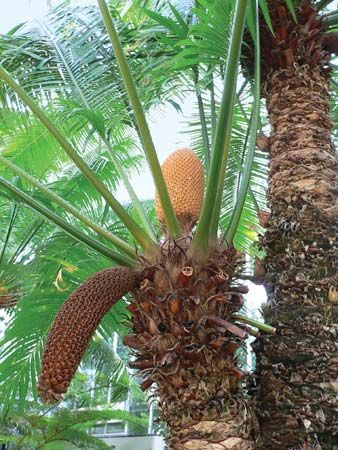
- Reproduction: Cycads are universally dioecious, meaning male and female reproductive structures are borne on separate plants. They produce seeds with a single integument, and their ovules are borne either on foliage or on specialized megasporophylls.943
- Primitive Traits: A notable feature is the production of large, multiflagellate, motile sperm cells, which are released to fertilize eggs within archegonia. to fertilize eggs within archegonia.34
Sources
- Cycadeoidophyta — Encyclopædia Britannica
- cycadophyte - Distribution and abundance — Encyclopædia Britannica
- cycadophyte - Gametophyte phase — Encyclopædia Britannica
- cycadophyte - Annotated classification — Encyclopædia Britannica
- cycadophyte - Cycadeoids — Encyclopædia Britannica
- cycadophyte — Encyclopædia Britannica
- cycadophyte - Sporophyte phase — Encyclopædia Britannica
- Angiosperm - General characteristics — Encyclopædia Britannica
- Plant reproductive system - Gymnosperms — Encyclopædia Britannica
- gymnosperm - Appearance of gymnosperm divisions — Encyclopædia Britannica
- cycadophyte - Sporophylls and strobili — Encyclopædia Britannica
- cycadophyte - Cycads — Encyclopædia Britannica
- Cycas — Encyclopædia Britannica
- cycad — Encyclopædia Britannica
- Did you know? — Merriam-Webster
- cycadophyte - Ecology and habitats — Encyclopædia Britannica
- cycasin — Merriam-Webster
- cycadophyte - Stem — Encyclopædia Britannica
Published on · 4 min read