Cycad
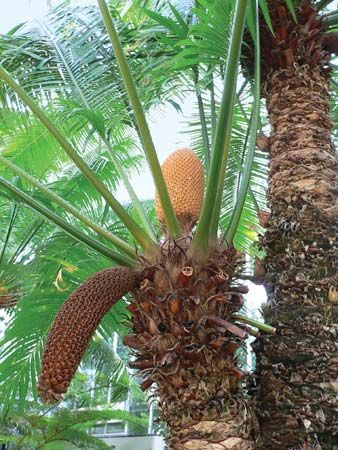
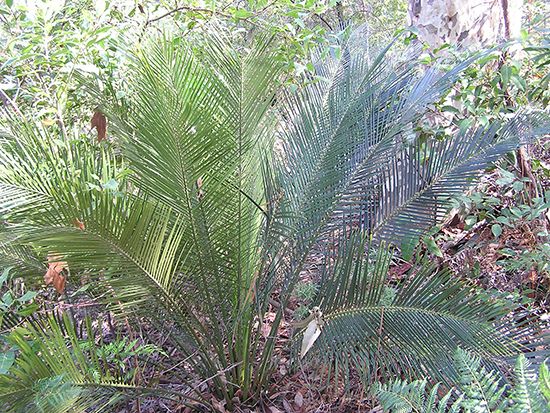
Scientists study and classify cycads (order Cycadales) by examining their unique physical characteristics, reproductive structures, and internal anatomy.…
How do scientists study and classify cycads?
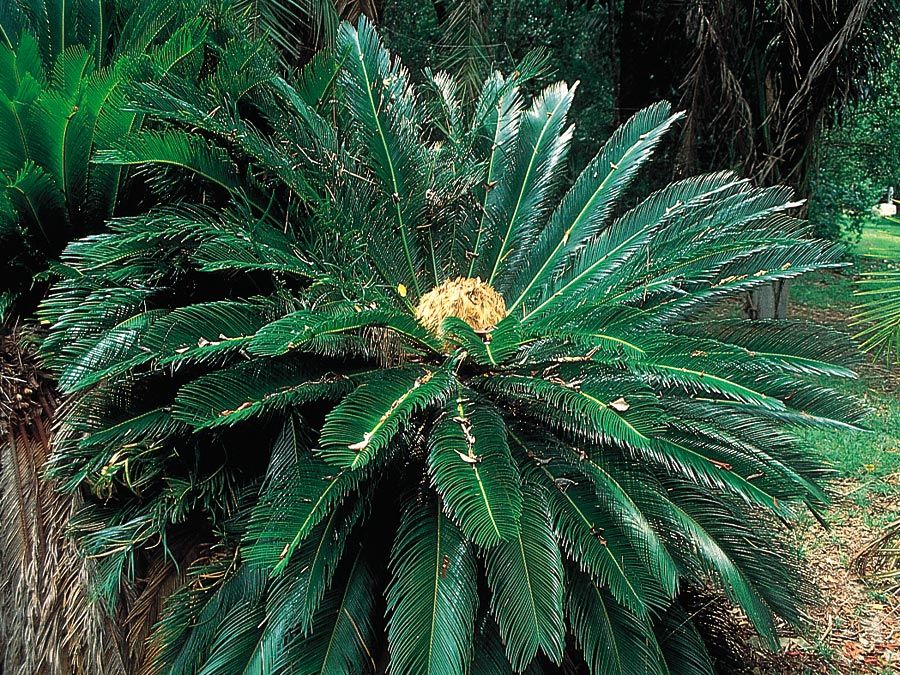
Scientists study and classify cycads (order Cycadales) by examining their unique physical characteristics, reproductive structures, and internal anatomy. Because these gymnosperms possess primitive traits—such as flagellated motile sperm—they are vital for understanding the evolutionary history of seed plants and the origins of insect pollination.1
Classification
Cycads are classified into three extant families based on their morphology, particularly their leaf structure and reproductive organs:23
- Cycadaceae: Characterized by foliar, multiovulate megasporophylls that do not form a true cone but are arranged in whorls.245
- Stangeriaceae: Distinguished by fernlike leaves with prominent midribs and dichotomously branching lateral veins.2
- Zamiaceae: Comprises the largest group, featuring singly pinnate leaves and simple, distinct cones.2
Methods of Study
Researchers analyze several key features to distinguish between genera and species:
- Stem Anatomy: Scientists study the “pachycaulous” (thick) stems, noting the presence of girdling leaf traces and the arrangement of vascular tissue, which helps differentiate them from fossilized cycadeoids.6
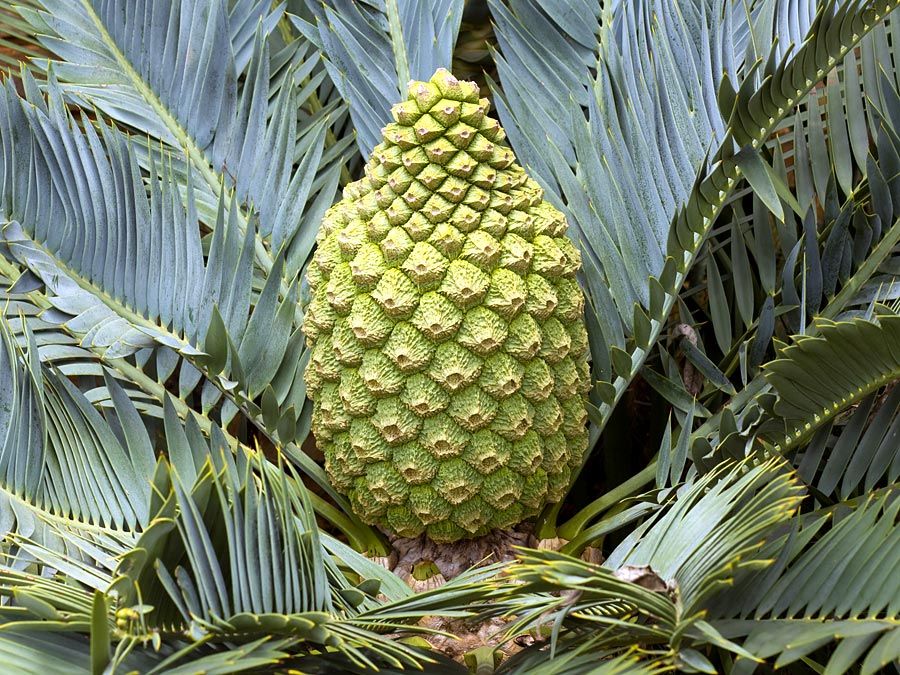
- Reproductive Morphology: Studies focus on whether a plant is dioecious and the specific structure of microsporophylls and megasporophylls.45
- Growth Patterns: Because cycads lack annual growth rings, researchers estimate age by counting whorls of leaf scars.6
What are the various genera of cycads, and how are they distributed globally?
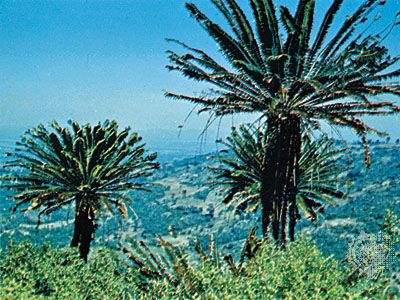
There are 10 to 11 recognized genera of cycads, an ancient group of palmlike gymnosperms comprising approximately 310 extant species. These plants are primarily distributed throughout tropical and subtropical regions globally.72
Global Distribution and Genera
Cycad genera are categorized by their geographic origins and family classifications:
- Australia: Home to three endemic genera: Macrozamia, Lepidozamia, and Bowenia.1
- The Americas and Caribbean: Includes four genera: Zamia, Ceratozamia, Dioon, and Microcycas. Additionally, the genus Chigua was identified in northwestern Colombia.1
- Africa: Includes two genera: Encephalartos and Stangeria.1
- Wide-ranging: The genus Cycas is the most geographically diverse, spanning from eastern Australia across the Pacific and Indian oceans to Madagascar and the east coast of South Africa.1
While these plants are concentrated in equatorial regions, their fossil record indicates a much broader historical distribution, including areas that are now temperate or subarctic.12
How do cycads reproduce, and what makes their reproduction process unique?
Cycads reproduce through a slow, complex process that highlights their evolutionary status as primitive gymnosperms. Their reproductive cycle is characterized by several unique biological features:
Reproductive Structures
Cycads are dioecious, meaning male and female reproductive organs are borne on separate plants. They produce simple strobili (cones). Male plants produce microsporophylls that generate vast quantities of pollen, while female plants produce megasporophylls that house ovules. Unlike most conifers, most cycads rely on insect vectors—such as snout weevils—rather than wind for effective pollination.8
Unique Fertilization
The fertilization process is particularly distinct:
- Motile Sperm: Cycads produce large, multiflagellated spermatozoids. These are released from the male gametophyte into an archegonial chamber, where they swim to the egg.9
- Large Gametes: The female archegonia contain the largest eggs in the plant kingdom, reaching up to three millimeters in length.9
- Slow Development: The entire cycle is remarkably slow. For example, the Florida coontie (Zamia integrifolia) requires approximately 14 months from the appearance of cones to seed maturity.9
Seed Dispersal and Germination
Cycad seeds often lack a dormant period and may begin germinating while still attached to the parent plant. While some species, such as Cycas rumphii, utilize ocean currents for dispersal, most rely on visual signals—such as bright red seed coats—to attract animals. However, dispersal is often inefficient, and many seeds germinate at the base of the parent plant.9
How long have cycads existed on Earth, and what is their evolutionary history?
Cycads have a deep evolutionary history, with their origins tracing back to the Permian Period (298.9 million to 252.2 million years ago), though some fragmentary fossils suggest they may have been present during the Carboniferous Period. While some problematic forms have been identified in the Paleozoic Era, the oldest undisputed cycad remains date to the Triassic Period.1011
Evolutionary Context
Cycads belong to the division Cycadophyta, a group believed to have descended from seed ferns (Pteridospermophyta). During the Mesozoic Era (251.9 million to 66 million years ago), cycads were so abundant that the era is frequently referred to as the “Age of Cycads”.11012
They coexisted with the Cycadeoidophyta, an extinct group of plants that were superficially similar but evolutionarily distinct. Unlike cycads, which persist today, the cycadeoids flourished throughout the Mesozoic before becoming extinct during the Cretaceous Period. Today, cycads are represented by 10 to 11 genera and approximately 310 species, serving as vital subjects for understanding the evolution of seed plants and early insect pollination for understanding the evolution of seed plants and early insect pollination.1013114
Sources
- cycad — Encyclopædia Britannica
- list of cycads — Encyclopædia Britannica
- cycadophyte - Stem — Encyclopædia Britannica
- cycadophyte - Sporophylls and strobili — Encyclopædia Britannica
- gymnosperm - Cycadophyta — Encyclopædia Britannica
- cycadophyte - Cycads — Encyclopædia Britannica
- cycadophyte - Distribution and abundance — Encyclopædia Britannica
- cycadophyte - Sporophyte phase — Encyclopædia Britannica
- cycadophyte - Gametophyte phase — Encyclopædia Britannica
- Cycadeoidophyta — Encyclopædia Britannica
- cycadophyte - Annotated classification — Encyclopædia Britannica
- gymnosperm - Appearance of gymnosperm divisions — Encyclopædia Britannica
- cycadophyte - Cycadeoids — Encyclopædia Britannica
- Did you know? — Merriam-Webster
- cycadophyte — Encyclopædia Britannica
Published on · 4 min read