Eon
An eon is defined as the longest span of geologic time. In formal geological classification, eons represent the largest divisions of Earth's history, with…
What is eon?
An eon is defined as the longest span of geologic time. In formal geological classification, eons represent the largest divisions of Earth’s history, with eras serving as the second-longest units.1
There are three recognized eons:
- The Phanerozoic Eon, which extends from the beginning of the Cambrian Period to the present.1
- The Proterozoic Eon.1
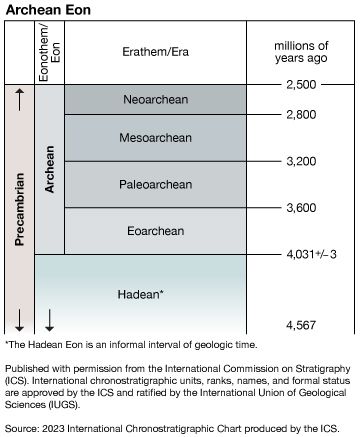
- The Archean Eon.1
In less formal contexts, the term eon is frequently used to describe a duration of one billion years.1
How do scientists determine the boundaries between different eons?
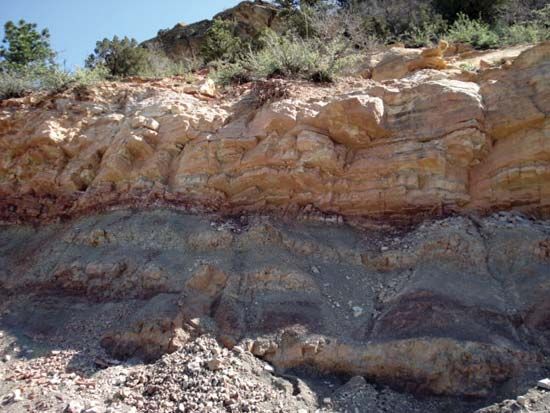
Scientists determine the boundaries between eons and other geologic time units through a combination of stratigraphy—the study and correlation of rock strata—and numerical dating methods.4
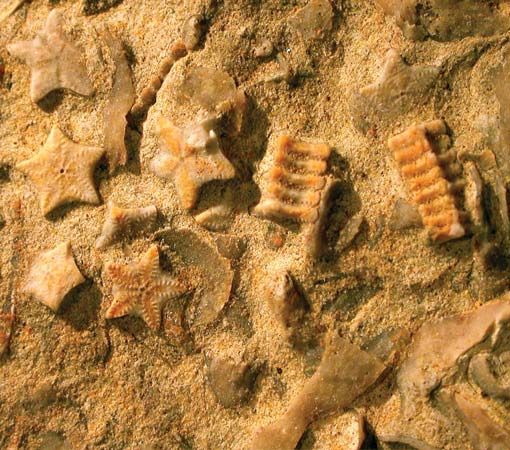
For the Phanerozoic Eon, which contains a rich fossil record, boundaries are primarily delineated by the appearance or disappearance of specific species. Paleontologists use these biostratigraphic markers to define the start and end of various time intervals.54
Because the older Precambrian time lacks abundant fossils, scientists rely on different evidence to establish boundaries, including:
- Isotopic age determinations: Radiometric dating provides numerical ages for rocks and minerals, allowing for a chronometric scale.657
- Field relationships: Geologists analyze unconformities (gaps in the rock record) and crosscutting dikes to determine the relative order of events.67
These standards are maintained by the International Commission on Stratigraphy (ICS), which often marks globally recognized boundaries with a Global Stratotype Section and Point (GSSP), or “golden spike”.14
What are the major characteristics of the Phanerozoic Eon?
The Phanerozoic Eon, spanning from 541 million years ago to the present, is widely known as the “eon of visible life.” Its primary characteristics include:
- Rapid Biological Evolution: This eon is defined by the rapid diversification and evolution of complex, multicellular life-forms. It began with the Cambrian explosion, marked by the appearance of most major animal phyla and the development of hard body parts like shells, which significantly improved the fossil record.91011
- Geologic Activity: Throughout the eon, Earth’s continents have steadily moved toward their current configurations through processes such as continental drift, mountain building, and glaciation.9
- Climatic Variability: The eon has experienced significant climatic shifts, alternating between warm “greenhouse” phases and cool “icehouse” phases. These transitions are influenced by tectonic forces and variations in greenhouse gases.12
- Eras and Periods: The eon is divided into three major eras—the Paleozoic, Mesozoic, and Cenozoic—which are further subdivided into 12 distinct periods.9
How does the geologic time scale differ from human historical timelines?
The geologic time scale and human historical timelines differ primarily in their scope, measurement, and the nature of the evidence used to define them.
Scale and Duration
Human history typically spans a few thousand years, focusing on the development of civilizations, cultures, and recorded events. In contrast, geologic time encompasses the entire history of Earth, spanning approximately 4.6 billion years. While human history is measured in years, decades, and centuries, geologic time is organized into vast units—eons, eras, periods, epochs, and ages—that can last for millions or even billions of years.86
Methods of Documentation
- Human History: Relies on written records, oral traditions, and archaeological artifacts to reconstruct events.
- Geologic Time: Is recorded in the planet’s rock strata. Scientists use stratigraphy to determine the relative order of events, often using the fossil record to mark the emergence or extinction of species.85
Quantitative vs. Relative Dating
Human history is almost exclusively quantitative, relying on precise calendar dates. Geologic time historically relied on relative dating—determining if one rock layer was older or younger than another—before the development of radiometric dating. Modern geochronology now integrates both relative stratigraphic sequences and absolute numerical ages derived from isotopic analysis to create a standardized “calendar” for Earth’s history.65
Sources
- eon — Encyclopædia Britannica
- epoch — Merriam-Webster
- era — Merriam-Webster
- Precambrian - Major subdivisions of the Precambrian System — Encyclopædia Britannica
- geologic history of Earth - Time scales — Encyclopædia Britannica
- geology - Historical geology and stratigraphy — Encyclopædia Britannica
- Silurian Period - Silurian boundaries — Encyclopædia Britannica
- geologic time — Encyclopædia Britannica
- A Journey Through Time Since the Precambrian — Encyclopædia Britannica
- Cambrian Period: Top Questions — Encyclopædia Britannica
- Climate change - Phanerozoic climates — Encyclopædia Britannica
- life - Geologic record — Encyclopædia Britannica
- geologic time — Merriam-Webster
Published on · 3 min read