Exogyra
Exogyra is an extinct genus of bivalve mollusks related to true oysters. These organisms were common in shallow-water marine environments during the Jurassic…
What is Exogyra?
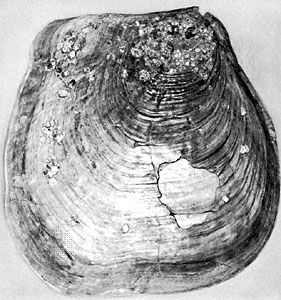
Exogyra is an extinct genus of bivalve mollusks related to true oysters. These organisms were common in shallow-water marine environments during the Jurassic and Cretaceous periods, spanning approximately 200 million to 65.5 million years ago.12
The genus is primarily identified by its massive, very thick shell. Its morphology is distinct: the left valve is spirally twisted, while the right valve is significantly smaller and flatter. Additionally, the left valve often features a well-developed longitudinal pattern of ribbing and common pitting.12
How do bivalve mollusks differ from other types of shellfish?
Bivalve mollusks, which include clams, oysters, mussels, and scallops, are a specific class of mollusks defined by a shell divided into two distinct halves, or valves, connected by a hinge.345
They differ from other types of shellfish—such as crustaceans (like crabs or shrimp) or other mollusks (like snails or cephalopods)—in several key ways:
- Anatomy: Unlike most other mollusks, bivalves have lost their head and the radula (a rasping organ used for feeding). They are characterized by a sedentary lifestyle and have evolved specialized respiratory gills called ctenidia, which function as organs for filter feeding.367
- Feeding: While many other mollusks are active predators or grazers, almost all bivalves are ciliary suspension feeders, drawing water through their mantle cavity to sieve microscopic organisms.75
- Mobility: Bivalves vary significantly in how they interact with their environment. Many burrow into sediment using a muscular foot, while others remain sessile by cementing themselves to hard surfaces or anchoring with byssal threads. Notably, scallops are unique among bivalves for their ability to swim by using jet propulsion.65
What are some other common fossils found in Cretaceous marine deposits?
Cretaceous marine deposits are rich in diverse fossil remains, which scientists use to correlate geologic strata and understand ancient environments. Beyond bivalves like Exogyra, Gryphaea, inoceramids, and rudists, common fossils include:
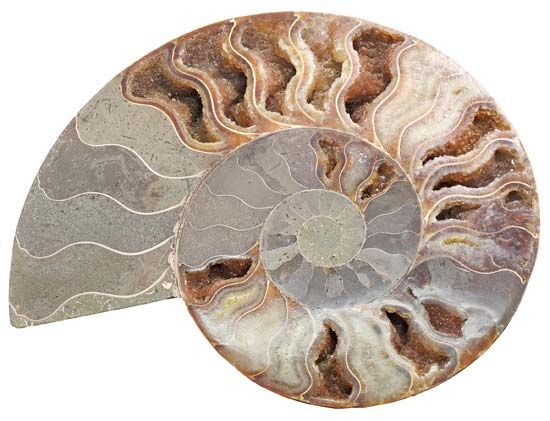
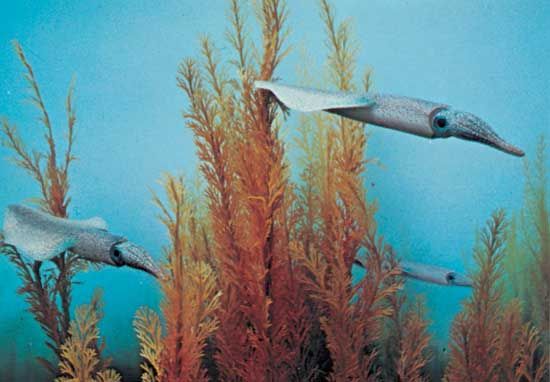
- Cephalopods: Ammonites are among the most widely used index fossils due to their abundance and geographic range. Belemnites, which possessed internal shells, are also frequently found, particularly in cooler boreal waters.910
- Microfossils: Planktonic foraminiferans, coccolithophores, diatoms, radiolarians, and dinoflagellates are significant. Coccolithophores were so abundant that their remains formed vast deposits of chalk.910
- Echinoderms: Echinoids (sea urchins) and crinoids (sea lilies) are common in many Cretaceous marine sequences and are often used for local zoning.91011
- Vertebrates: Marine reptiles such as mosasaurs, plesiosaurs, and ichthyosaurs are well-represented, alongside various sharks and teleost fishes.912
- Other Invertebrates: Ostracods and calpionellids are also significant, though often smaller in size.910
How do scientists use fossils to determine the age of rock layers?
Scientists determine the age of rock layers using fossils primarily through the principle of faunal succession, which observes that different intervals of geologic history are characterized by unique assemblages of animal and plant life. By identifying these specific fossils, geologists can correlate sedimentary rock layers across different geographic locations.1314
The most effective tools for this process are index fossils. To be considered a useful index fossil, a species must meet several criteria:
- Short temporal range: It existed for a relatively brief span of geologic time.1413
- Wide distribution: It is found across large geographic areas.1413
- Distinctive appearance: It is easily recognizable to avoid misidentification.1413
- Abundance: It is common enough to be discovered reliably.1413
While fossils provide the relative order of rock layers, they are often calibrated using absolute dating. This involves measuring the decay of radioactive isotopes in volcanic minerals found within or near the fossil-bearing strata, providing a precise age in years. Integrating these methods allows geologists to assemble a comprehensive history of Earth.151316
Sources
- Exogyra — Encyclopædia Britannica
- Exogyra — Merriam-Webster
- bivalve — Encyclopædia Britannica
- bivalve - Internal features — Encyclopædia Britannica
- mollusk - Habitats, feeding habits, and associations — Encyclopædia Britannica
- bivalve - External features — Encyclopædia Britannica
- mollusk — Encyclopædia Britannica
- What’s the difference between clams, mussels, and oysters? — Encyclopædia Britannica
- Cretaceous Period - Marine life — Encyclopædia Britannica
- Cretaceous Period - Correlation — Encyclopædia Britannica
- reptile - Fossil distribution — Encyclopædia Britannica
- echinoderm — Encyclopædia Britannica
- index fossil — Encyclopædia Britannica
- dating - Distinctions between relative-age and absolute-age measurements — Encyclopædia Britannica
- Tertiary Period - Correlation of Tertiary strata — Encyclopædia Britannica
- dating - Principles and techniques — Encyclopædia Britannica
- Earth sciences - Micropaleontology — Encyclopædia Britannica
- geology - Micropaleontology — Encyclopædia Britannica
Published on · 3 min read