Farmington River
There are two distinct rivers known as the Farmington River:
What is Farmington River?
There are two distinct rivers known as the Farmington River:
- In Liberia: The Farmington River is a river located in the western part of the country. It rises in the Bong Range and flows 75 miles (120 km) to the Atlantic coast. It is the only river in Liberia of commercial importance, serving as a vital transport route for rubber shipments from Harbel to the port of Monrovia.1
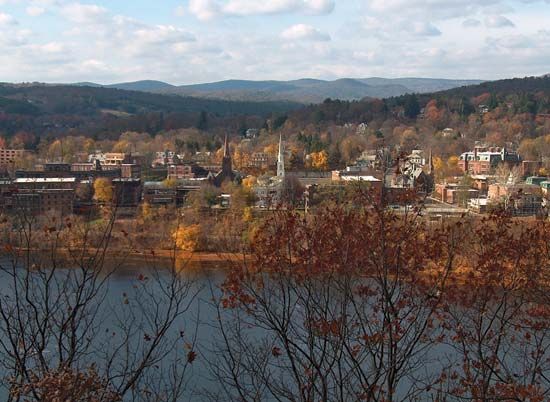
- In the United States: The Farmington River is a tributary of the Connecticut River. It is one of 23 principal tributaries of the Connecticut River, which is the longest stream in New England. The town of Farmington, Connecticut, is situated along this river.23
How does the Farmington River contribute to the Connecticut River system?
The Farmington River serves as one of the 23 principal tributaries of the Connecticut River, the longest stream in New England. As a right-bank tributary, it contributes to the drainage of the Connecticut River’s 11,085-square-mile (28,710-square-km) basin.3
Like many of the system’s primary tributaries, the Farmington is characterized as a relatively short, swift stream flowing through a narrow valley. These tributaries are historically significant for their role in regional development, often featuring small power dams, storage ponds, and factories along their courses. The river flows through the town of Farmington, Connecticut, which experienced an industrial boom in the early 19th century that utilized the river’s resources for the production of goods such as linen, buttons, and muskets.31
What role do rivers play in the development of industrial towns?
Rivers have historically been fundamental to the development of industrial towns, serving as essential hubs for power, transportation, and resource management.
Power and Manufacturing
Before the widespread adoption of steam power during the Industrial Revolution, waterwheels were the primary source of mechanical energy. Industrial towns frequently emerged in locations where consistent water flow could drive mills for grinding grain, powering sawmills, or operating textile machinery. Even after steam power became available, many industrial facilities—including steel mills, chemical plants, and nuclear power stations—remained tied to river sites because they required massive quantities of water for cooling processes.456
Transportation and Trade
Rivers provided the most efficient, and often the only, means of moving goods and people before the expansion of rail networks. Cities functioned as “funnels” for collecting raw materials from the interior and shipping them to global markets, while receiving manufactured goods in return. Control over river crossing points often led to the rise of “bridge towns,” and natural waterways directed the lines of exploration and settlement in North America and Asia.78
Environmental and Social Impact
While rivers fostered rapid urbanization, this growth often came at a cost. Industrial towns frequently used rivers as “open sewers” for municipal and industrial waste, leading to severe water pollution and ecological degradation. Furthermore, the intensive use of rivers for irrigation and navigation has historically altered natural ecosystems and water tables, sometimes leading to long-term environmental challenges.65
Are there other rivers in the world that share the same name?
Yes, it is quite common for rivers to share the same name, often due to historical naming practices, descriptive terms used by early explorers, or regional identity.
A notable example is the Colorado River, which refers to two distinct systems in the United States. One flows from the Rocky Mountains to the Gulf of California, while the other is located entirely within Texas. Both were named by early Spanish explorers who used the term colorado—meaning “reddish” or “colored”—to describe their silt-heavy waters.3
Other instances of shared names include:
- River Avon: There are multiple rivers by this name in the United Kingdom, including those in central, southern, and western England.9
- River Dee: This name is shared by rivers in Scotland and in the region spanning Wales and England.9
- Han River: In China, this name applies to two separate rivers: one in the Fujian and Guangdong provinces, and another in the Hubei and Shaanxi provinces.10
- River Don: This name is used for rivers in both England and Scotland.9
Sources
- Farmington — Encyclopædia Britannica
- Farmington River — Encyclopædia Britannica
- Connecticut River — Encyclopædia Britannica
- river - Significance in early human settlements — Encyclopædia Britannica
- energy conversion - Waterwheels — Encyclopædia Britannica
- river - Significance to trade , agriculture, and industry — Encyclopædia Britannica
- river - Environmental problems attendant on river use — Encyclopædia Britannica
- United States - Classic patterns of siting and growth — Encyclopædia Britannica
- list of rivers - Europe — Encyclopædia Britannica
- list of rivers - Asia — Encyclopædia Britannica
- Why are there two Colorado Rivers? — Encyclopædia Britannica
Published on · 3 min read