Flying Snake
A flying snake is not a single species but refers to any of five species of nonvenomous snakes belonging to the genus Chrysopelea in the family Colubridae.…
What is flying snake?
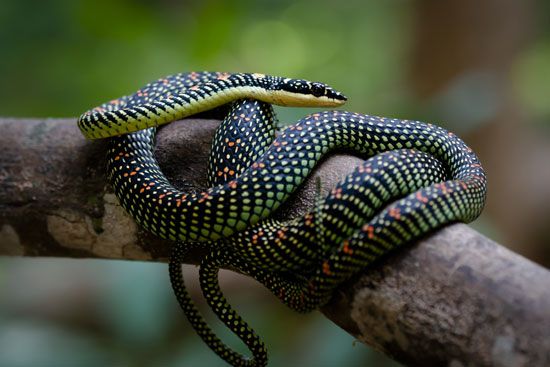
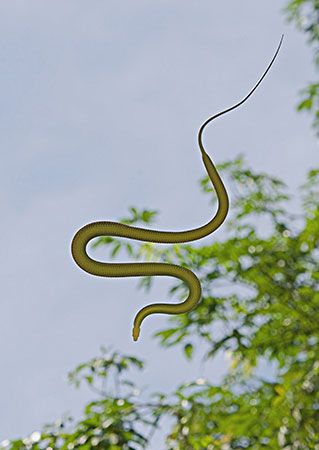
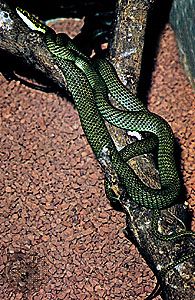
A flying snake is not a single species but refers to any of five species of nonvenomous snakes belonging to the genus Chrysopelea in the family Colubridae. Contrary to some descriptions that limit their movement to short leaps, these slender, arboreal snakes are capable of gliding through the air for distances of up to 100 meters (300 feet) from tree canopies.1
To achieve this, they draw up their ventral scales to create a concave underside, which allows them to glide while performing an undulatory motion to maintain balance and extend their flight. They are the only known limbless vertebrates that can glide in this manner. Found throughout South Asia and the Indonesian archipelago, these snakes are active during the day and feed on rodents, bats, birds, and lizards.1
How do flying snakes change their body shape to glide?
To glide through the air, flying snakes (genus Chrysopelea) undergo a specific physical transformation to increase their surface area and manage wind resistance. They flatten their bodies dorsoventrally and draw in their ventral scales, which creates a concave trough along their underside.43
This structural change allows the snake to act as an airfoil. While in the air, the snakes perform an undulatory motion—a rhythmic, wave-like movement—which helps them maintain balance and extend their gliding distance as they descend from tree canopies. By combining this body shape modification with active movement, they are able to glide for distances of up to 100 meters (300 feet).3
What other animals are known for gliding instead of flying?
Many animals have evolved the ability to glide, a form of locomotion that relies on increasing surface area to manage wind resistance and extend travel distance without the energy expenditure of powered flight.46
Notable Gliding Animals
- Mammals: Several species, such as the flying squirrel and the colugo, possess a patagium—a fold of skin extending between their limbs. When they leap, they spread their limbs to unfold this membrane, creating a gliding platform.47
- Lizards: The genus Draco, or flying lizards, features elongated ribs that open laterally like a fan, supporting a skin-based “wing” that allows them to glide between trees.48
- Amphibians: Certain species of frogs, such as Rhacophorus, are known to glide by flattening their bodies and spreading their limbs, which are equipped with webs between the digits to increase surface area.46
- Fish: Several groups of fish have evolved winglike modifications of their fins to facilitate gliding through the air.6
While these animals are expert gliders, they are distinct from true flyers—such as birds, bats, and most insects—which possess the physiological adaptations necessary for powered, flapping flight.6
What do flying snakes typically eat in the wild?
Flying snakes (genus Chrysopelea) are active, diurnal predators that hunt in their arboreal habitats. Their diet typically consists of:
As members of the family Colubridae, these snakes are well-adapted to life in the trees, where they utilize their agility to capture this variety of prey.9
Sources
- flying snake — Merriam-Webster
- flying snake — Encyclopædia Britannica
- Locomotion - Rectilinear locomotion — Encyclopædia Britannica
- Locomotion - Gliding — Encyclopædia Britannica
- snake - Locomotion — Encyclopædia Britannica
- Flight — Encyclopædia Britannica
- reptile - Flying — Encyclopædia Britannica
- flying squirrel — Encyclopædia Britannica
- colubrid — Encyclopædia Britannica
- What eats snakes? — Encyclopædia Britannica
- tree snake — Encyclopædia Britannica
- mongoose: Top Questions — Encyclopædia Britannica
Published on · 2 min read