Fringe Tree
The fringe tree (genus Chionanthus) is a group of approximately 150 species of flowering trees and shrubs belonging to the oleander family. These plants are…
What is Fringe tree?
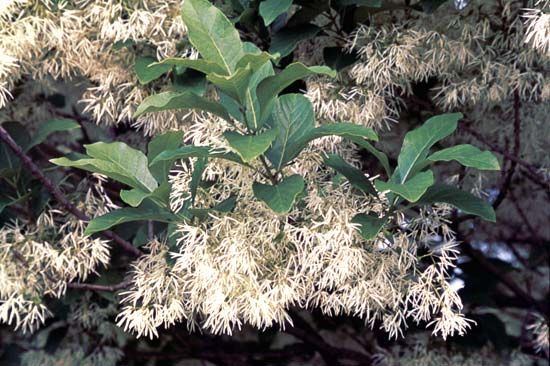
The fringe tree (genus Chionanthus) is a group of approximately 150 species of flowering trees and shrubs belonging to the oleander family. These plants are named for their distinctive, fragrant, snow-white flowers that bloom in spring, characterized by four narrow, fringy petals that hang in clusters.1
The genus includes two notable species often cultivated as ornamentals:
- White fringe tree (Chionanthus virginicus): Native to southeastern North America, this species can grow to approximately 10 metres (33 feet) in height.1
- Chinese fringe tree (C. retusus): A smaller variety that typically reaches a height of no more than 6 metres (20 feet).1
In addition to their showy blossoms, these plants produce oblong drupes that appear as dark blue fruits. The terms “fringe bush” and “white fringe” are also used to refer to these plants.123
What other plants belong to the olive family?
The olive family (Oleaceae) comprises approximately 24 genera and 615 species of woody plants, including trees, shrubs, and some woody climbers. Beyond the olive tree, many members of this family are widely recognized for their economic value or horticultural beauty.4
Notable plants within the Oleaceae family include:
- Ashes (Fraxinus): Valued primarily for their durable hardwood timber.4
- Lilacs (Syringa): Famous for their fragrant, colorful flowers.4
- Jasmines (Jasminum): Often woody climbers, these are prized for their scent and used in perfumes and teas.4
- Privets (Ligustrum): Commonly utilized for hedges and ornamental landscaping.4
- Forsythia (Forsythia): Known for its vibrant yellow blossoms, often called golden bell.4
- Tea olive (Osmanthus): Highly regarded for its fragrance and use in scenting teas.4
- Mock privet (Phillyrea): Another genus frequently used in ornamental plantings.4
Most members of this family are native to forested regions and are distributed globally, excluding the Arctic.4
How do fringe trees attract pollinators?
The fringe tree (Chionanthus) attracts pollinators primarily through its showy, fragrant, snow-white flowers. While specific pollinator interactions for the genus are not detailed in the provided search results, flowering plants in general—including those in the oleander family—typically rely on a combination of visual cues and scents to draw in insects and other pollinators to facilitate the transfer of pollen.167
Many plants utilize nectar as a reward to encourage repeat visits from pollinators, often using floral colors and specific odor patterns as “advertisements” to guide insects toward the nectar. Because fringe trees are noted for their fragrance and distinct, fringy petals, these traits likely serve as key attractants for the pollinators necessary for their reproduction.816
What are the main differences between deciduous and evergreen trees?
The primary difference between deciduous and evergreen trees lies in their leaf-retention strategies, which are adaptations to their specific environments.
Deciduous Trees
Deciduous trees shed their leaves seasonally, typically in autumn or during a dry season.1011
- Leaf Characteristics: These trees generally produce relatively thin, delicate leaves that require less chemical energy to grow.12
- Environmental Strategy: In temperate regions, shedding leaves is an adaptation to winter, when cold temperatures and shorter days make photosynthesis difficult and leaves susceptible to freezing damage. By dropping their leaves, these trees avoid the metabolic cost of maintaining foliage that cannot function efficiently during stressful periods.12
- Appearance: Forests dominated by these trees exhibit dramatic seasonal changes, transitioning from bare branches in winter to lush canopies in summer.1213
Evergreen Trees
Evergreen trees retain their leaves throughout the year, with individual leaves often remaining on the tree for two years or longer.10
- Leaf Characteristics: Their leaves are typically thicker and more leathery than those of deciduous trees, often appearing as needles or scales in coniferous species.10
- Environmental Strategy: This strategy is advantageous in environments where photosynthesis is possible year-round or where moisture is limited. Thickened, sclerophyllous leaves help reduce water loss through transpiration, and because these leaves are costly to produce, the tree retains them to maximize the return on its energy investment.12
- Distribution: While common in cold-temperate and Arctic regions as conifers, evergreens are also prevalent in tropical rain forests and mild, dry temperate zones.1012
Sources
- Fringe tree — Encyclopædia Britannica
- fringe bush — Merriam-Webster
- white fringe — Merriam-Webster
- Oleaceae — Encyclopædia Britannica
- Oleaceae — Merriam-Webster
- Joshua tree — Encyclopædia Britannica
- Angiosperm - Pollination — Encyclopædia Britannica
- Pollination — Encyclopædia Britannica
- Pollination - Evolution of insect pollination — Encyclopædia Britannica
- Evergreen — Encyclopædia Britannica
- Temperate forest - Environment — Encyclopædia Britannica
- Temperate forest - Flora — Encyclopædia Britannica
- Deciduous forest: Top Questions — Encyclopædia Britannica
- deciduous — Merriam-Webster
Published on · 3 min read