Great Sandy Desert
The Great Sandy Desert is an arid region located in northern Western Australia. It is the second-largest desert in Australia, surpassed in size only by the…
What is Great Sandy Desert?
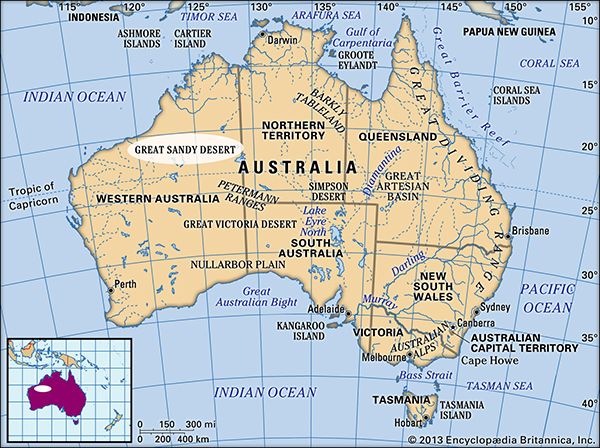
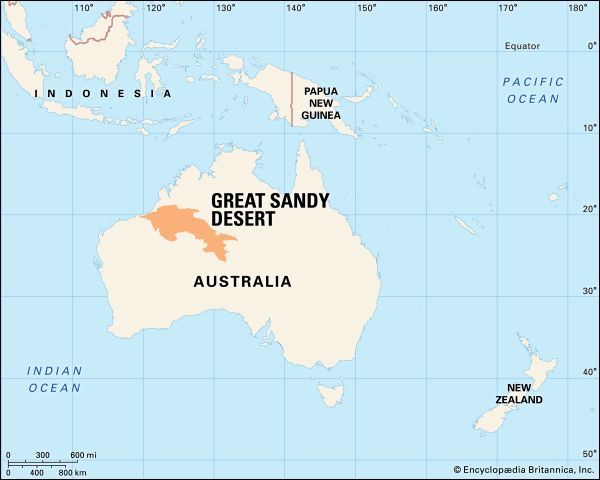
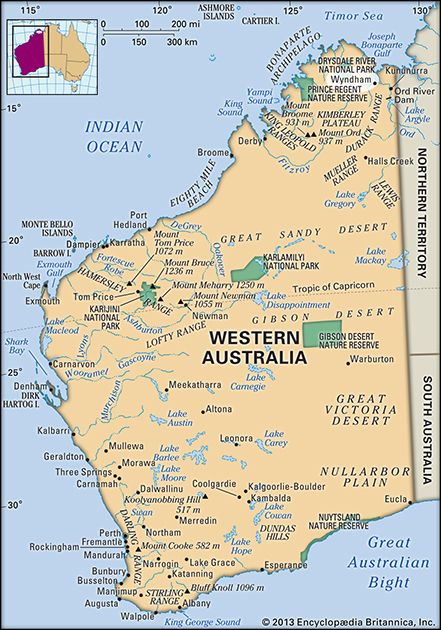
The Great Sandy Desert is an arid region located in northern Western Australia. It is the second-largest desert in Australia, surpassed in size only by the Great Victoria Desert.1
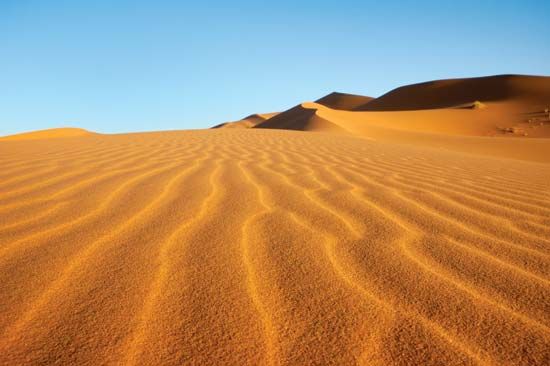
Geographically, the desert stretches from Eighty Mile Beach on the Indian Ocean eastward into the Northern Territory. Its boundaries extend from the Kimberley Downs in the north to the Tropic of Capricorn and the Gibson Desert in the south. The region roughly aligns with the sedimentary Canning Basin and is characterized by a vast landscape of sand hills and salt marshes interspersed with Triodia (Spinifex) grass.1
The area is traversed by the 1,000-mile (1,600-km) Canning Stock Route, which runs from Wiluna to Halls Creek. The first recorded European crossing of the desert occurred in 1873, led by Major Peter Egerton Warburton.1
What makes the Canning Stock Route historically significant?
The Canning Stock Route is historically significant primarily as a major 1,000-mile (1,600-km) transit corridor that spans the Great Sandy Desert.
Running in a northeasterly direction, the route connects Wiluna to Halls Creek, passing through the remote landscape of the Canning Basin and near Lake Disappointment. Its development was a critical endeavor in the early 20th century, designed to facilitate the movement of livestock across the harsh, arid interior of Western Australia. By providing a path through this challenging terrain, the route played a vital role in the expansion of the pastoral industry in the region.
How do animals like the red kangaroo survive in such an arid environment?
Red kangaroos have evolved several physiological and behavioral adaptations that allow them to thrive in the harsh, arid environments of the Australian desert.
Dietary Adaptations
As herbivores, red kangaroos are highly adaptable grazers. They possess a unique, chambered stomach that functions similarly to the rumen of cattle, allowing them to ferment and digest tough plant materials like cellulose that many other animals cannot process. When grass is scarce, they can shift their diet to include leaves, shrubs, and tree bark, ensuring they can find sustenance even when food sources are limited.5
Thermoregulation
To manage extreme heat, red kangaroos utilize a specific cooling behavior: they lick their forearms. This action promotes heat loss through evaporation. While they are generally more active at night to avoid the peak heat of the day, they are also capable of remaining active in bright sunlight when necessary.6
Environmental Factors
Their survival has also been aided by human activity. The introduction of permanent water sources by pastoralists in arid regions has provided consistent access to water, which has supported the growth of their populations across the continent.6
What are the main differences between the Great Sandy Desert and the Great Victoria Desert?
The Great Sandy Desert and the Great Victoria Desert are two of Australia’s most prominent arid regions, distinguished primarily by their geographic location and specific landscape features.
Geographic Positioning
- Great Sandy Desert: Located in northern Western Australia, it is the country’s second-largest desert. It extends from the Indian Ocean coast eastward into the Northern Territory and is bounded to the south by the Tropic of Capricorn and the Gibson Desert.
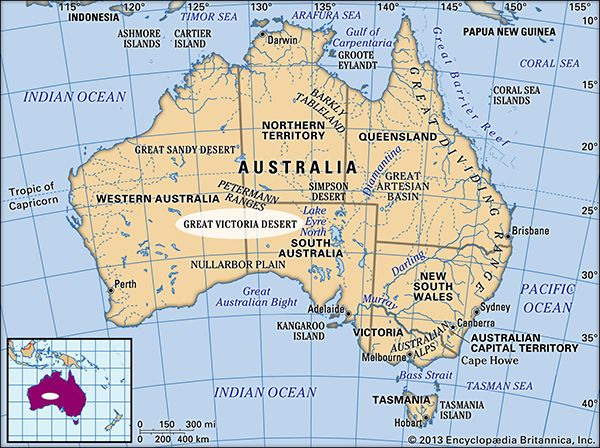
- Great Victoria Desert: Situated further south, it represents the largest desert in Australia. It spans across the border of Western Australia and South Australia, lying south of the Gibson Desert.
Landscape and Composition
- Great Sandy Desert: This region is characterized by a vast expanse of sand hills and salt marshes interlaced with Triodia (Spinifex) grass. It roughly coincides with the sedimentary Canning Basin. Its linear sand dunes are typically 26 to 30 feet (8 to 9 metres) high.
- Great Victoria Desert: This desert is defined by west-east-trending sand dunes. While it shares the arid characteristics of the northern deserts, it also contains remnants of ancient stream networks and is part of the geologically stable Precambrian shield.
Sources
- Great Sandy Desert — Encyclopædia Britannica
- Sahara - People of the Sahara — Encyclopædia Britannica
- South Australia - Plant and animal life — Encyclopædia Britannica
- Australia - The Interior Lowlands — Encyclopædia Britannica
- What do kangaroos eat? — Encyclopædia Britannica
- Desert - Fauna — Encyclopædia Britannica
- kangaroo - Behaviour — Encyclopædia Britannica
- Western Australia - Relief — Encyclopædia Britannica
- South Australia - Relief — Encyclopædia Britannica
- Australia - The Western Plateau — Encyclopædia Britannica
Published on · 3 min read