Houseleek
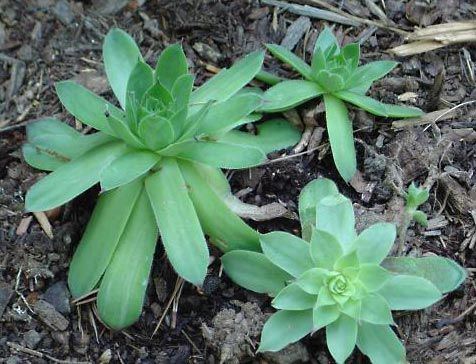
Houseleek refers to any of about 30 species of low-growing succulent plants belonging to the genus Sempervivum and the stonecrop family (Crassulaceae).…
What is houseleek?
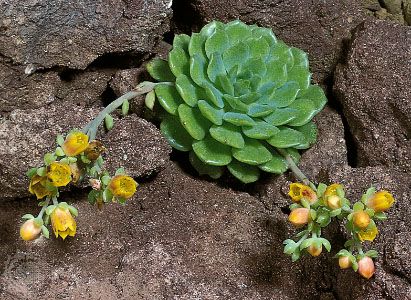
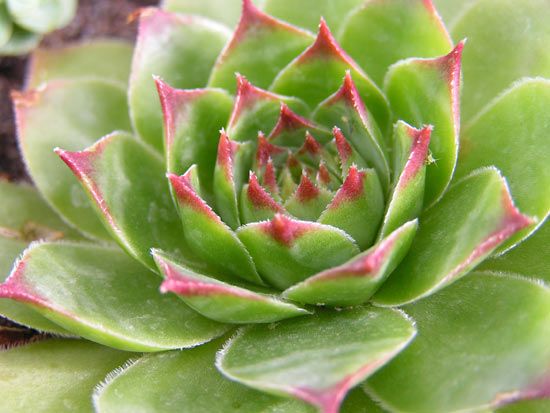
Houseleek refers to any of about 30 species of low-growing succulent plants belonging to the genus Sempervivum and the stonecrop family (Crassulaceae). Native to Europe, Morocco, and western Asia, these hardy plants are characterized by thick, fleshy leaves arranged in dense rosettes.1
The name “houseleek” stems from the historical European custom of planting them on thatched roofs, where they were believed to ward off lightning. They are also known as “live-forever” due to their durability. These plants are monocarpic, meaning the parent rosette dies after flowering, though they produce clonal offsets—often called “hen-and-chicks”—that ensure the plant persists. Like other members of their family, they utilize a specialized photosynthesis process called Crassulacean acid metabolism (CAM). Popular varieties include the common houseleek and the cobweb houseleek, both of which are frequently used in rock gardens and containers.12
What is Crassulacean acid metabolism?
Crassulacean acid metabolism (CAM) is a specialized carbon fixation pathway used by many succulent plants to survive in arid environments by minimizing water loss. Unlike most plants that open their stomata during the day, CAM plants keep their stomata closed during daylight hours and open them at night when the air is cooler and more humid.45
The process involves a temporal separation of carbon fixation stages:
- Nighttime: The plant assimilates carbon dioxide (CO2CO_2) and fixes it into the four-carbon acid oxaloacetate using the enzyme PEP carboxylase. This is converted into malate and stored in the cell’s vacuoles as malic acid.45
- Daytime: The stomata remain closed to prevent water loss. The stored malate is decarboxylated, releasing CO2CO_2 internally. This CO2CO_2 is then fixed by the enzyme Rubisco through the standard Calvin-Benson cycle.45
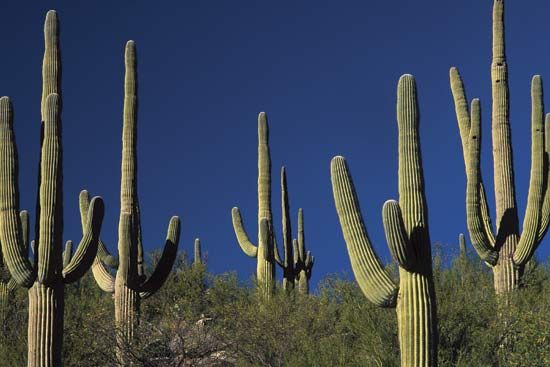
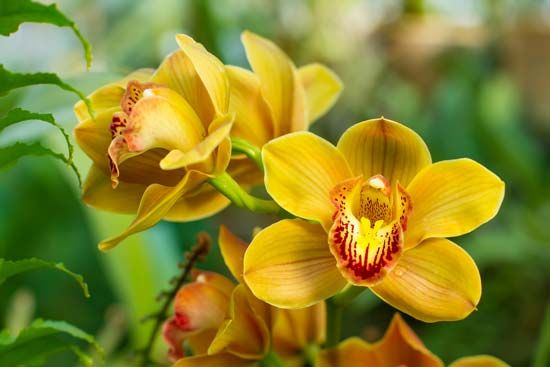
Named after the Crassulaceae family, this metabolism is found in over 20,000 species across 34 families, including cacti, orchids, and bromeliads.4
Why were houseleeks historically planted on roofs?
Historically, houseleeks—specifically Sempervivum tectorum—were planted on the roofs of houses because of a widespread belief that they could ward off lightning. The specific epithet tectorum actually translates to “of the roofs,” reflecting this long-standing association with domestic structures.1
Beyond this protective folklore, the plants were valued for their extreme hardiness and durability, which allowed them to thrive in the challenging conditions found on thatched roofs. This resilience is also why they are commonly referred to as “live-forever”.2
What are some other types of succulent plants?
Succulent plants are diverse, characterized by their ability to store water in fleshy tissues, such as stems or leaves. Beyond the well-known cacti, many other varieties are popular for indoor and garden cultivation.67
Common Types of Succulents
- Leaf Succulents: These store water primarily in their leaves. Notable examples include Aloe, known for its medicinal properties; Echeveria, often called “hen and chickens”; the jade plant (Crassula); the panda plant (Kalanchoe tomentosa); and Haworthia, which features rosettes with pearly dots.76
- Stem Succulents: These store water in their stems, often lacking leaves or having very small ones. The genus Euphorbia is a classic example, frequently featuring angled, column-like structures.76
- Aizoaceae Family: This group includes unique plants like ice plants and lithops, which are often referred to as “living stones” due to their appearance.8
- Durable Varieties: Species such as the strap-leaf Sansevieria (snake plant) are highly valued for their ability to thrive in less-than-ideal conditions and tolerate neglect.7
Sources
- houseleek — Encyclopædia Britannica
- houseleek — Merriam-Webster
- sempervivum — Merriam-Webster
- Photosynthesis - Carbon fixation via crassulacean acid metabolism (CAM) — Encyclopædia Britannica
- Plant - Specific variations in photosynthesis — Encyclopædia Britannica
- houseplant - Succulents — Encyclopædia Britannica
- Succulent — Encyclopædia Britannica
- houseplant — Encyclopædia Britannica
- Caryophyllales - Economic importance — Encyclopædia Britannica
Published on · 3 min read