Moscovian Stage
The Moscovian Stage is the second of four internationally recognized stages within the Pennsylvanian Subsystem of the Carboniferous System. It encompasses…
What is Moscovian Stage?
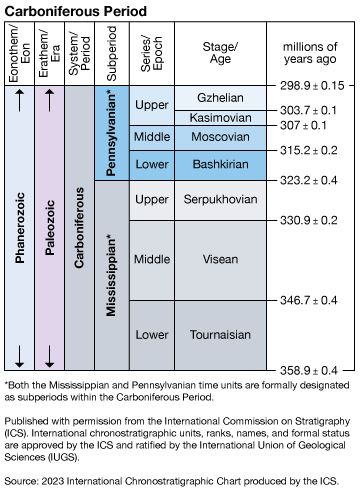
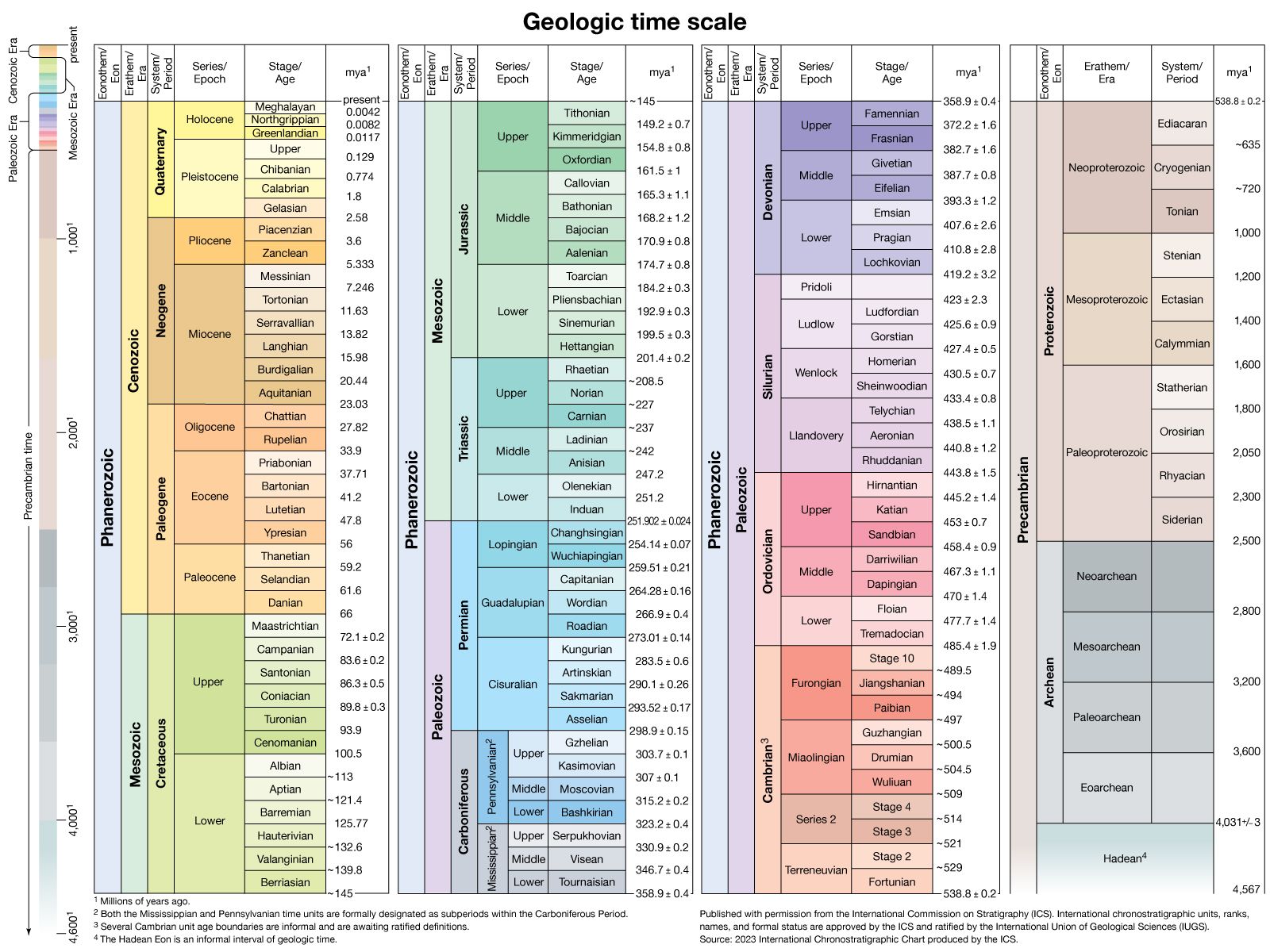
The Moscovian Stage is the second of four internationally recognized stages within the Pennsylvanian Subsystem of the Carboniferous System. It encompasses the geological time period from approximately 315.2 million to 307 million years ago.1
The stage is named after exposures found in the Moscow Basin, Russia, where the rock record is primarily composed of fossiliferous limestones and dolomites, along with thinner layers of shale and sandstone.1
Geologically, the Moscovian Stage sits above the Bashkirian Stage and below the Kasimovian Stage. Its base is defined by the appearance of specific index fossils, such as the conodont Declinognathus donetzianus or, in regions like the Ural Mountains, the ammonoid Winslowoceras.1
What are coal swamps and why were they important during the Pennsylvanian?
Coal swamps were low-lying, moist environments characterized by stagnant water and dense vegetation, which provided the ideal conditions for the accumulation of plant material that eventually transformed into coal. These areas required specific physical conditions to thrive, including slow, continuous subsidence (sinking of the land), protection from frequent flooding by natural structures like levees, and a restricted supply of incoming sediments that could otherwise interrupt the process.3
During the Pennsylvanian Subperiod, these swamps were exceptionally important because they were the primary sites for the most extensive coal formation in the entire geologic record. The Pennsylvanian was a time of significant sea-level fluctuations, creating cyclical sedimentary deposits known as cyclothems, where nonmarine swamp conditions alternated with marine environments. These swamps were populated by unique vascular plants, such as lycopods and sphenopsids, whose remains were buried and carbonized over millions of years to form the vast coal fields we mine today.4526
What are fusulinids and how do they help date rock layers?
Fusulinids are a group of extinct, single-celled foraminiferans that lived from the late Early Carboniferous to the end of the Permian Period. While they are protozoans, they are notable for their complex, shell-like structures that are easily preserved as fossils. These shells range in size from microscopic to approximately 5 cm in length and often resemble grains of wheat.9
Because fusulinids evolved rapidly and were widely distributed in clear marine environments, they serve as excellent index fossils (or guide fossils) for dating and correlating rock layers. Their distinctive internal chamber patterns allow geologists to identify specific evolutionary stages, which helps in dividing geologic time into precise units. For example, genera such as Fusulina and Fusulinella are particularly useful for identifying and correlating marine rocks from the Late Carboniferous. Additionally, their presence is often used by petroleum geologists to locate economically significant deposits of oil and natural gas.91011
How does the Carboniferous Period differ from other geologic periods?
The Carboniferous Period (358.9 to 298.9 million years ago) is distinct in the geologic record for several key environmental and biological developments:
- Coal Formation: The period is most famous for the massive accumulation of coal, particularly during the Pennsylvanian subperiod. The prevalence of coal swamps, fueled by dense vascular land plants, resulted in more coal formation during this time than at any other point in Earth’s history.124
- Atmospheric Composition: Scientists suggest that atmospheric oxygen levels reached approximately 30 percent, significantly higher than today’s 21 percent. This high concentration is believed to have enabled terrestrial insects, such as early dragonflies, to reach massive sizes.513
- Biological Milestones: The period saw the peak of amphibian development and the emergence of the first reptiles. In marine environments, crinoids dominated the seafloor, and the appearance of fusulinids provided a vital tool for biostratigraphic dating.51213
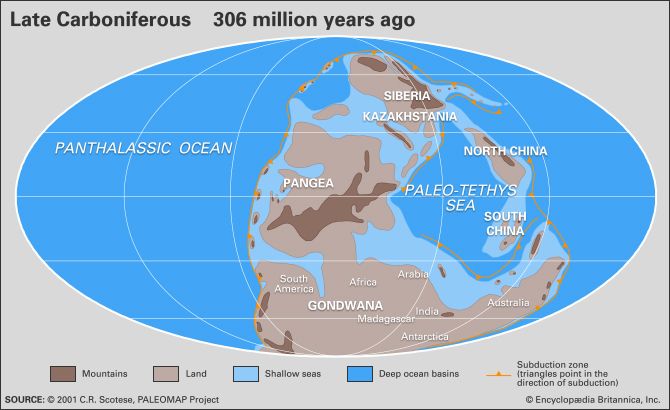
- Climatic Extremes: While equatorial regions remained tropical, the Southern Hemisphere landmass of Gondwana experienced widespread continental glaciations, creating a stark contrast in global climate patterns.1214
Sources
- Moscovian Stage — Encyclopædia Britannica
- Pennsylvanian Subperiod — Encyclopædia Britannica
- coal - Peat — Encyclopædia Britannica
- Carboniferous Period - Distinctive features — Encyclopædia Britannica
- Carboniferous Period - Paleoclimate — Encyclopædia Britannica
- Carboniferous Period - Pennsylvanian subsystem — Encyclopædia Britannica
- Carboniferous Period - Pennsylvanian cyclothems , tillites , and turbidites — Encyclopædia Britannica
- coal - The fossil record — Encyclopædia Britannica
- fusulinid — Encyclopædia Britannica
- Fusulina — Encyclopædia Britannica
- Fusulinella — Encyclopædia Britannica
- A Journey Through Time Since the Precambrian - Carboniferous Period: 358.9 million to about 298.9 million years ago — Encyclopædia Britannica
- Carboniferous Period - Economic significance of Carboniferous deposits — Encyclopædia Britannica
- Carboniferous Period - Invertebrates — Encyclopædia Britannica
Published on · 3 min read