Kidney Vetch
Kidney vetch (Anthyllis vulneraria) is a perennial herb belonging to the pea family (Fabaceae). Native to Europe and northern Africa, this low-growing, hairy…
What is kidney vetch?
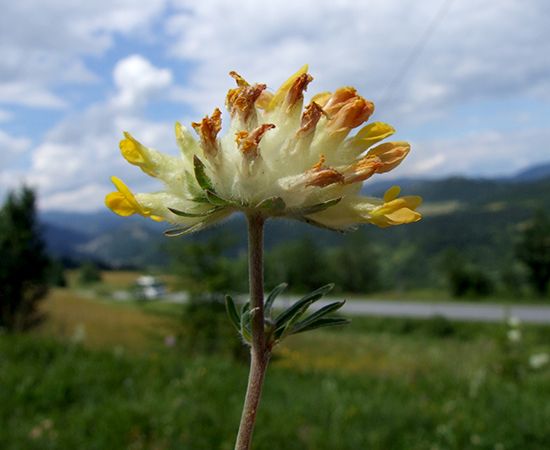
Kidney vetch (Anthyllis vulneraria) is a perennial herb belonging to the pea family (Fabaceae). Native to Europe and northern Africa, this low-growing, hairy plant typically reaches heights of 15–40 cm (6–16 inches).12
Key characteristics of the plant include:
- Leaves: Narrow, compound leaves measuring approximately 1.4–3.8 cm long.1
- Flowers: Dense, round clusters of yellow-white or red flowers featuring wooly bases.12
- Fruit: A small legume.1
While the plant was historically used as a traditional remedy for kidney disorders, it is now primarily cultivated for ornamental purposes in rock gardens. It is commonly found in meadows, alpine pastures, and other dry environments.12
What are the characteristics of the Fabaceae family?
The Fabaceae family, commonly known as the pea family, is the third-largest group of angiosperms, comprising approximately 766 genera and 19,580 species of trees, shrubs, vines, and herbs.3
Morphological Characteristics
- Leaves: Typically compound, though some species exhibit simple leaves. A pair of stipules is usually present at the base of the leaf petiole.4
- Flowers: Often bisexual, they feature five petals and commonly 10 stamens, which may be free or fused into tubular structures.4
- Fruit: The defining feature of the family is the legume—a single-carpel fruit that typically splits along one or both sutures at maturity to release seeds. While the classic pea or bean pod is the standard, fruit forms vary widely, including indehiscent structures, fleshy pods, and subterranean fruits like the peanut.4
Ecological and Economic Importance
The family is globally significant for its role in nitrogen fixation. Through a symbiotic relationship with Rhizobium bacteria housed in root nodules, these plants convert atmospheric nitrogen into compounds usable by the biotic world. This process is vital for soil health and agricultural productivity, making legumes essential for food production and sustainable farming practices.53
How do legumes contribute to soil health?
Legumes play a fundamental role in maintaining soil health primarily through a unique symbiotic relationship with Rhizobium bacteria. These bacteria inhabit root nodules, where they convert atmospheric nitrogen into ammonia and other nitrogen compounds that plants can metabolize.65
When legume roots and other plant parts decay, these nitrogen products are released into the soil, enriching it for other vegetation. This process is essential for sustainable agriculture, as it provides natural fertilization and reduces reliance on synthetic alternatives.5
Beyond nitrogen fixation, legumes contribute to soil health in several ways:
- Erosion Control: As cover crops, legumes protect the soil surface, reducing erosion caused by wind and water.57
- Soil Structure: Including legumes in crop rotation helps maintain favorable soil structure, which improves water availability and nutrient retention.7
- Pest Management: Rotating legumes with other crops changes the growing environment, which can help disrupt the life cycles of certain insects and diseases.57
What other plants were historically used for medicinal purposes?
Throughout history, humans have identified numerous plants with medicinal properties through trial and error, forming the foundation of folk medicine and early pharmacology. Many of these botanical remedies remain significant in modern medicine, either in their original form or as the basis for synthesized drugs.8910
Notable plants used historically include:
- Cinchona: The bark of this Andean tree was the primary treatment for malaria for centuries due to its quinine content.911
- Opium: Used by ancient civilizations and later by Galen, it provided the source for morphine and other pain-relieving alkaloids.1210
- Atropa belladonna: This plant served as the source for atropine, which has a variety of medical applications.12
- Coca leaves: Historically used as a source for cocaine, which was later utilized as a local anesthetic.12
- Autumn Crocus: This plant provided colchicine, a long-standing treatment for gout.12
- Willow Bark: Known for its pain-relieving properties, it provided the main ingredient for aspirin.9
- Yew Tree: The bark of this tree was the original source of Taxol, a significant cancer treatment.9
- Traditional Remedies: Ancient practices also utilized Dichroa febrifuga (chang shan) for fevers, senna and castor oil for digestive issues, and ma huang (containing ephedrine) for respiratory and allergy symptoms.10
Sources
- kidney vetch — Encyclopædia Britannica
- kidney vetch — Merriam-Webster
- Fabaceae — Encyclopædia Britannica
- Fabales - Characteristic morphological features — Encyclopædia Britannica
- Fabaceae - Nitrogen fixation — Encyclopædia Britannica
- Nitrogen-fixing bacteria — Encyclopædia Britannica
- Agricultural technology - Crop rotation — Encyclopædia Britannica
- Did you know? — Merriam-Webster
- herbal — Encyclopædia Britannica
- history of medicine - Early medicine and folklore — Encyclopædia Britannica
- pharmaceutical industry - Isolation and synthesis of compounds — Encyclopædia Britannica
- Cinchona — Encyclopædia Britannica
- pharmaceutical industry - Medicines of ancient civilizations — Encyclopædia Britannica
- traditional Chinese medicine - The practice of traditional medicine — Encyclopædia Britannica
Published on · 3 min read