Nyala
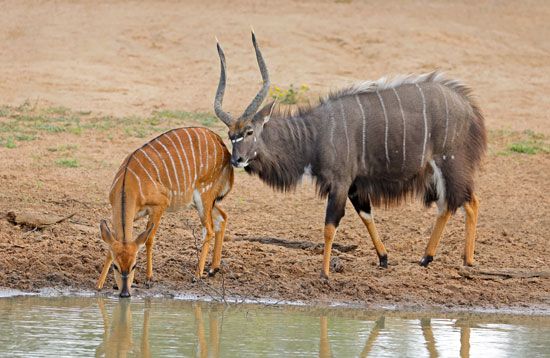
The nyala (Tragelaphus angasii) exhibits extreme sexual dimorphism, with males and females differing significantly in size, coloration, and physical features.
What are the physical characteristics that distinguish male and female nyalas?
The nyala (Tragelaphus angasii) exhibits extreme sexual dimorphism, with males and females differing significantly in size, coloration, and physical features.1
Females and Young
- Appearance: They possess short, bright chestnut coats marked by 8–13 white stripes on the torso, along with spots and bands on the legs, chest, and cheeks.1
- Size: They are smaller, weighing approximately 58 kg (128 pounds) with a shoulder height of 92 cm (36 inches).1
- Features: They lack horns and have a bushy tail with a white underside.1
Males
- Appearance: As they mature, males develop a dark charcoal gray, shaggy coat. While they also have stripes and spots, these are largely obscured by their long hair. They feature a long fringe extending from the throat to the hindquarters and an erectile spinal crest.1
- Size: They are significantly larger, standing 106 cm (42 inches) tall and weighing between 98–125 kg (216–275 pounds).1
- Features: Males carry prominent horns measuring 60–83 cm (24–33 inches) with 1.5–2.5 twists.1
What is a nyala and which family of animals does it belong to?
The nyala (Tragelaphus angasii) is a slender antelope native to southeastern Africa. It belongs to the family Bovidae (the bovid family), which includes other hoofed mammals such as cattle, sheep, goats, and bison.
Within the Bovidae family, the nyala is classified under the tribe Tragelaphini, a group of spiral-horned antelopes that also includes the kudu and eland. The species is particularly noted for its extreme sexual dimorphism and its preference for dense woodlands near water sources in the Lowveld of southern Africa.
Where are nyalas typically found in the wild?
Nyalas are primarily found in the Lowveld of southern Africa, where they occupy dense woodlands located near water sources. Their distribution spans the coastal plains and major river valleys of eastern Africa, ranging from southern Malawi to Natal.1
These animals are cover-dependent, requiring habitats that provide both dense vegetation for daytime shelter and access to high-quality grassland for nighttime grazing during the rainy season. Their diet is flexible, consisting of browse—such as the foliage of dicotyledons, forbs, seeds, and fruits—during the dry season.1
In contrast, the related mountain nyala is endemic to the high-altitude montane habitats of the Ethiopian highlands, specifically within the Rift Valley region.1
What are the main threats to nyala populations in their natural habitat?
The primary threats to nyala populations vary by species, as their survival is heavily influenced by habitat specialization and human activity.
For the mountain nyala (Tragelaphus buxtoni), which is classified as an endangered species, the main threats include:
- Habitat Loss and Encroachment: Increasing human populations have significantly reduced the available range for these animals, pushing them into smaller, fragmented areas.
- Disease: The species is highly susceptible to diseases transmitted by livestock, which poses a constant risk to their health and population stability.
- Political Instability: Historical events, such as the Ethiopian revolution of 1991, led to the overrunning of protected areas like the Bale Mountains National Park, causing drastic population declines.
While the lowland nyala (Tragelaphus angasii) is generally more stable, its reliance on specific, dense woodland habitats near water makes it sensitive to environmental changes and land-use shifts within its limited range in southeastern Africa. Protecting these specialized ecosystems is essential for the long-term survival of both species.
We could dive deeper into the specific conservation strategies used to protect these populations or explore the differences in their social structures.
Sources
- nyala — Encyclopædia Britannica
- bovid — Encyclopædia Britannica
Published on · 3 min read