Land Crab
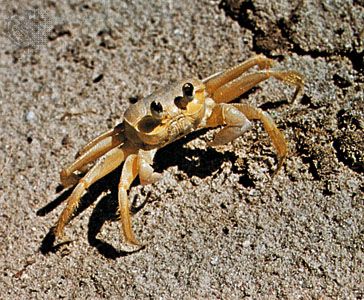
A land crab is typically defined as any member of the family Gecarcinidae (order Decapoda), which consists of square-bodied, largely terrestrial crabs found…
What is land crab?
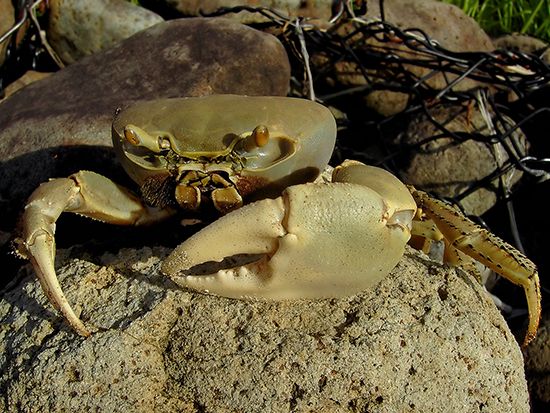
A land crab is typically defined as any member of the family Gecarcinidae (order Decapoda), which consists of square-bodied, largely terrestrial crabs found in tropical regions of the Americas, West Africa, and the Indo-Pacific.12
While these crustaceans live primarily on land—often inhabiting fields, swamps, and mangrove thickets—they are not fully independent of the water; as adults, they must return to the sea to allow their larvae to hatch. They are omnivorous, consuming both plant and animal tissue. Some species, such as Cardisoma guanhumi, can travel as far as 8 km (5 miles) inland.13
It is worth noting that the term “land crab” can occasionally refer to other organisms depending on the region; for instance, in Australia, it may refer to a burrowing crawfish (Eugaeus fossor). Additionally, while some crabs are amphibious or semiterrestrial, the Gecarcinidae family represents those most adapted to life away from the water.23
Why do land crabs need to return to the sea to reproduce?
Although land crabs of the family Gecarcinidae have adapted to life on land, they remain biologically tethered to the ocean for their reproductive cycle. These crustaceans must return to the sea because their larvae require an aquatic environment to hatch and develop1.1
While many other crustaceans have evolved to bypass free-living larval stages—allowing their young to hatch as miniature versions of the adults—land crabs typically follow a developmental path that necessitates the water. When the eggs are ready to hatch, the female migrates to the coast to release them into the sea. Once the larvae have hatched and completed their early development in the water, the young crabs eventually migrate inland to join the adult population.154
How do land crabs breathe while living on land?
Land crabs breathe using gills, but they have evolved specific physiological adaptations to survive outside of an aquatic environment. While their gills are the primary site for gas exchange, they are housed within specialized branchial chambers located beneath the carapace.88
To function on land, these branchial chambers are significantly larger and more vascularized than those found in fully aquatic crabs. Because gills must remain moist to facilitate the diffusion of oxygen, land crabs possess specialized chambers designed to retain moisture, preventing the respiratory surfaces from drying out in the air.8
Furthermore, the efficiency of their respiration is supported by the presence of hemocyanin, a copper-based respiratory pigment in their blood that helps transport oxygen throughout the body. While they are highly adapted to terrestrial life, they still rely on these modified gill systems rather than lungs to extract oxygen from the atmosphere.89
What do land crabs typically eat in their natural habitats?
Land crabs are generally omnivorous, meaning they consume a diverse diet consisting of both plant and animal tissue.110
Their specific feeding habits often reflect their role as scavengers within their ecosystems. For example, the Christmas Island red crab plays a vital ecological role by cleaning the forest floor, where it primarily consumes leaf litter and occasionally feeds on dead animals. Because they are opportunistic feeders, land crabs help recycle nutrients in their habitats by breaking down organic matter, which also aids in soil aeration as they excavate their burrows.3
While many crabs are scavengers, some species may also exhibit predatory or vegetarian behaviors depending on the availability of food in their environment.10
Sources
- land crab — Encyclopædia Britannica
- cirripede - Reproduction and life cycles — Encyclopædia Britannica
- land crab — Merriam-Webster
- crustacean - Distribution and abundance — Encyclopædia Britannica
- Migration - Lower invertebrates — Encyclopædia Britannica
- Salt marsh — Encyclopædia Britannica
- crustacean - Reproduction and life cycles — Encyclopædia Britannica
- Respiratory system - Gills of invertebrates — Encyclopædia Britannica
- malacostracan - Respiration — Encyclopædia Britannica
- Christmas plants and animals: 12 festive species - Christmas Island red crab ( Gecarcoidea natalis ) — Encyclopædia Britannica
- crab — Encyclopædia Britannica
Published on · 3 min read