Laughing Dove
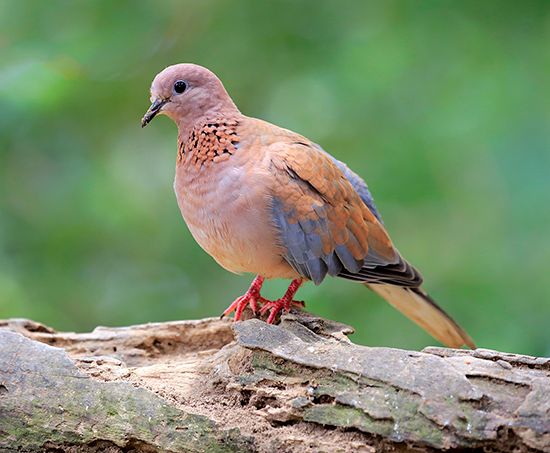
The laughing dove (Streptopelia senegalensis) is a bird belonging to the pigeon family, Columbidae. Native to scrublands across Africa and southwest Asia…
What is Laughing dove?
The laughing dove (Streptopelia senegalensis) is a bird belonging to the pigeon family, Columbidae. Native to scrublands across Africa and southwest Asia, this species has also been successfully introduced to Australia.12
Physically, the laughing dove is characterized by its reddish-brown plumage, blue wing markings, a long tail with a white edge, purplish legs, and a black bill. During courtship, the male performs a “bowing display” that highlights prominent copper-tipped feathers on its neck. These birds are monogamous and typically care for a clutch of two white eggs.1
The species earns its name from its distinctive call, which possesses a musical, bubbly quality that sets it apart from the typical cooing sounds associated with most other doves.1
How does the laughing dove’s call differ from other pigeons?
The laughing dove (Streptopelia senegalensis) is distinguished from most other members of the pigeon family by its unique vocalization. While the majority of doves are characterized by a standard cooing sound, the laughing dove produces a call with a distinctively musical and bubbly quality.1
In contrast, the name of the turtledove—the namesake of the Streptopelia genus—is derived directly from the sound of its own call, which is notably different from the bubbly notes of the laughing dove.2
What are the main differences between laughing doves and turtledoves?
While both the laughing dove (Streptopelia senegalensis) and the turtledove (Streptopelia turtur) belong to the same genus and share a reddish-brown coloration, they exhibit several distinct differences:
- Vocalization: The laughing dove is named for its unique, musical, and bubbly call, which contrasts with the standard cooing of most doves. Conversely, the name “turtledove” is derived from the specific sound of its own call, which is distinct from the laughing dove’s bubbly notes.12
- Physical Appearance: The laughing dove features blue wing markings and a long tail with a white edge. The turtledove is characterized by a blue-gray head and a tail marked with a white tip.12
- Distribution and Behavior: The laughing dove is native to African and southwest Asian scrublands and has been introduced to Australia. The turtledove is a migratory species native to Europe and North Africa that winters in northern Africa and is known as a ground feeder that consumes large quantities of small seeds.12
Why are some bird species introduced to new environments?
Bird species are introduced to new environments through both deliberate and accidental means, often resulting in significant ecological consequences.3
Deliberate Introductions
Humans have historically introduced species for a variety of personal and practical reasons:
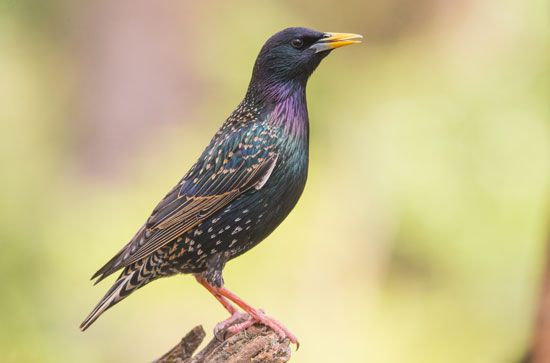
- Aesthetics and Culture: Species have been introduced to enhance local landscapes or to fulfill cultural desires, such as the introduction of the common starling to North America, which was allegedly driven by a desire to populate Central Park with birds mentioned in the works of William Shakespeare.34
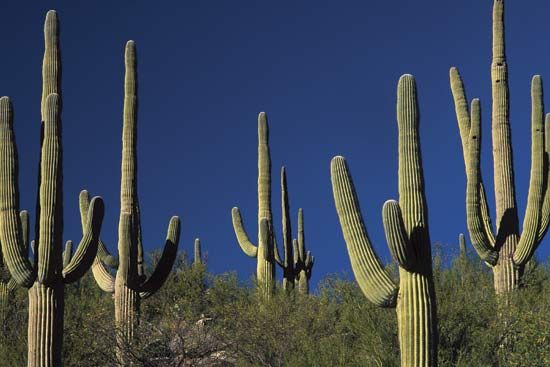
- Utility and Recreation: Hunters have sought exotic game, fishermen have desired challenging species, and gardeners have introduced ornamental plants—such as cacti and Lantana camara—for their beauty. Additionally, some species were introduced for insect control.34
Accidental Introductions
Many species arrive in new environments unintentionally:
- Hitchhikers: Animals like rats have historically traveled as stowaways on ships.3
- Ballast Water: Modern oceangoing vessels often transport a wide array of marine organisms in their ballast tanks, releasing them into new ports half a world away.3
- Unintended Consequences: Some introductions, such as the brown tree snake on Guam, were accidental but proved devastating to native bird populations.3
While some introduced species integrate without major disruption, others become invasive species, causing extinction, habitat degradation, and economic damage.34
Sources
- Laughing dove — Encyclopædia Britannica
- Turtledove — Encyclopædia Britannica
- conservation - Introduced species — Encyclopædia Britannica
- Common starling — Encyclopædia Britannica
- Migration - Origin and evolution of migration — Encyclopædia Britannica
Published on · 3 min read