Loon
There are five distinct species of loons belonging to the genus Gavia. While they share common traits—such as a strong tapered bill, solid bones, and legs…
What different species of loons exist, and how do they differ from each other?
There are five distinct species of loons belonging to the genus Gavia. While they share common traits—such as a strong tapered bill, solid bones, and legs positioned far back on the body—they differ in appearance, habitat requirements, and behavior.1
The five species include:
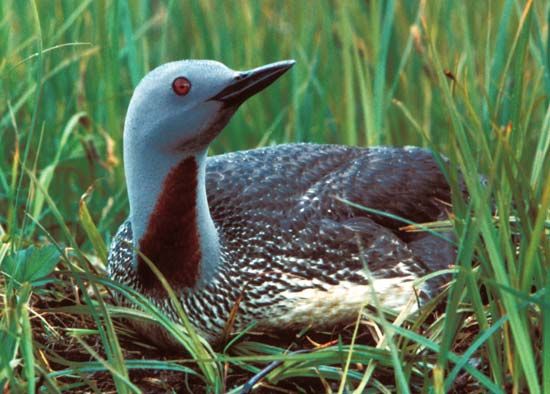
- Red-throated loon (G. stellata): Unique among loons, it features a reddish-brown throat patch during the breeding season and develops white speckling on its back in winter. Unlike other species, it does not require a large expanse of water for takeoff.1
- Arctic loon (G. arctica): Also known as the black-throated diver, this species is notable for its tendency to migrate or winter in flocks, unlike the generally solitary nature of other loons.1
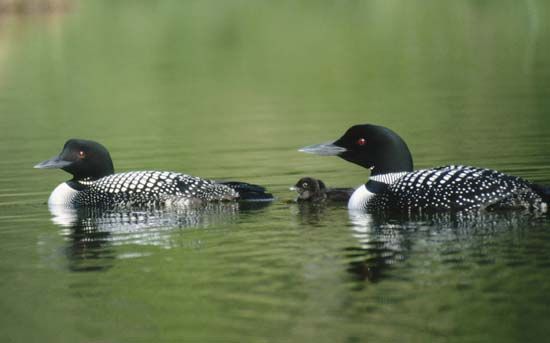
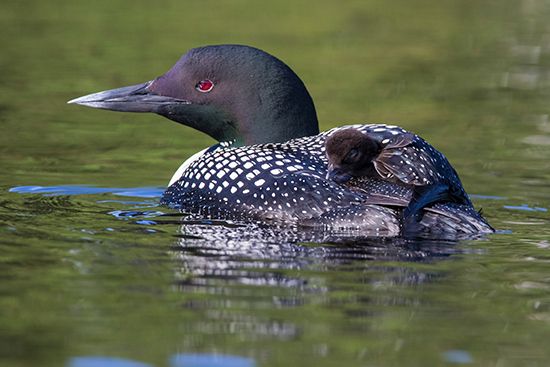
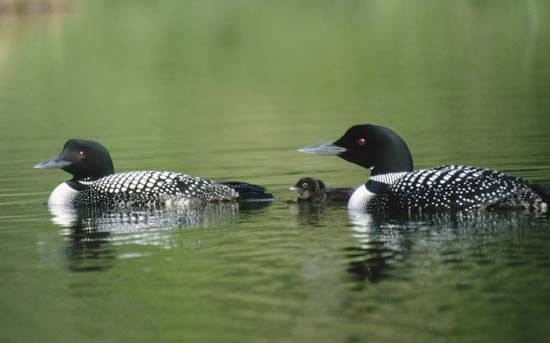
- Common loon (G. immer): The most abundant species in North America, it is identified by its black head, a striped black-and-white neck ring, and a checkered black-and-white back during breeding.12
- White- (or yellow-) billed diver (G. adamsii): This species serves as the Eurasian counterpart to the common loon, which it closely resembles.12
- Pacific loon: Often grouped within the broader classification of loons, these birds are adapted to their specific circumpolar distributions.1
What are the distinctive physical characteristics of loons?
Loons (genus Gavia) are large, aquatic diving birds characterized by several distinct physical adaptations suited for their lifestyle:
- Body Structure: They range from 60 to 90 cm (2 to 3 feet) in length and possess solid bones, which help them dive to depths of up to 60 meters (200 feet). To manage buoyancy during these dives, they can compress air from their lungs, feathers, and internal air sacs.1
- Locomotion: Their legs are positioned far back on the body, which is ideal for swimming underwater but makes walking on land awkward. They also have webs between their front three toes.13
- Plumage: Loons have thick feathers that are generally black or gray above and white below. During the breeding season, most species develop distinctive white markings on their dorsal plumage, though the red-throated loon is uniquely distinguished by a reddish-brown throat patch.1
- Bill and Wings: They possess a strong, tapered bill and small, pointed wings. While they are strong fliers, their wing structure requires a broad expanse of water for takeoff, limiting most species to large lakes.1
What is unique about the loon’s call, and why is it significant?
The loon is renowned for its distinctive, haunting vocalizations, which carry long distances across water and serve as a powerful symbol of the wilderness. The name “loon” itself may derive from the Old Norse word lómr, meaning “to moan,” reflecting the mournful quality of these cries.1
These calls are significant for both communication and territorial defense:
- Wail: Used to locate a missing mate through responsive calling.12
- Yodel: An aggressive call used to defend territory. Each male possesses a unique version of this yodel that remains consistent year after year.12
- Tremolo: A series of 8–10 notes resembling human laughter. It is the only call performed during flight and is used to defend territory or chicks.12
- Hoot (or “kwuuk”): A soft call used by parents to gather chicks that have strayed.12
Culturally, these mournful songs have held deep significance; for example, the Ojibwa viewed the bird as an omen of death, while the Cree interpreted its cry as the spirit of a warrior denied entry to heaven.12
Where are loons typically found, and what habitats do they prefer?
Loons are primarily found in northern regions, with distributions that vary by species. The red-throated loon and Arctic loon are virtually circumpolar, while the common loon is the most abundant species in North America, breeding across Canada, Alaska, northern U.S. states, and coastal Greenland.12
Habitat Preferences
Loons are almost entirely aquatic and have specific requirements for their environment:
- Water Requirements: Because most species require a broad expanse of water for takeoff, they are typically limited to large lakes. The red-throated loon is an exception, as it does not require as much space for flight.1
- Breeding Grounds: During the summer, they favor northern wooded lakes for nesting, where they build their nests as heaps of vegetation at the water’s edge.12
- Wintering Grounds: In the winter, many species migrate to coastal areas. For instance, the common loon can be found along the Atlantic and Pacific coasts of the United States, the Baja California peninsula, and the western coasts of various European countries.12
Sources
- Loon — Encyclopædia Britannica
- Common loon — Encyclopædia Britannica
- gavial — Encyclopædia Britannica
- loon — Merriam-Webster
Published on · 4 min read