White-fronted Goose
The white-fronted goose (Anser albifrons) is a relatively small, dark-bodied bird belonging to the family Anatidae. It is recognized by its distinctive white…
What is White-fronted goose?
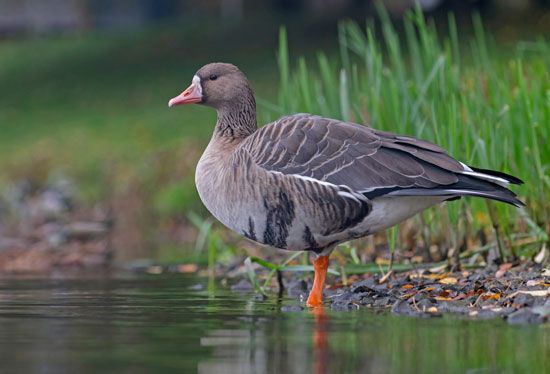
The white-fronted goose (Anser albifrons) is a relatively small, dark-bodied bird belonging to the family Anatidae. It is recognized by its distinctive white forehead, yellow bill, and irregular black patches on its belly.1
As the most widely distributed of the “gray geese,” this species breeds in the Arctic and exists in four or five different races. During migration, these birds travel as far south as Mexico, the Mediterranean Sea, India, and Japan. While the European white-fronted goose winters across Europe, the British Isles, and Central Asia, the largest form—known as the tule goose—winters exclusively in the Sacramento Valley of California. Like other members of the goose family, they are migratory, social birds that often travel in V-formations to conserve energy.12
What are the main differences between gray geese and black geese?
The primary distinction between gray geese and black geese lies in their scientific classification within the family Anatidae. While both groups are large, heavy-bodied waterfowl that share similar biological traits—such as monogamous mating, ground nesting, and migratory V-formation flight—they are categorized into two distinct genera:3
- Gray Geese (Anser): This genus includes species such as the white-fronted goose. Modern domestic geese are primarily descended from the greylag and the swan goose, both of which belong to this group.3
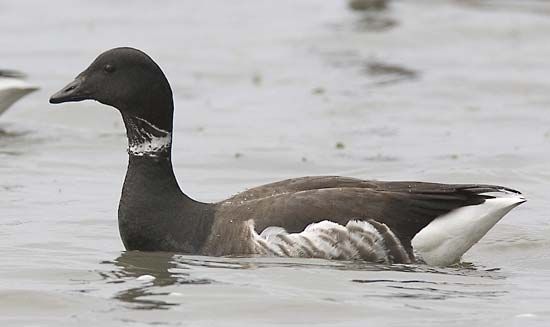
- Black Geese (Branta): This genus includes well-known species such as the Canada goose, the barnacle goose, the brant, and the nene.3
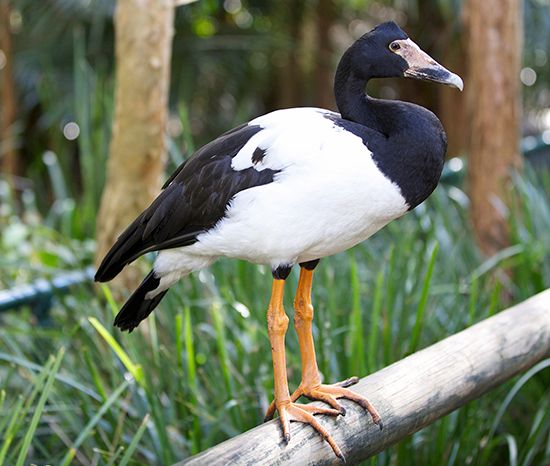
While these genera represent the core groups of geese, other waterfowl with a gooselike build, such as the snow goose or the magpie goose, are sometimes colloquially referred to as geese despite belonging to different taxonomic groups.3
Why do migratory birds like geese fly in V-formations?
Migratory birds such as geese, ducks, pelicans, and cranes frequently fly in a “V” formation to enhance their efficiency during long-distance travel. This characteristic arrangement allows members of the flock to conserve energy by flying in the wake of another bird.
In these formations, the birds often rotate leadership roles; each member takes a turn at the front of the “V” before dropping back to a position where the air resistance is reduced by the preceding birds. This cooperative behavior helps the flock maintain cohesion and manage the physical demands of migration, which can involve thousands of miles of travel and flight at high altitudes.5
What are some other types of waterfowl found in the Arctic?
In addition to the various species of geese, the Arctic is home to several other types of waterfowl and water-associated birds that thrive in its unique environment. These birds are often migratory, arriving in the Arctic during the summer to take advantage of the long daylight hours and the high productivity of the tundra’s wetlands.
Key groups of waterfowl and related birds found in the Arctic include:
- Ducks: Many species of ducks nest in the Arctic, particularly in wet sedge meadows and near lake margins. These include dabbling ducks, such as the mallard, pintail, teal, shoveler, and wigeon. Additionally, various diving ducks, such as eiders and scoters, are common in marine and freshwater habitats.
- Loons: These specialized diving birds, such as the common loon and the red-throated loon, are well-adapted to Arctic lakes. They are known for their ability to swim long distances underwater and their distinctive, mournful calls.
- Grebes: While more common in temperate regions, some grebe species are found in Arctic environments, where they utilize still or slow-moving bodies of fresh water for breeding.
- Shorebirds: Although not classified as waterfowl, many species of waders—such as plovers and sandpipers—are abundant in the Arctic, often nesting in the same wet habitats as ducks and geese.
These birds rely heavily on the Arctic’s coastal areas, estuaries, and lake margins for nesting and feeding before migrating to more southern latitudes for the winter.
Sources
- White-fronted goose — Encyclopædia Britannica
- white-fronted goose — Merriam-Webster
- Goose — Encyclopædia Britannica
- black brant — Merriam-Webster
- Migration - Modes of migration — Encyclopædia Britannica
- Why do vultures circle? — Encyclopædia Britannica
- Polar ecosystem - Biota of the Arctic — Encyclopædia Britannica
- Anseriform - Reproductive behaviour — Encyclopædia Britannica
- Arctic - Animals of the land and fresh water — Encyclopædia Britannica
- Duck — Encyclopædia Britannica
- Dabbling duck — Encyclopædia Britannica
- Asia - The tundra — Encyclopædia Britannica
- Loon — Encyclopædia Britannica
- Swan — Encyclopædia Britannica
- Anseriform - Life history — Encyclopædia Britannica
- Grebe — Encyclopædia Britannica
Published on · 3 min read