Marsh Frog
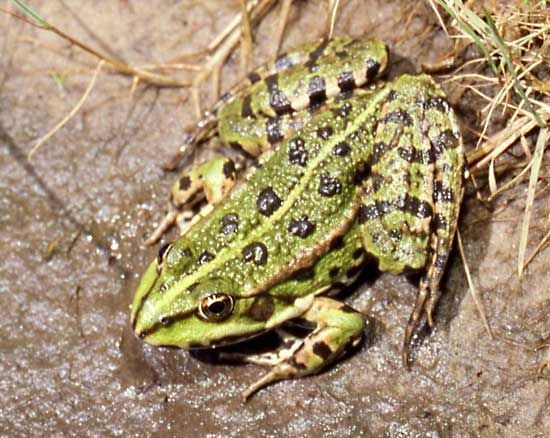
The marsh frog (Rana ridibunda) is the largest member of the Ranidae family found in Europe. These large, aquatic frogs are native to a range extending from…
What is marsh frog?
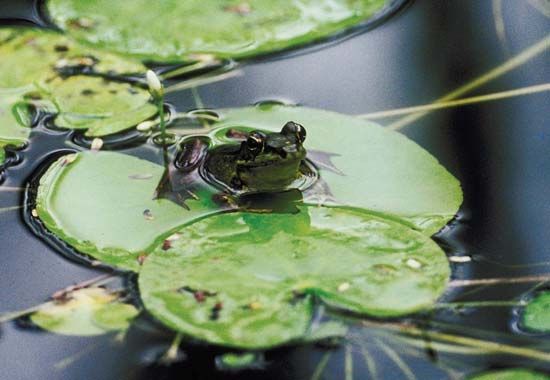
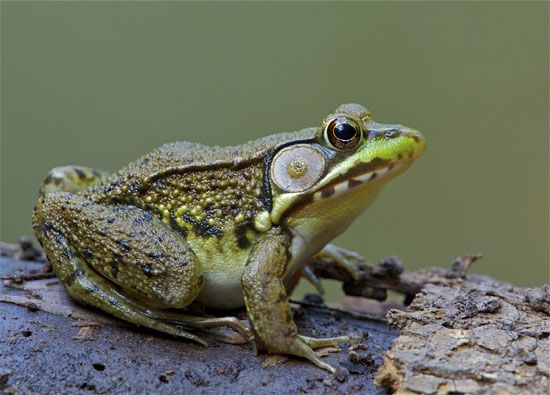
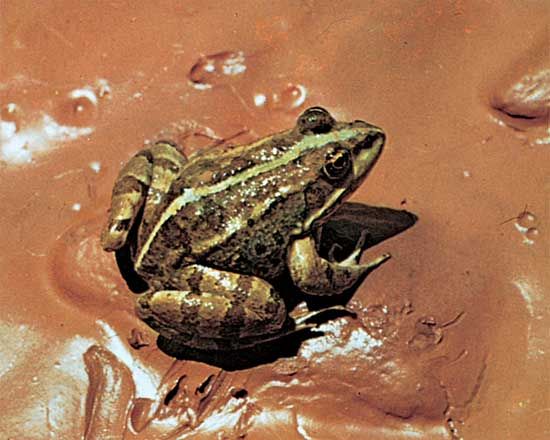
The marsh frog (Rana ridibunda) is the largest member of the Ranidae family found in Europe. These large, aquatic frogs are native to a range extending from France to the Ural Mountains and have been introduced to southern England.1
Typically, these frogs remain within 1 to 2 metres of permanent water sources. In terms of size, females can reach lengths of 13 cm (5 inches), while males are smaller, growing to about 9 cm (3.5 inches).1
The marsh frog is closely related to the pool frog (R. lessonae). When these two species interbreed, they produce a hybrid known as the European edible frog (R. esculenta). While edible frogs can successfully breed with either parent species, mating between two edible frogs does not result in viable offspring.1
What is the difference between a frog and a toad?
It is a common misconception that frogs and toads are distinct, immutable categories. In reality, there is no strict taxonomic basis for these labels; all toads are technically classified as frogs, as both belong to the order Anura.2
While the terms are often used interchangeably, people typically rely on superficial physical differences to distinguish them:
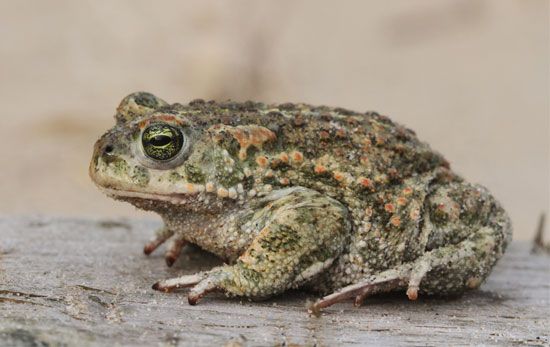
- Skin: Frogs generally have smooth, moist skin, whereas toads often have dry, rough, and bumpy skin. These bumps are glandular and not actual warts.23
- Habitat: Because frogs need to keep their skin moist, they are frequently found near water. Toads are better at retaining moisture and are often found in drier environments away from ponds or streams.2
- Legs: Frogs typically have long, powerful hind legs adapted for leaping and swimming. Toads usually have shorter hind legs, resulting in a squat appearance and a movement style characterized by small hops or walking.23
Because these descriptors are “wobbly,” some species may be called a frog in one context and a toad in another. Ultimately, these differences are mostly superficial.2
How do frogs undergo metamorphosis?
Frogs undergo a radical and abrupt transformation known as metamorphosis, which marks the transition from an aquatic larval stage—the tadpole—to a terrestrial adult form. This complex process is controlled by hormones, specifically thyroxine, which is produced by the thyroid gland in response to signals from the hypophysis.456
During this transition, the tadpole experiences profound physiological and structural changes:
- Respiration and Circulation: As lungs develop to facilitate air-breathing, the gills and their associated blood circulation disappear.45
- Skeletal and Muscular Changes: Limbs develop, with forelimbs eventually breaking through the opercular wall. The tail is resorbed by the body, with its cells being destroyed and devoured by phagocytic cells. Additionally, the vertebral column and limb bones ossify.476
- Digestive System: The long, coiled intestine of the herbivorous tadpole shortens significantly to become the thick-walled, folded intestine of the adult. Adult mouthparts, including jaws and true teeth, replace larval structures.47
- Sensory and Skin Modifications: The eyes enlarge and develop eyelids, and the skin thickens, acquiring a keratinized layer and subcutaneous glands.467
What are some other types of amphibians?
Beyond frogs and toads, the class Amphibia consists of two other primary groups:
- Salamanders and Newts (Order Caudata): These amphibians are distinguished by their long tails and two pairs of limbs that are typically of roughly equal size. They are generally found in freshwater and damp woodlands. This order includes diverse species such as the hellbender, the mud puppy, and the axolotl, the latter of which is known for retaining larval features into adulthood.89
- Caecilians (Order Gymnophiona): These are limbless, wormlike amphibians that have evolved specifically for a burrowing, subterranean lifestyle. They possess a body segmented by annular grooves and a short, blunt tail. Because they live underground, they have specialized, compact skulls and reduced vision, relying instead on well-developed nasal organs and chemosensory perception to navigate their environment.810
Together with the order Anura (frogs and toads), these three groups comprise the subclass Lissamphibia.811
Sources
- marsh frog — Encyclopædia Britannica
- What’s the Difference Between a Frog and a Toad? — Encyclopædia Britannica
- frog and toad - Size range and diversity of structure — Encyclopædia Britannica
- amphibian - Metamorphosis — Encyclopædia Britannica
- Animal development - Metamorphosis — Encyclopædia Britannica
- tadpole — Encyclopædia Britannica
- frog and toad - From tadpole to adult — Encyclopædia Britannica
- amphibian - Size range and diversity of structure — Encyclopædia Britannica
- amphibian — Encyclopædia Britannica
- salamander — Encyclopædia Britannica
- amphibian - Caecilians — Encyclopædia Britannica
- leopard frog — Encyclopædia Britannica
Published on · 3 min read