Myophoria
Myophoria is a genus of extinct clams that lived during the Triassic Period, approximately 251 million to 200 million years ago. These organisms are…
What is Myophoria?
Myophoria is a genus of extinct clams that lived during the Triassic Period, approximately 251 million to 200 million years ago. These organisms are primarily recognized by their angular shells, which feature distinct radiating ribs and fine growth lines that encircle the shell at right angles to those ribs.1
Because of their unique shell form and ornamentation, they serve as an important index fossil, helping geologists and paleontologists date and correlate Triassic rock layers.1
What are index fossils and why are they important?
An index fossil is any plant or animal preserved in the rock record that serves as a diagnostic marker for a specific span of geologic time or a particular environment.2
To be considered a useful index fossil, a specimen should ideally possess the following characteristics:
- Short temporal range: The species existed for only a brief moment in geologic history, allowing for precise dating.23
- Wide geographic distribution: The organism was cosmopolitan, meaning it can be found in many different locations, which aids in global correlation.23
- Abundance: The fossilized remains are common enough that discovery is highly probable.23
- Distinctive appearance: The fossil is easily recognizable, which helps prevent misidentification.23
Index fossils are essential to stratigraphy because they provide the basis for defining boundaries in the geologic time scale and allow geologists to correlate separated rock outcrops. By applying the principle of faunal succession, scientists can determine the relative age of fossiliferous rock based on the unique assemblages of life forms they contain.23
What characterizes the Triassic Period?
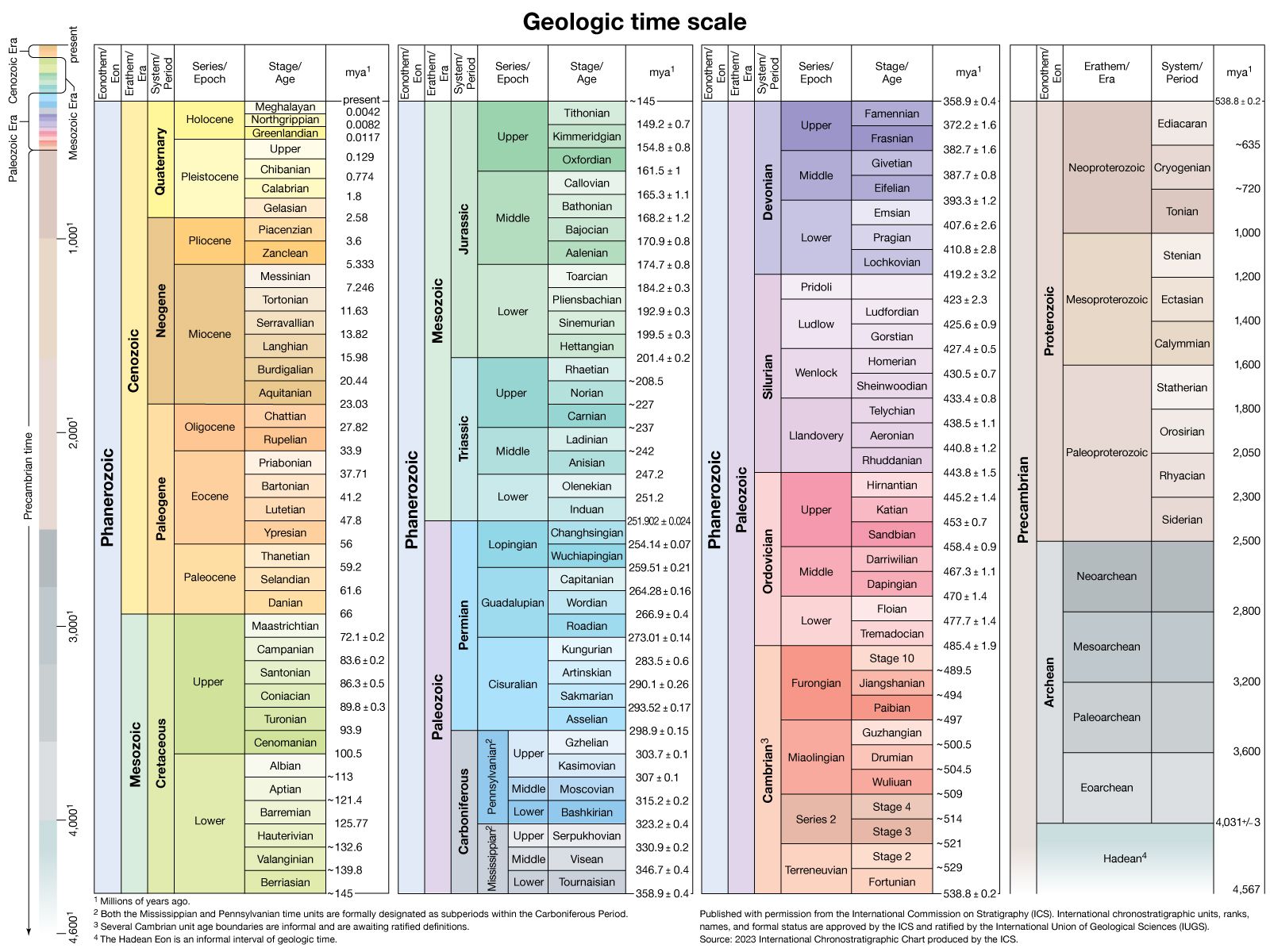
The Triassic Period (approximately 252.2 million to 201.3 million years ago) was a time of significant transition that initiated the Mesozoic Era.4
Geological and Climatic Setting
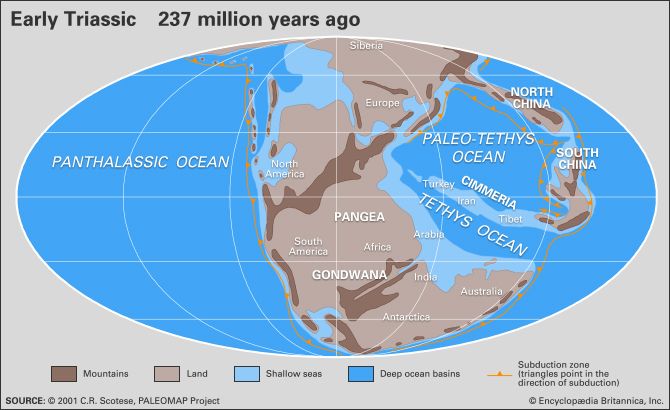
At the start of the period, Earth’s landmasses were consolidated into the supercontinent Pangea. The climate was generally warm and dry, characterized by widespread aridity and a lack of polar ice. However, evidence suggests a monsoonal climate developed during the Middle and Late Triassic, bringing seasonal precipitation to many regions. By the end of the period, plate tectonic activity increased, leading to the rifting of Pangea.45
Biological Evolution
Following the massive Permian extinction, life began to recover and diversify:
- Marine Life: Shallow seas expanded, allowing for the colonization of continental shelves by reef-building corals and large marine reptiles.4
- Terrestrial Life: Reptiles increased in diversity, and the first dinosaurs appeared. The period also saw the emergence of the first mammals.4
- Flora: The landscape was dominated by gymnosperms, including conifers, cycads, and ginkgoes, while ferns remained common in the understory.6
The period concluded with another mass extinction, which eliminated many marine and terrestrial species, ultimately clearing ecological niches that allowed dinosaurs to become the dominant land animals in the subsequent Jurassic Period.7
How do scientists classify extinct mollusks?
Scientists classify extinct mollusks primarily by analyzing their preserved hard parts, as soft tissues are rarely available in the fossil record. Because mollusks like bivalves and cephalopods are typically enclosed in calcium carbonate shells, paleontologists rely on these structures to determine taxonomic relationships.89
Key Features for Classification
- Shell Morphology: For both bivalves and cephalopods, investigators examine the general shape, coiling patterns, and external sculpture of the shell.810
- Internal Structures: In bivalves, classification is guided by the arrangement of hinge teeth, ligament structures, and muscle scars that indicate where internal organs were once attached.8
- Suture Patterns: For extinct cephalopods such as ammonoids, the complexity of the sutures—the lines where internal partitioning walls meet the outer shell—is a primary diagnostic feature used to distinguish different groups and evolutionary stages.210
- Microstructure and Mineralogy: The chemical and physical composition of the shell provides additional evidence to support taxonomic groupings, helping researchers navigate challenges like parallel evolution, where unrelated species develop similar forms due to shared habitats.8
Sources
- Myophoria — Encyclopædia Britannica
- index fossil — Encyclopædia Britannica
- dating - Principles and techniques — Encyclopædia Britannica
- A Journey Through Time Since the Precambrian - Triassic Period: 252.2 million to 201.3 million years ago — Encyclopædia Britannica
- Triassic Period - Plants — Encyclopædia Britannica
- Triassic Period - Paleoclimate — Encyclopædia Britannica
- end-Triassic extinction — Encyclopædia Britannica
- bivalve - Classification — Encyclopædia Britannica
- ammonoid — Encyclopædia Britannica
- list of mollusks — Encyclopædia Britannica
- cephalopod - Distinguishing taxonomic features — Encyclopædia Britannica
- bivalve - Evolution and paleontology — Encyclopædia Britannica
- index fossil — Merriam-Webster
Published on · 3 min read