Water Cycle
Evaporation is the process by which liquid water transitions into a gaseous state, allowing it to enter the atmosphere as water vapour. This process is a…
How does evaporation contribute to the water cycle?
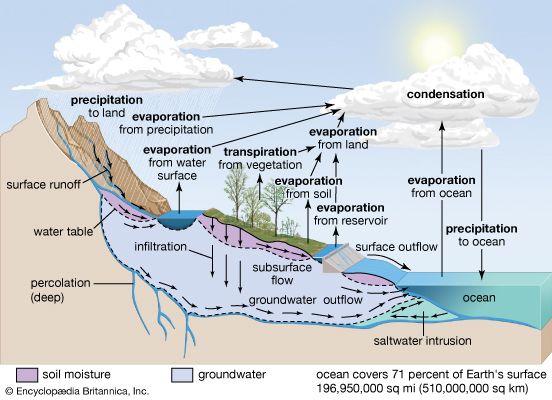
Evaporation is the process by which liquid water transitions into a gaseous state, allowing it to enter the atmosphere as water vapour. This process is a fundamental component of the water cycle, serving as the primary mechanism for the ascending movement of moisture from the Earth’s surface to the air.123
By replenishing atmospheric humidity, evaporation plays a critical role in the Earth-atmosphere energy exchange, which drives weather and climate patterns. This transfer occurs when water molecules gain sufficient kinetic energy to escape from surfaces such as oceans or vegetation. The rate of this process is influenced by several environmental factors, including solar radiation, temperature, wind speed, and relative humidity. Additionally, evapotranspiration—the combined loss of water from soil surfaces and plant transpiration—contributes significantly to the total moisture entering the atmosphere.124
How does human activity impact the water cycle?
Human activities significantly alter the water cycle by disrupting natural processes and water quality. These impacts primarily occur through the following mechanisms:
Greenhouse Gas Emissions and Climate Change
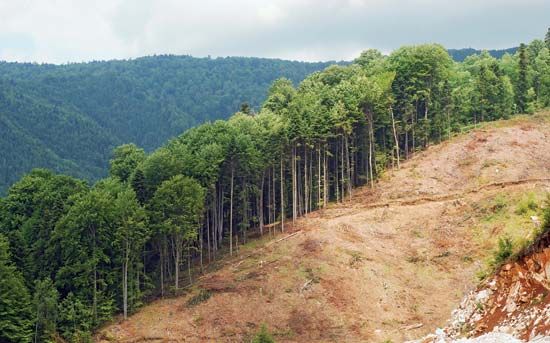
The combustion of fossil fuels and deforestation release greenhouse gases like carbon dioxide, driving global warming. This warming accelerates the hydrologic cycle by increasing evaporation rates and altering precipitation patterns. Furthermore, rising temperatures cause the melting of mountain glaciers and polar ice, which contributes to sea-level rise and shifts in moisture transport.56
Water Management and Resource Depletion
Human intervention in water systems, such as the construction of dams, reservoirs, and diversions, regulates river flows to manage water quantity and quality. However, these practices can lead to unintended consequences, including increased evaporation from larger surface areas and the disruption of local ecosystems. Additionally, excessive groundwater mining for irrigation depletes aquifers faster than they can be naturally recharged, potentially causing land subsidence and saline intrusion.789
Pollution and Quality Degradation
Society impacts the hydrosphere by discharging toxic chemicals, industrial wastes, pesticides, and fertilizers into aquatic systems. These pollutants, alongside improper sewage disposal and thermal pollution, degrade water quality and contribute to issues like eutrophication and acid rain, further stressing the natural balance of the water cycle.510
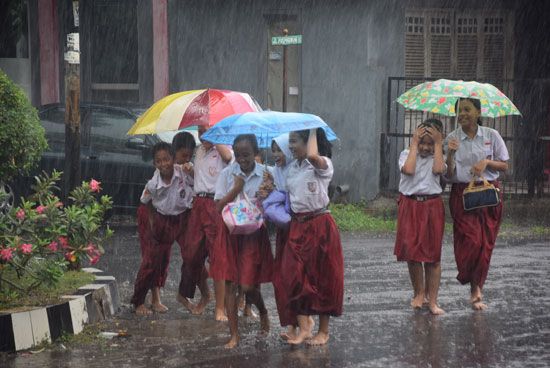
How does precipitation occur in the water cycle?
Precipitation occurs when water particles within clouds grow large enough to overcome atmospheric updrafts and fall to the Earth’s surface. This process begins with the formation of clouds, which occurs when damp air rises, cools, and reaches saturation, causing water vapour to condense onto aerosol particles known as condensation nuclei.121314
The transition from non-precipitating cloud droplets to precipitation involves two primary growth mechanisms:
- Ice Crystal Growth: In supercooled clouds, ice crystals form on sublimation nuclei. Because the equilibrium vapour pressure is lower over ice than over liquid water, these crystals grow rapidly at the expense of surrounding water droplets.1213
- Collision and Coalescence: Whether starting as ice crystals or solution droplets, particles grow significantly by colliding and merging with smaller cloud droplets as they fall. Because larger particles fall faster, they sweep up smaller droplets in their path, increasing their mass until they are heavy enough to reach the ground as rain, snow, or hail.1213
What role do clouds play in the water cycle?
Clouds serve as a critical component of the water cycle, acting as the primary mechanism for the transformation of atmospheric water vapour into liquid or solid precipitation.316
Formation and Composition
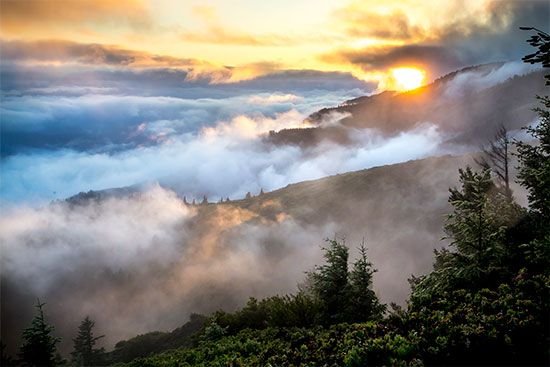
Clouds form when moist air rises and cools due to expansion at lower atmospheric pressures. As the air reaches its dew point, it becomes saturated, and water vapour condenses onto microscopic particles known as condensation nuclei, such as dust, salt, or combustion aerosols. These initial droplets are typically very small and float in the atmosphere, creating non-precipitating clouds.16173
Role in Precipitation
Clouds facilitate the growth of these small droplets into larger particles capable of falling to Earth through two main processes:
- Coalescence: In warmer clouds, droplets of varying sizes collide and fuse, growing large enough to fall as rain.13
- Ice Crystal Growth: In colder clouds, supercooled water droplets and ice crystals coexist. Because the air is supersaturated with respect to ice, crystals grow rapidly at the expense of the droplets, eventually forming snowflakes that may melt into rain before reaching the ground.13
Sources
- evaporation — Encyclopædia Britannica
- Climate - Evaporation and humidity — Encyclopædia Britannica
- hydrosphere - Water vapour and precipitation — Encyclopædia Britannica
- evapotranspiration — Encyclopædia Britannica
- Water cycle: Top Questions — Encyclopædia Britannica
- hydrosphere - Buildup of greenhouse gases — Encyclopædia Britannica
- aquifer — Encyclopædia Britannica
- lake - The water budget — Encyclopædia Britannica
- hydrosphere - Impact of human activities on the hydrosphere — Encyclopædia Britannica
- Irrigation - Water supply — Encyclopædia Britannica
- Origins of agriculture - Irrigation — Encyclopædia Britannica
- Precipitation — Encyclopædia Britannica
- Climate - Cloud formation — Encyclopædia Britannica
- Climate - Precipitation — Encyclopædia Britannica
- Climate - Snow and sleet — Encyclopædia Britannica
- How do clouds form? — Encyclopædia Britannica
- Climate - Mechanisms of precipitation release — Encyclopædia Britannica
Published on · 4 min read