Abyssal Plain
Sediments on abyssal plains are primarily characterized by their role in smoothing the seafloor, creating vast, flat surfaces that can reach thicknesses of…
What are the main characteristics of the sediments found on abyssal plains?
Sediments on abyssal plains are primarily characterized by their role in smoothing the seafloor, creating vast, flat surfaces that can reach thicknesses of approximately one kilometer. These deposits are generally composed of two distinct types of material:1
- Turbidites: These are coarse, land-derived sediments transported from continental margins by turbidity currents—dense, sediment-laden slurries that flow down continental slopes due to gravity. Turbidites consist of horizontal beds of silt, sand, and occasionally gravel, which may be graded from coarse at the bottom to fine at the top. These layers can comprise 2 to 90 percent of the total sediment volume.12
- Fine-grained Pelagic Sediments: Between turbidity-current events, the plains accumulate fine-grained clay and the microscopic remains of organisms (such as Foraminifera) that settle slowly through the water column. These sediments accumulate at very low rates, often measured in millimeters per thousand years.1
The composition and distribution of these sediments are heavily influenced by factors such as proximity to land, water depth, and the calcite compensation depth, which limits the accumulation of carbonate-rich materials in deeper areas.34
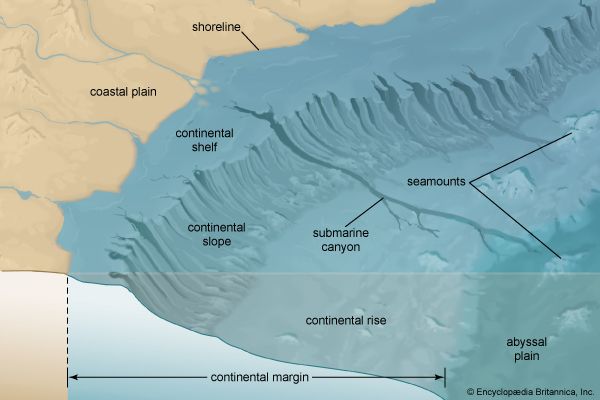
How do abyssal plains differ from continental shelves and slopes in terms of geology?
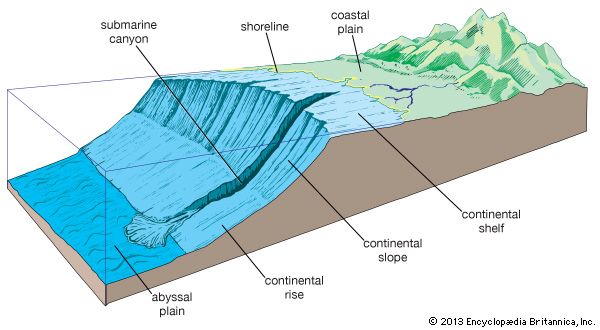
Geologically, abyssal plains, continental shelves, and continental slopes represent distinct zones of the ocean floor with significant differences in depth, composition, and formation processes.
Continental Shelves and Slopes
- Continental Shelves: These are the shallowest parts of the ocean, extending from the coast to depths of 100–200 meters. They are essentially submerged extensions of the continental landmass, composed of continental crust, which is thicker and less dense than oceanic crust. Their surfaces are often characterized by sand, silt, and mud, featuring varied relief like ridges and submarine canyons.1011
- Continental Slopes: Located at the seaward edge of the shelf, the slope is a much steeper zone (averaging over 4°) that descends to the deep ocean basins. It marks the transition from continental to oceanic crust. Slopes act as temporary depositional sites where sediment accumulates until it becomes unstable and moves downslope via gravity.12
Abyssal Plains
- Depth and Topography: Abyssal plains are found at much greater depths, typically 3,000 to 6,000 meters. Unlike the varied relief of shelves and slopes, abyssal plains are remarkably flat, with variations of only 10 to 100 cm per kilometer.1
- Geological Origin: While shelves and slopes are defined by the structure of the continental crust, abyssal plains are formed by the accumulation of thick layers of land-derived sediment (averaging one kilometer thick) that bury the original, undulating oceanic crust topography oceanic crust topography. This sediment is primarily delivered by turbidity currents originating from the continental margins.113
- Crustal Composition: Abyssal plains rest upon oceanic crust, which is basaltic, thinner (averaging 6 km), and denser than the granitic continental crust found beneath shelves.11
What is the average depth of abyssal plains in the ocean?
Abyssal plains are found at depths ranging from 3,000 to 6,000 meters (approximately 10,000 to 20,000 feet).116
What types of unique organisms inhabit the abyssal plains?
The abyssal plains host a sparse but specialized community of organisms adapted to an environment defined by total darkness, high hydrostatic pressure, and cold, calm waters. Because no sunlight reaches these depths, these animals do not rely on photosynthesis; instead, they depend on organic matter—often called marine snow—that drifts down from the upper ocean layers.17181
Unique Adaptations
- Physical Traits: Abyssal fauna are typically gray or black, delicately structured, and lack streamlined bodies. Many mobile species possess long legs to navigate the soft sediment, while sessile (attached) organisms often have stalks to elevate themselves above the seafloor, where oxygen levels may be lower.17
- Sensory and Bioluminescence: In the absence of light, some crustaceans and fish have evolved to be blind. Conversely, other organisms utilize bioluminescent organs to produce their own light in the darkness.1718
- Metabolic Strategies: Many abyssal inhabitants are scavengers or deposit feeders that consume mud and organic debris. Some species sustain themselves through chemoautotrophic bacterial associations, particularly near marine hot vents.1718
Common Inhabitants
The abyssal fauna include representatives from all major marine invertebrate phyla, as well as various fish. Common groups found in these deep-sea environments include:17
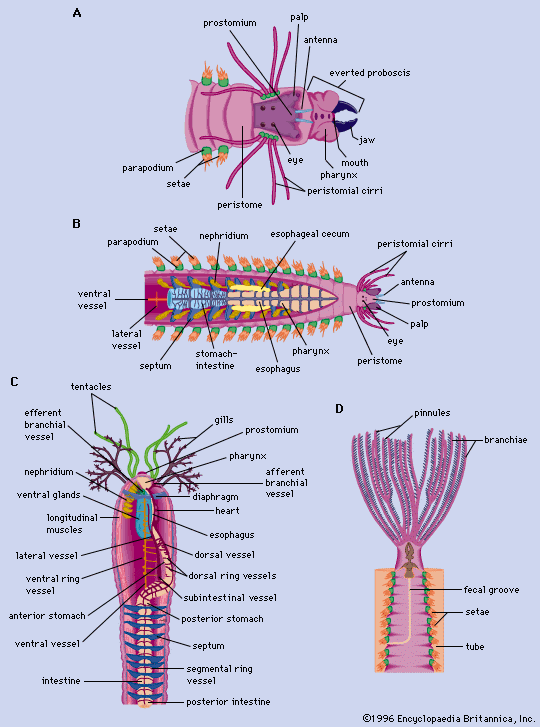
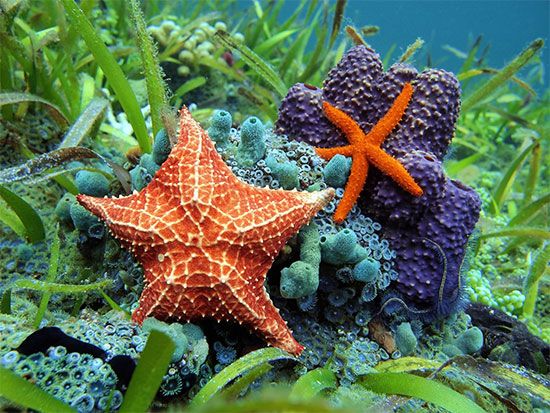
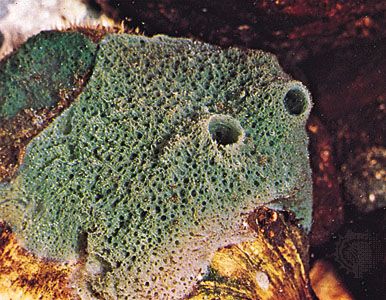
- Invertebrates: Polychaete worms, echinoderms, sponges, crustaceans, and clams.171918
- Fish: Various species of deep-sea fish, such as pout fish, which are capable of surviving under extreme pressure.1718
Sources
- abyssal plain — Encyclopædia Britannica
- terrigenous sediment — Encyclopædia Britannica
- pelagic deposits — Merriam-Webster
- abyssal plain — Merriam-Webster
- ocean basin - Deep-sea sediments — Encyclopædia Britannica
- ocean basin - Sedimentation patterns — Encyclopædia Britannica
- ocean basin - Sediment types — Encyclopædia Britannica
- ooze — Encyclopædia Britannica
- sedimentary rock - Origin of limestones — Encyclopædia Britannica
- continental shelf - Structure — Encyclopædia Britannica
- continental margin - Margin types — Encyclopædia Britannica
- continental crust — Encyclopædia Britannica
- continental slope — Encyclopædia Britannica
- turbidity current — Encyclopædia Britannica
- abyssal hill — Encyclopædia Britannica
- ocean basin - General features — Encyclopædia Britannica
- abyssal zone — Encyclopædia Britannica
- benthos — Encyclopædia Britannica
- life - Temperature and desiccation — Encyclopædia Britannica
- Marine ecosystem - Plankton — Encyclopædia Britannica
Published on · 4 min read