Opah
The opah (genus Lampris) refers to two species of large, deep-bodied marine fish belonging to the family Lampridae. They are known for their distinctive…
What is opah?
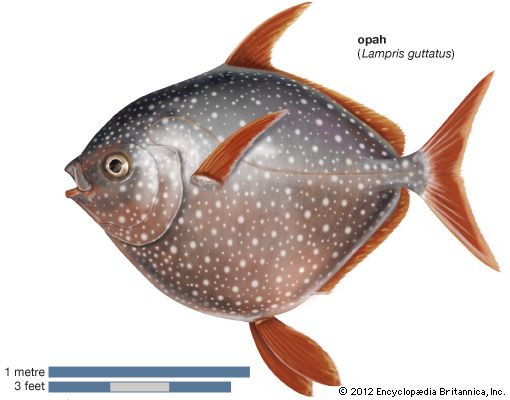
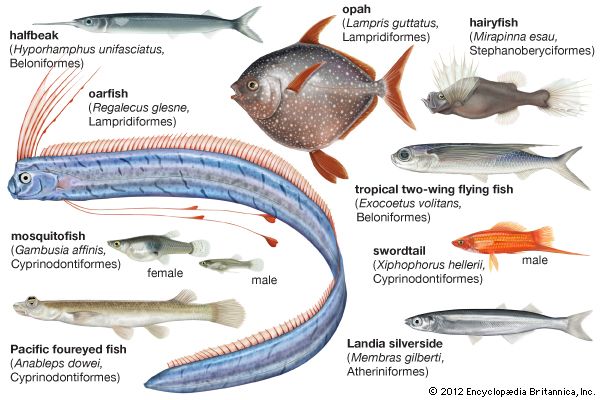
The opah (genus Lampris) refers to two species of large, deep-bodied marine fish belonging to the family Lampridae. They are known for their distinctive appearance, featuring blue upper bodies, rosy undersides, scarlet fins, and white spots.1
The most notable species, Lampris guttatus, is the only known fully warm-blooded fish. It maintains its body temperature through a specialized heat-exchange system in its gills, where heat generated by pectoral fin movement is transferred to oxygenated blood. This physiological adaptation allows the opah to swim faster and perform more efficiently than other deep-sea fish.1
While L. guttatus is found in tropical and temperate oceans globally, the southern opah (L. immaculatus) is restricted to the temperate waters of the Southern Hemisphere. Though they are uncommon, these fish are valued as food and primarily feed on other fish, cephalopods, and invertebrates.1
How does being warm-blooded help the opah hunt in deep water?
Being warm-blooded provides the opah (Lampris guttatus) with a significant physiological advantage when hunting in the cold, deep-sea environment. Unlike most deep-sea fish, which are typically sluggish due to the low temperatures of their habitat, the opah utilizes a specialized heat exchange system located in its gills.1
This system works by capturing heat generated by the movement of the fish’s pectoral fin muscles. This heat is transported via deoxygenated blood to the gills, where it is transferred to oxygenated blood before being circulated throughout the body. This process allows the opah’s heart to pump faster and its muscles to function more efficiently. Consequently, the opah maintains a higher level of activity and speed than its prey, which provides a distinct predatory advantage in the deep ocean.1
What are cephalopods and why are they a common food source for deep-sea fish?
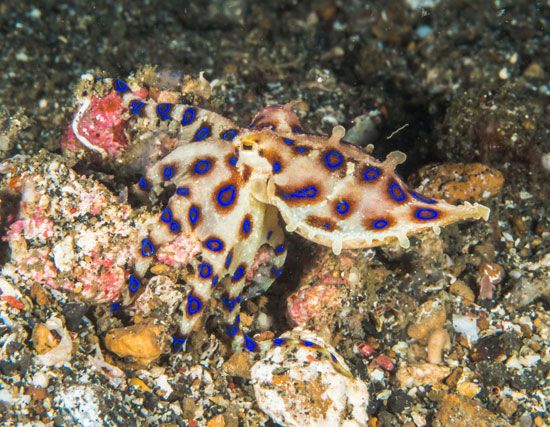
Cephalopods are a class of highly advanced and organized mollusks that live exclusively in marine environments. This diverse group includes familiar animals such as octopuses, squids, cuttlefish, and the chambered nautilus. They are characterized by their possession of arms and tentacles, as well as their ability to range significantly in size, from tiny species to the giant squid, which is among the largest living invertebrates.34
Cephalopods serve as a vital food source for many marine predators, including deep-sea fish, seals, seabirds, and various species of whales. Their importance as a food resource stems from several factors:45
- Abundance: Cephalopods occur in large numbers throughout the world’s oceans, making them a reliable and widespread source of nutrition.4
- Ecological Range: They occupy diverse habitats, ranging from shallow coastal waters to depths exceeding 5,000 metres (16,400 feet), which brings them into contact with a wide variety of deep-sea predators.5
- Nutritional Value: As carnivorous animals that feed on crustaceans, mollusks, and smaller fish, they represent a significant link in the marine food web, concentrating energy that is then transferred to larger predators.5
What other unique adaptations do deep-sea fish have to survive?
Deep-sea fish have evolved a variety of specialized adaptations to survive the extreme pressure, darkness, and limited food availability of their environment.6
Physical and Physiological Adaptations
- Pressure Resistance: To survive the immense hydrostatic pressure of the deep ocean, many deep-sea species lack air-filled compartments like lungs or swim bladders, which would otherwise compress or rupture.8
- Energy Conservation: Because the deep sea is a food-poor environment, many species have evolved reduced skeletons and muscles, often appearing gelatinous, to minimize the energy required to maintain their bodies.9
- Body Structure: Mid-water species often possess huge mouths and enlarged eyes to capture prey and detect light in the darkness. In contrast, bottom-dwelling (benthic) fish typically have smaller eyes and down-turned mouths.6
Bioluminescence
Many deep-sea organisms utilize bioluminescence for survival:10
- Lures: Species like anglerfishes use luminous organs on modified dorsal fin spines to attract prey directly to their jaws.610
- Camouflage: Some fish use photophores on their ventral surfaces to match the intensity of sunlight from above, effectively concealing their shadows from predators lurking below.10
- Communication: Light flashes serve as vital signals for species recognition and mating in the perpetual darkness.10
Sources
- opah — Encyclopædia Britannica
- opah — Merriam-Webster
- cephalopod — Encyclopædia Britannica
- cephalopod - General features and importance to humans — Encyclopædia Britannica
- octopus — Encyclopædia Britannica
- deep-sea fish — Encyclopædia Britannica
- cephalopod - Ecology — Encyclopædia Britannica
- Bioluminescence - The role of bioluminescence in behavior — Encyclopædia Britannica
- Biosphere - Hydrostatic pressure — Encyclopædia Britannica
- fish - Structural diversity — Encyclopædia Britannica
- Photoreception - Lens eyes — Encyclopædia Britannica
- protacanthopterygian - Ecology — Encyclopædia Britannica
Published on · 3 min read