Oxygen Cycle
Earth’s oxygen cycle has undergone a profound transformation over geological time, shifting from an anoxygenic environment to one dominated by free oxygen.
How has the Earth’s oxygen cycle changed over geological time scales?
Earth’s oxygen cycle has undergone a profound transformation over geological time, shifting from an anoxygenic environment to one dominated by free oxygen.
The Anoxygenic Era
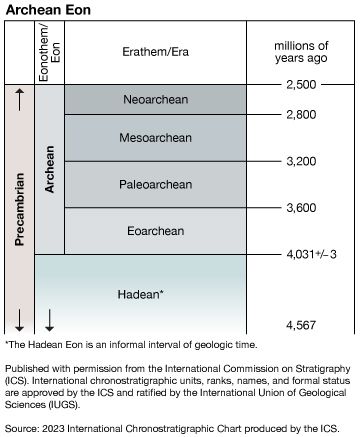
For the first billion years or more of Earth’s history, the atmosphere was essentially devoid of free oxygen. During the Archean Eon, volcanic activity and the erosion of unoxidized crustal materials created massive “sinks” that consumed any oxygen produced by early biological processes. Evidence for this reducing environment includes the presence of unoxidized grains of uraninite and pyrite in sediments older than 2.2 billion years.1234
The Rise of Oxygen
The transition began with the evolution of photosynthesis by cyanobacteria, which released oxygen as a byproduct. Initially, this oxygen was sequestered by dissolved ferrous iron in the oceans, leading to the widespread deposition of banded-iron formations.523
As these iron sinks were exhausted around 1.7 to 2 billion years ago, oxygen began to accumulate in the atmosphere. This rise enabled the development of eukaryotes and, eventually, complex animal life. By the time land plants proliferated roughly 400 million years ago, atmospheric oxygen levels had reached their present-day values.524367
What are the main sources of oxygen in the atmosphere?
The primary sources of oxygen in Earth’s atmosphere are:
- Photosynthesis: This is the most significant process controlling atmospheric oxygen levels throughout geological time. Through this biological process, autotrophs—including land plants, phytoplankton, and cyanobacteria—convert carbon dioxide and water into carbohydrates, releasing molecular oxygen as a byproduct.932
- Photochemical Dissociation: A minor source of atmospheric oxygen is the photochemical decomposition of water vapor in the upper atmosphere. In this process, solar ultraviolet radiation cleaves water molecules, producing oxygen and hydrogen. The hydrogen, being a light atom, can then escape into outer space, allowing the oxygen to remain.910
While photochemical production occurs, its contribution to atmospheric oxygen levels is limited by atmospheric conditions and was historically insufficient to overcome oxygen sinks, such as oxidative weathering, until the establishment of widespread oxygenic photosynthesis.10
How does the oxygen cycle interact with other biogeochemical cycles, such as the carbon cycle?
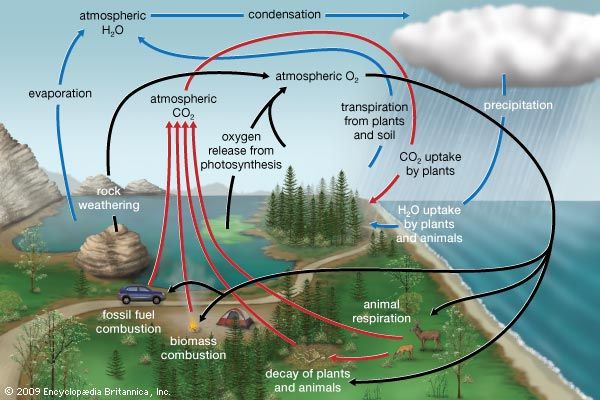
The oxygen cycle is deeply intertwined with other biogeochemical cycles, most notably the carbon cycle, as they share a fundamental relationship through biological and geological processes.1213
Biological Coupling
The primary link between oxygen and carbon is the process of photosynthesis. During this cycle, plants and algae consume carbon dioxide and water to produce carbohydrates, releasing molecular oxygen as a byproduct. Conversely, respiration by living organisms consumes oxygen and returns carbon dioxide to the atmosphere.127
In this context, oxygen acts as the primary “redox partner” for carbon. When photosynthesis exceeds respiration, organic carbon is buried in sediments without being reoxidized. This imbalance prevents the carbon from returning to the atmosphere as CO₂, which in turn allows for the net accumulation of atmospheric oxygen.147
Geological Interactions
The oxygen cycle also interacts with the geologic carbon cycle through weathering reactions. When organic matter—such as coal or oil—is exposed to the atmosphere through erosion and uplift, it reacts with oxygen to produce carbon dioxide. Additionally, the oxidation of minerals containing iron and sulfur consumes atmospheric oxygen, acting as a significant sink that balances the oxygen produced by biological activity.15
What is the oxygen cycle and why is it important in ecology?
The oxygen cycle is the continuous movement of oxygen in its various forms through the atmosphere, hydrosphere, and biosphere. It is a fundamental biogeochemical cycle that sustains life on Earth by regulating the availability of this essential element.1218
Importance in Ecology
The oxygen cycle is critical to ecological health for several reasons:
- Biological Respiration: Oxygen is vital for the survival of most living organisms, including animals, plants, and fungi. These heterotrophs rely on oxygen to perform cellular respiration, a process that breaks down organic molecules to generate the energy required for life.1920
- Energy Production: Through photosynthesis, autotrophs—primarily algae and green plants—convert solar energy into chemical energy, releasing oxygen as a byproduct. This process is the primary source of atmospheric oxygen, with aquatic algae estimated to replace about 90 percent of the oxygen used by the biosphere.1218
- Nutrient Cycling: Oxygen is a core component of the protoplasm in all living cells. Its movement between inorganic and organic states ensures that essential elements are recycled through the environment, supporting the growth and maintenance of all organisms.18
Sources
- evolution of the atmosphere - Rise of molecular oxygen — Encyclopædia Britannica
- Climate change - Photosynthesis and atmospheric chemistry — Encyclopædia Britannica
- chemical element - Geochemical history — Encyclopædia Britannica
- geologic history of Earth - Formation of the secondary atmosphere — Encyclopædia Britannica
- Phanerozoic Eon — Encyclopædia Britannica
- Precambrian - Oxygenation of the atmosphere — Encyclopædia Britannica
- evolution of the atmosphere - Attainment of the modern O 2 level — Encyclopædia Britannica
- evolution of the atmosphere - Transition to an aerobic environment — Encyclopædia Britannica
- evolution of the atmosphere - Photochemical production — Encyclopædia Britannica
- phytoplankton — Encyclopædia Britannica
- photosynthesis - Importance of photosynthesis — Encyclopædia Britannica
- Oxygen cycle — Encyclopædia Britannica
- evolution of the atmosphere - Biogeochemical cycles — Encyclopædia Britannica
- evolution of the atmosphere - Interaction of biological and geologic cycles — Encyclopædia Britannica
- photosynthesis - Photorespiration — Encyclopædia Britannica
- evolution of the atmosphere - Weathering reactions — Encyclopædia Britannica
- evolution of the atmosphere - Biological carbon cycle — Encyclopædia Britannica
- life - Energy , carbon, and electrons — Encyclopædia Britannica
- Protozoan - Aerobic protozoans — Encyclopædia Britannica
- ecosystem — Encyclopædia Britannica
Published on · 3 min read