Phanerozoic Eon
Scientists use geochronology to date rocks and events from the Phanerozoic Eon by integrating two primary approaches: relative dating and absolute…
How do scientists use geochronology to date rocks and events from the Phanerozoic Eon?
Scientists use geochronology to date rocks and events from the Phanerozoic Eon by integrating two primary approaches: relative dating and absolute (radiometric) dating.12
Relative Dating
Relative dating establishes the chronological order of events without assigning specific numerical ages.
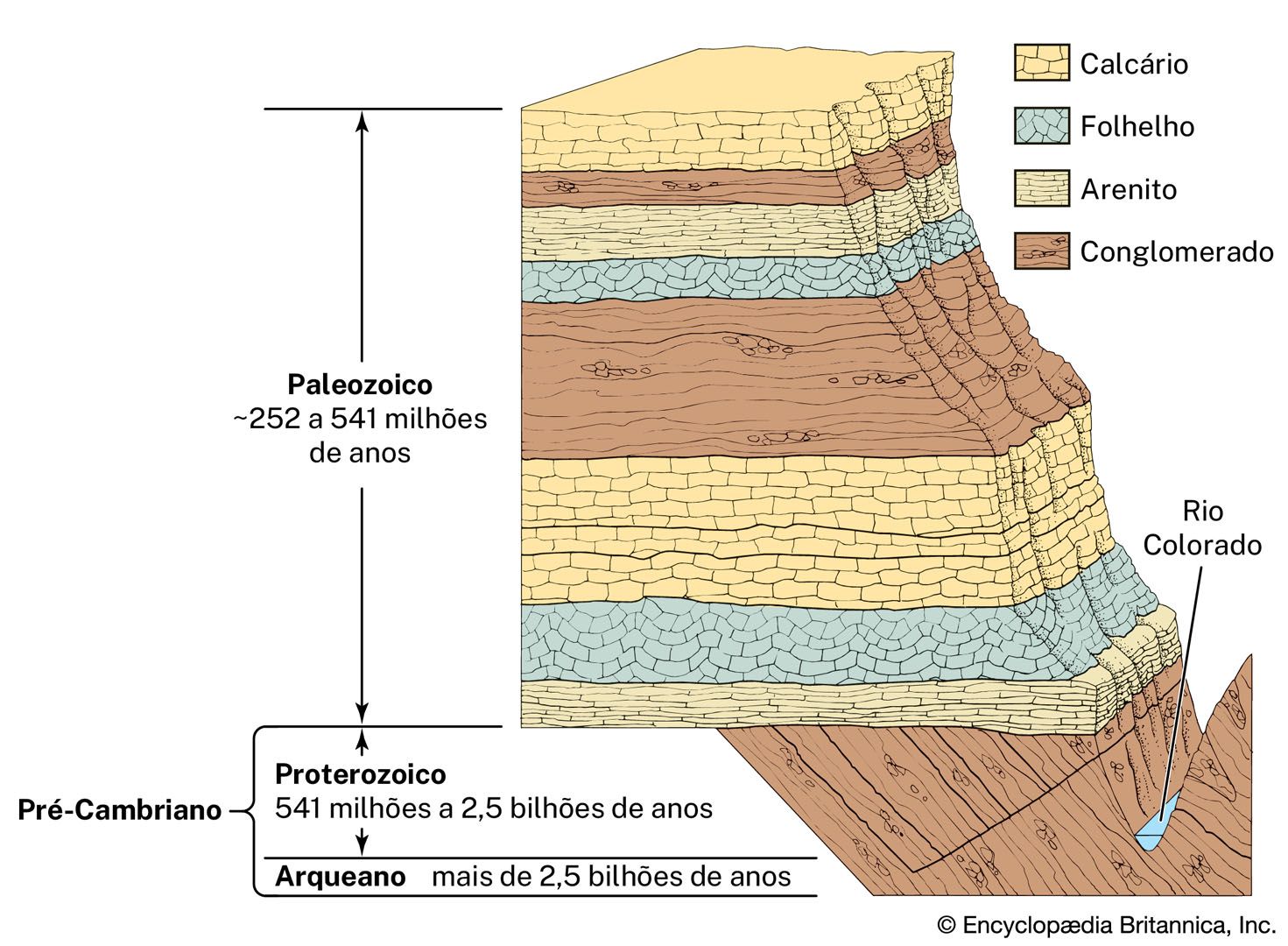
- Stratigraphy and Superposition: Based on the principle of superposition, the oldest rock layers are at the base, with younger layers deposited above.31
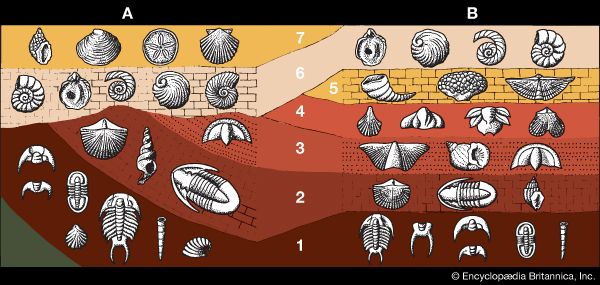
- Biostratigraphy: Paleontologists use index fossils—species that were geographically widespread and existed for a short temporal range—to correlate rock layers across different regions based on the principle of faunal succession.4
Absolute Dating
Absolute dating provides numerical ages by measuring the decay of radioactive isotopes within minerals.32
- Radiometric Methods: Scientists analyze parent-daughter isotope pairs, such as uranium-lead, potassium-argon, and rubidium-strontium.12
- Technological Advances: Tools like the mass spectrometer and ion microprobes (e.g., SHRIMP) allow for high-precision dating of tiny mineral samples, such as zircon.152
- Magnetostratigraphy: By studying the magnetic orientation of rocks, scientists can correlate sequences with the history of Earth’s magnetic field reversals.16
What were the major extinction events during the Phanerozoic Eon, and what caused them?
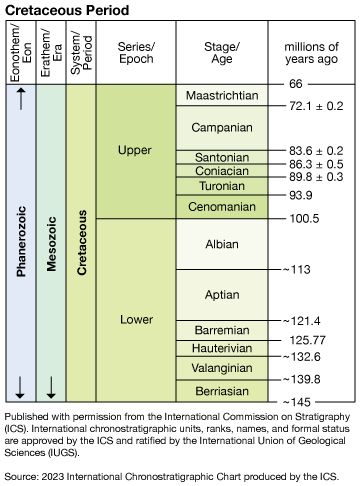
The Phanerozoic Eon has been marked by five major mass extinction events, which are periods of significant biodiversity loss caused by catastrophic environmental changes.9
Event
Approximate Time
Primary Proposed Causes
Ordovician-Silurian
443.8 million years ago
Rapid global cooling, glaciation, and subsequent sea-level fall.
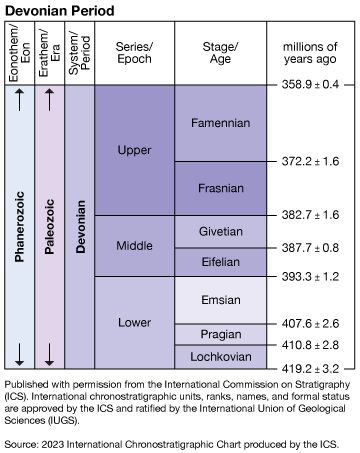
Devonian
407.6–358.9 million years ago
Oceanic anoxia, global temperature fluctuations, and potential bolide impacts.
Permian
265.1–251.9 million years ago
Intense volcanism, oceanic anoxia, and climatic shifts.
End-Triassic
201.3 million years ago
Massive volcanic activity, rapid climate change (greenhouse effect), or asteroid impact.
Cretaceous-Paleogene (K-Pg)
66 million years ago
Asteroid impact, volcanic activity (Deccan Traps), and resulting climate disruption.
Key Drivers of Extinction
These events were rarely the result of a single factor. Instead, they often involved complex interactions between terrestrial and extraterrestrial phenomena.9
- Volcanism and Climate: Large-scale volcanic activity, such as the creation of flood basalts, released massive amounts of carbon dioxide, triggering global warming and ocean acidification.13149
- Oceanic Changes: Shifts in ocean circulation and nutrient influxes often led to oceanic anoxia, devastating marine ecosystems.121511
- Extraterrestrial Impacts: The K-Pg extinction is strongly linked to an asteroid impact, which caused immediate environmental collapse by blocking sunlight and disrupting the food chain.149
We could dive deeper into how specific groups, such as dinosaurs or trilobites, were uniquely affected by these transitions.
What are some of the key fossil records from the Phanerozoic Eon?
The Phanerozoic Eon, spanning from 541 million years ago to the present, is defined by a rich fossil record that documents the rapid evolution and diversification of life.1617
Key Fossil Groups and Transitions
- The Cambrian Explosion: This period marks the sudden appearance of most major animal phyla, including mollusks, arthropods, and chordates.16 Trilobites are particularly iconic, dominating Cambrian marine deposits and serving as essential index fossils for early Paleozoic strata.1754
- Paleozoic Marine Life: Following the Cambrian, brachiopods became the dominant life-form in marine strata from the Ordovician through the Permian. Other significant fossils include graptolites, conodonts, and ammonoids, which are frequently used to correlate rock layers across vast distances.4
- Terrestrial Colonization: The fossil record captures the transition of life to land, such as the Rhynie Chert in Scotland, which preserves early vascular plants and fungi from the Devonian Period.174
Utility in Geochronology
Fossils are fundamental to stratigraphy through the principle of faunal succession, which states that specific fossil assemblages correspond to unique intervals of geologic time. By identifying these distinct “key beds” or index fossils, geologists can correlate separated rock outcrops and establish a continuous historical timeline of the biosphere.818
What is the Phanerozoic Eon, and when did it begin?
The Phanerozoic Eon is the current eon of geologic time, often referred to as the “eon of visible life” due to the rapid expansion and diversification of complex life-forms that occurred during this interval.521
While estimates can vary slightly based on stratigraphic definitions, the Phanerozoic Eon began approximately 538.8 to 541 million years ago, following the end of the Proterozoic Eon.2122
This eon is characterized by:
- Biological Evolution: The development of plants capable of photosynthesis increased atmospheric oxygen levels, which was critical for the evolution of complex animals.21
- Geological Activity: Earth’s physical features and continental configurations were shaped by continental drift, mountain building, and glaciation.geology), mountain building, and glaciation.521
- Time Divisions: It is divided into three major eras: the Paleozoic, Mesozoic, and Cenozoic eras.521
Although the Phanerozoic represents only about one-eighth of Earth’s history, it is the period during which the ancestors of modern plants and animals flourished.521
Sources
- dating: Top Questions — Encyclopædia Britannica
- geochronology — Encyclopædia Britannica
- geologic history of Earth - Time scales — Encyclopædia Britannica
- dating - Principles and techniques — Encyclopædia Britannica
- A Journey Through Time Since the Precambrian — Encyclopædia Britannica
- dating - Uranium–lead method — Encyclopædia Britannica
- geology - Isotopic geochemistry — Encyclopædia Britannica
- Tertiary Period - Correlation of Tertiary strata — Encyclopædia Britannica
- end-Triassic extinction — Encyclopædia Britannica
- Ordovician Period - Mass extinction at the end of the Ordovician — Encyclopædia Britannica
- Cretaceous Period - Mass extinction — Encyclopædia Britannica
- Triassic Period - Permian-Triassic extinctions — Encyclopædia Britannica
- mass extinction event — Encyclopædia Britannica
- Devonian Period - Extinction events — Encyclopædia Britannica
- Devonian extinctions — Encyclopædia Britannica
- Cambrian Period - Fossil record of the Precambrian-Cambrian transition — Encyclopædia Britannica
- Cambrian explosion — Merriam-Webster
- life - Geologic record — Encyclopædia Britannica
- Paleozoic Era — Encyclopædia Britannica
- fossil record — Encyclopædia Britannica
- Phanerozoic Eon — Encyclopædia Britannica
- Cambrian Period — Encyclopædia Britannica
Published on · 4 min read