Parafusulina
Parafusulina is a genus of extinct fusulinid foraminiferans, which are single-celled organisms characterized by complex, hard shells. These organisms lived…
What is Parafusulina?
Parafusulina is a genus of extinct fusulinid foraminiferans, which are single-celled organisms characterized by complex, hard shells. These organisms lived during the Permian Period, specifically within the Leonardian and Guadalupian stages.1
Because their presence is restricted to these specific time intervals, Parafusulina serves as an excellent index or guide fossil, helping geologists correlate marine rock units across different regions. Their shells are notable for distinct flutings, and their internal structures are typically examined using thin sections. Like other fusulinids, these creatures inhabited clear marine waters far from the shore.12
How do scientists use index fossils to date rock layers?
Scientists use index fossils to determine the relative age of rock layers through the principle of faunal succession. This principle establishes that different intervals of Earth’s history are characterized by unique assemblages of animal and plant life, allowing geologists to correlate sedimentary rock units found in different geographic locations.4
To be effective as an index fossil, a specimen must meet several criteria:
- Short temporal range: The species existed for a relatively brief moment in geologic time, ensuring that its presence indicates a specific interval.54
- Wide distribution: It was geographically widespread, allowing for the correlation of rock layers across vast distances.54
- Distinctiveness: It is easily recognizable, which helps prevent misidentification.54
- Abundance: The fossils are sufficiently common to be discovered with high probability.54
By identifying these fossils within sedimentary rock strata, scientists can define boundaries in the geologic time scale and piece together the history of life on Earth. While fossils provide relative ages, they are often calibrated using absolute dating techniques, such as measuring radioactive isotopes, to provide precise numerical ages.5647
What defines the Permian Period in Earth’s history?
The Permian Period was the final interval of the Paleozoic Era, spanning from 298.9 million to 252.2 million years ago. It is defined by significant geological and biological transitions:89
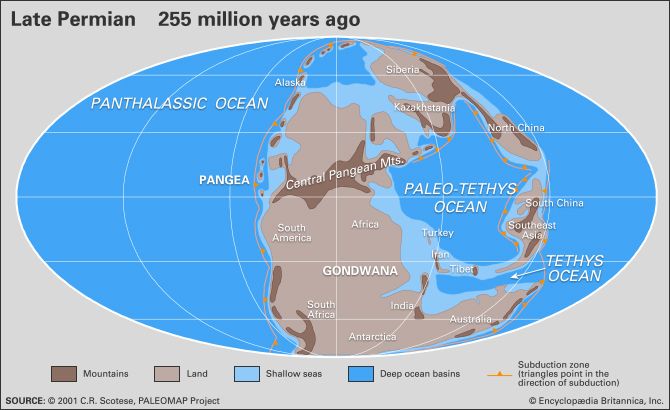
- Geographic Transformation: Most of Earth’s landmasses assembled into the supercontinent of Pangea, which was surrounded by the massive Panthalassa ocean.8109
- Climatic Shift: The period began with widespread glaciation, but the climate warmed significantly over time. By the end of the period, extensive hot and dry conditions created a severe environmental crisis.89
- Biological Evolution: Terrestrial plants diversified, insects evolved rapidly, and key reptile lineages appeared, including ancestors of mammals.89
- Mass Extinction: The period concluded with the largest mass extinction in Earth’s history, where 90 percent or more of species were lost, likely driven by extreme temperature fluctuations and disrupted nutrient cycles.8119
The period is named after the Perm region in Russia, where its rock strata are well-preserved.9
Why are foraminiferans important to petroleum geologists?
Foraminiferans are essential to petroleum geologists because they serve as highly effective index fossils for dating and correlating sedimentary rock layers where oil and natural gas deposits are often found.21213
Their importance stems from several key factors:
- Abundance and Size: Because they are microscopic and occur in vast numbers, they are frequently recovered in the small rock chips flushed up from boreholes during drilling, allowing for analysis where larger fossils would be absent.1413
- Biostratigraphic Utility: Their rapid evolution and wide geographic dispersal allow geologists to divide Mesozoic and Cenozoic sediments into detailed stratigraphic zones. This helps determine the age and depositional environment of the rock, which is critical for evaluating its potential as a hydrocarbon reservoir. which is critical for evaluating its potential as a hydrocarbon reservoir.13
- Specific Groups: Certain groups, such as fusulinids, are particularly valued as keys to locating economically significant deposits.2
By analyzing these microfossils, geologists can construct a high-resolution framework to map subsurface structures, significantly improving the efficiency and accuracy of exploration efforts.1315
Sources
- Parafusulina — Encyclopædia Britannica
- fusulinid — Encyclopædia Britannica
- Paraschwagerina — Encyclopædia Britannica
- index fossil — Encyclopædia Britannica
- dating - Principles and techniques — Encyclopædia Britannica
- biostratigraphy — Merriam-Webster
- dating - Distinctions between relative-age and absolute-age measurements — Encyclopædia Britannica
- A Journey Through Time Since the Precambrian - Permian Period: 298.9 million to 252.2 million years ago — Encyclopædia Britannica
- Permian Period - The Permian environment — Encyclopædia Britannica
- Permian Period - Temperature crises — Encyclopædia Britannica
- Permian Period — Encyclopædia Britannica
- foraminiferan — Encyclopædia Britannica
- Tertiary Period - Foraminiferans — Encyclopædia Britannica
- Earth sciences - Micropaleontology — Encyclopædia Britannica
- geology - Micropaleontology — Encyclopædia Britannica
- Tertiary Period - Correlation of Tertiary strata — Encyclopædia Britannica
Published on · 3 min read