Partridge
Partridges are medium-sized, stout-bodied game birds belonging to the family Phasianidae. They are primarily distinguished from quails—their smaller and less…
What are the physical characteristics of partridges that distinguish them from other game birds?
Partridges are medium-sized, stout-bodied game birds belonging to the family Phasianidae. They are primarily distinguished from quails—their smaller and less robust relatives—by their larger overall size, as well as their stronger bills and feet.12
Physical characteristics vary by species, but many exhibit specific identifying traits:
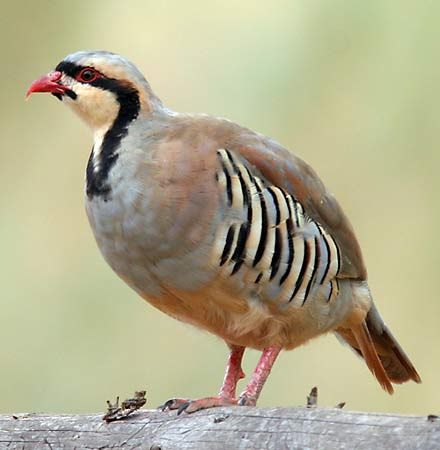
- Plumage: They typically feature variegated or intricately patterned plumage, often in shades of brown, gray, black, white, or red.13
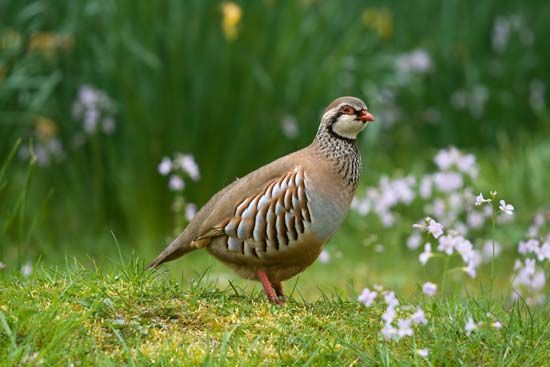
- Legs and Feet: Many species, such as francolins, possess strong legs and spurs. In the rock partridge group (Alectoris), both sexes have red legs and bills, with males additionally sporting blunt leg spurs.1
- Distinctive Markings: The gray partridge is known for its reddish face and tail, gray breast, and a dark U-shaped marking on the belly. Other species, like the chukar, are characterized by strongly barred sides and a black-outlined whitish throat.1
While some New World birds are colloquially called partridges, they are often more closely related to grouse or quail.13
In which regions of the world are partridges commonly found?
Partridges are native to the Old World, with various species distributed across several continents and regions:
- Europe and the British Isles: The gray partridge is the typical species of this region, ranging from the British Isles across the continent to the Caspian region.1
- Asia: This region hosts a wide variety of species. The chukar is native to areas stretching from southeastern Europe through India to Manchuria. The snow partridge inhabits the high mountains of south-central Asia. Additionally, rock partridges are widely distributed throughout southern and eastern Asia and around the Mediterranean.12
- Africa: There are approximately 35 species of francolins native to the African continent.1
- Malaysia: The crested wood partridge, or roulroul, is found in this region.1
While partridges are not native to North America, certain species, such as the gray partridge and the chukar, have been introduced to the continent as game birds.16
What are the different species of partridges, and how do they differ from each other?
Partridges are a diverse group of game birds within the family Phasianidae. While they share a stout-bodied build, they exhibit significant variations in appearance and habitat.
Key Species and Characteristics
- Gray Partridge (Perdix perdix): The typical European species, it features a reddish face and tail, a gray breast, and a distinctive dark U-shaped marking on the belly. They are primarily found in farmlands, foraging in family groups called coveys.1
- Rock Partridges (Alectoris): This group is defined by red legs and bills. The chukar is a well-known member, recognized by its brown back, strongly barred sides, and a black-outlined whitish throat.1
- Francolins (Francolinus): These are distinguished by the presence of leg spurs. They are highly prized as game birds, with approximately 40 species across Asia and Africa. They typically feature intricately patterned plumage in brown, black, white, or red.1
- Crested Wood Partridge (Rollulus roulroul): Found in Malaysia, this species is visually striking with an iridescent blue-green body, red feet, and a prominent crimson crest.1
- Snow Partridge (Lerwa lerwa): Inhabiting the high mountains of south-central Asia, this species is unique for its resemblance to a ptarmigan in both appearance and behavior.1
It is important to note that some birds referred to as partridges, such as the Mexican long-tailed partridge or Indian bush quail, are more accurately classified as quail.14
What is the typical diet and habitat of partridges in the wild?
Partridges are small game birds within the family Phasianidae that exhibit diverse habitat preferences depending on the species.
Habitat
Partridges are primarily ground-dwelling birds. Their environments vary significantly across species:
- Farmlands: The gray partridge typically inhabits agricultural areas, often nesting in grassy cups located within grainfields or hedges.1
- Mountainous Regions: Species such as the chukar are well-adapted to arid, mountainous terrain. Similarly, the snow partridge is found in the high-altitude mountains of south-central Asia.81
Diet
While specific dietary habits can vary by environment, partridges are generally foragers. For example, the gray partridge is known to forage in family groups, known as coveys, primarily consuming a diet of seeds and insects.1
As ground-nesting birds, they typically create simple nests consisting of shallow scrapes in the earth, often lined with soft grass or leaves.6
Sources
- Partridge — Encyclopædia Britannica
- Phasianidae — Encyclopædia Britannica
- Phasianidae — Merriam-Webster
- Quail — Encyclopædia Britannica
- partridge — Merriam-Webster
- chukar — Merriam-Webster
- rock partridge — Merriam-Webster
- Galliform - Courtship and mating — Encyclopædia Britannica
- Galliform - Nesting — Encyclopædia Britannica
Published on · 3 min read