Peter the Great Bay
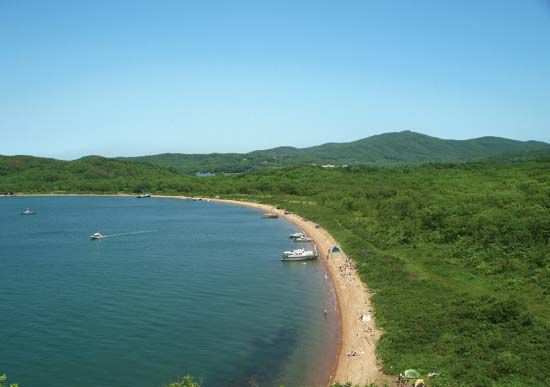
Peter the Great Bay (Zaliv Petra Velikogo) is a large, sheltered inlet of the Sea of Japan located in the Primorye region of far eastern Russia.
What is Peter the Great Bay?
Peter the Great Bay (Zaliv Petra Velikogo) is a large, sheltered inlet of the Sea of Japan located in the Primorye region of far eastern Russia1.1
The bay spans 115 miles (185 km) from the mouth of the Tumen River on the border with China to Cape Povorotny, extending 55 miles (88 km) inland. It is home to the major port city of Vladivostok, which sits on the Muravyov-Amursky Peninsula. While the bay is a vital maritime hub, its utility is restricted by ice that forms from early December to mid-April.2
Originally known as Victoria Bay starting in 1855, the inlet was renamed in 1859 to honor Peter I, the Russian tsar. It is distinct from the city of St. Petersburg, which Peter the Great also founded as a “window on Europe” in the west.23
What is the significance of the Trans-Siberian Railroad to Vladivostok?
The Trans-Siberian Railroad is of immense historical and economic significance to Vladivostok, serving as the vital link between the Russian Far East and the rest of the country.
- Strategic Expansion: Initiated in 1891 under the vision of Sergei Witte, the railroad was designed to extend Russian influence into East Asia and capture global trade. By connecting Moscow to the Pacific, it allowed for the transport of goods and raw materials in half the time required by sea routes.5
- Economic Development: The line facilitated the industrialization and settlement of Siberia, enabling the extraction of previously untapped natural resources. For Vladivostok, it transformed the city from a remote military outpost into a major commercial port and the eastern terminus of the world’s longest rail system.56
- Military and Geopolitical Role: The railroad was critical during the Russo-Japanese War and World War II, serving as a lifeline for military supplies and reinforcements. Its completion within Russian territory by 1916 secured a direct, sovereign route to the Pacific, reinforcing Vladivostok’s status as a key naval base.56
How does the Pacific monsoon influence the climate of the Primorye region?
The climate of the Primorye region is defined by a distinct monsoonal regime that creates sharp seasonal contrasts between continental and maritime influences.12
- Winter: The region is dominated by cold, dry air masses flowing from the Siberian anticyclone. This results in harsh, cold winters characterized by almost constant northerly winds. These winds bring dry, continental air across the region, contributing to the freezing of coastal waters, such as Peter the Great Bay, from December through mid-April.7189
- Summer: As the Asian landmass heats up, a low-pressure system develops, drawing in moist, maritime air from the North Pacific. This brings onshore southeast winds that make the summer season warm and wet. This moisture-laden monsoon is a primary driver of precipitation in the region, accounting for significantly higher annual rainfall totals in coastal areas like Vladivostok compared to inland Siberian regions.2110
This monsoonal cycle creates a humid continental climate, where the transition between these air masses dictates the region’s agricultural potential and overall weather patterns.17
What are some of the unique animals protected in the Sikhote-Alin mountains?
The Sikhote-Alin mountains, a designated UNESCO World Heritage site, are home to a diverse range of wildlife that benefit from ongoing conservation efforts, particularly those led by the Wildlife Conservation Society.11
Key animals protected in this region include:
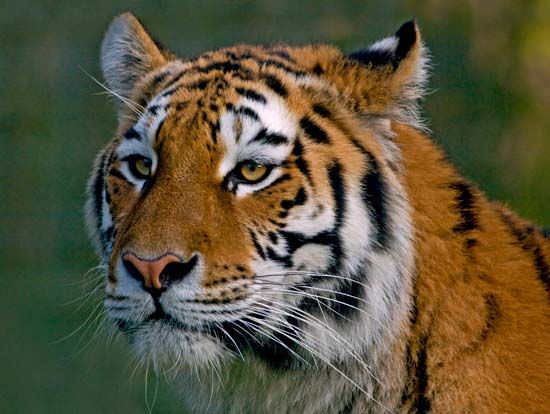
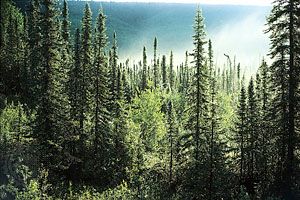
- Siberian tiger: Often considered the world’s largest tiger, this endangered subspecies is uniquely adapted to the cold taiga and mixed forests of the Russian Far East.2
- Leopards: These elusive big cats are a primary focus of regional protection projects.11
- Brown bears: These large mammals inhabit the mountainous terrain and are among the species targeted by conservation initiatives.211
- Fish owls: These specialized birds are also protected within the diverse ecosystems of the Primorye territory.11
These species rely on the preservation of their habitat, which faces ongoing pressures from logging, forest fires, and poaching.2
Sources
- Peter the Great Bay — Encyclopædia Britannica
- Primorye — Encyclopædia Britannica
- St. Petersburg: Top Questions — Encyclopædia Britannica
- St. Petersburg - Foundation and early growth — Encyclopædia Britannica
- Trans-Siberian Railroad — Encyclopædia Britannica
- Vladivostok — Encyclopædia Britannica
- Sea of Japan / East Sea - Climate — Encyclopædia Britannica
- Russia - Precipitation — Encyclopædia Britannica
- Humid continental climate — Encyclopædia Britannica
- Pacific Ocean - The monsoon regime — Encyclopædia Britannica
- Siberian tiger — Encyclopædia Britannica
Published on · 3 min read