Leopard
The leopard (Panthera pardus) is a large, robust cat native to parts of Africa and Asia. Closely related to the lion, tiger, and jaguar, the leopard is known…
What is leopard?
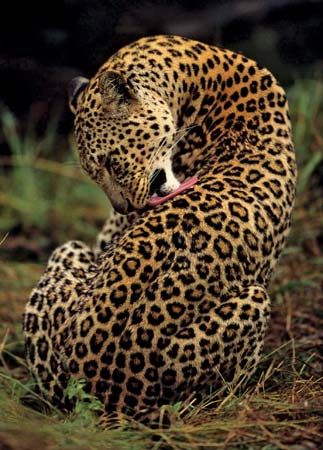
The leopard (Panthera pardus) is a large, robust cat native to parts of Africa and Asia. Closely related to the lion, tiger, and jaguar, the leopard is known for its strength, agility, and distinctive coat, which typically features black spots arranged in rosettes without central spots.123
Leopards are solitary, nocturnal hunters that rely on stealth to ambush prey, often dragging their kills into trees to protect them from scavengers. While they are highly adaptable to various habitats—including forests, mountains, and grasslands—their populations have declined significantly due to habitat loss, leading the International Union for Conservation of Nature to classify the species as vulnerable.13
It is important to note that while animals like the snow leopard and clouded leopard share the name, they belong to distinct biological genera. Additionally, the cheetah is often confused with the leopard, but it is built for speed rather than the leopard’s ambush-style hunting.143
What are the main differences between a leopard and a jaguar?
While leopards and jaguars are both powerful members of the genus Panthera, they can be distinguished by their physical characteristics, geographic ranges, and behaviors.
Physical Differences
- Coat Patterns: Both cats have rosettes, but the jaguar features a black spot in the center of its rosettes, whereas the leopard lacks this central spot.56
- Build: Jaguars are generally larger, more robust, and more heavily built than leopards. A male jaguar can weigh between 100 and 160 kg, while an average leopard weighs between 50 and 90 kg.56
- Melanism: Both species can exhibit melanism (the “black panther” form). In leopards, this is caused by recessive alleles, while in jaguars, it is caused by a dominant allele.1
Geography and Habitat
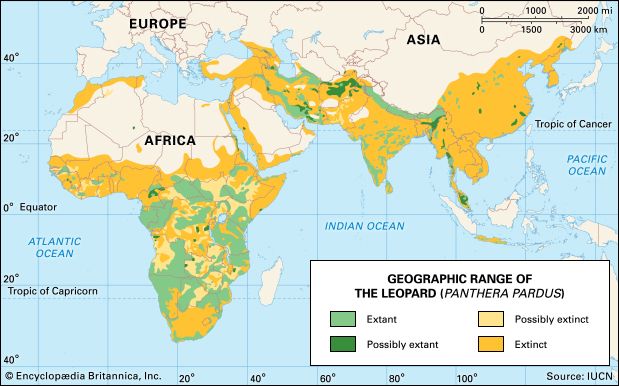
- Range: The jaguar is the only “big cat” native to the Western Hemisphere, found from Mexico to Argentina. Leopards are native to Africa and Asia.56
- Environment: Jaguars have a strong affinity for water and are often found in swamps and rainforests. While leopards are also highly adaptable and inhabit forests and mountains, they are famously known for dragging their kills into trees to protect them from scavengers.563
Why do leopards store their prey in trees?
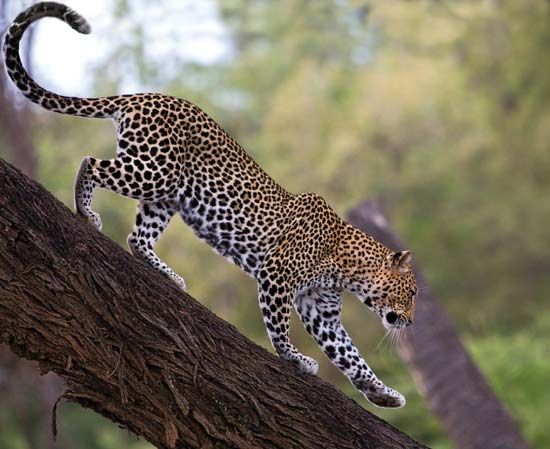
Leopards are highly agile climbers that frequently drag their kills into trees to protect their food from scavengers. By hoisting their prey off the ground, leopards can secure their meal and feed on it over a longer period, which is particularly important given the “feast-or-famine” nature of their diet. This behavior helps them avoid losing their hard-earned kills to other predators, such as lions or hyenas, which might otherwise forcefully steal the food.783
What is a black panther and how is it related to leopards?
A “black panther” is not a distinct species; rather, it is an informal, vernacular term used to describe large felines in the genus Panthera that exhibit melanism, a condition resulting in increased dark pigmentation in their fur and skin.106
The term is most frequently applied to melanistic leopards (Panthera pardus) and jaguars (P. onca). In leopards, this black coloration is caused by the expression of recessive alleles, whereas in jaguars, it is driven by a dominant allele. While these individuals appear black, their characteristic spotted patterns—often called “ghost rosettes”—can sometimes be seen under specific lighting conditions, such as in full sunlight.10
Although “black panther” is used loosely to describe other dark-colored felines like bobcats or pumas, it carries no formal taxonomic significance. Melanistic leopards are relatively uncommon worldwide, though their frequency varies significantly by region, reaching as high as 55 percent in some wet forests of Southeast Asia.106
Sources
- leopard — Encyclopædia Britannica
- leopard — Merriam-Webster
- What’s the difference between a cheetah and a leopard? — Encyclopædia Britannica
- clouded leopard — Encyclopædia Britannica
- jaguar — Encyclopædia Britannica
- black panther: Top Questions — Encyclopædia Britannica
- lion - Hunting — Encyclopædia Britannica
- Snow leopard — Encyclopædia Britannica
- feline - Natural history — Encyclopædia Britannica
- black panther — Encyclopædia Britannica
- panther — Encyclopædia Britannica
Published on · 3 min read