Phytosaur
Our understanding of phytosaurs has evolved significantly as paleontological methods have shifted from purely descriptive, character-based classification to…
How have scientists’ understanding of phytosaurs changed over time with new fossil discoveries?
Our understanding of phytosaurs has evolved significantly as paleontological methods have shifted from purely descriptive, character-based classification to rigorous phylogenetic analysis.
Historically, researchers focused on identifying new specimens and comparing shared physical traits to categorize these archosaurs. However, modern studies have moved toward cladistics, which classifies organisms based on their most recent common ancestor rather than just superficial similarities. This approach has helped clarify that while phytosaurs resemble crocodiles in appearance and habits—such as their semiaquatic lifestyle and armored backs—they are not ancestral to them.12
Furthermore, advancements in functional anatomy allow scientists to use biomechanical models to better understand how these reptiles lived. By analyzing skull structures, such as the unique placement of nostrils high on the head, researchers have confirmed that phytosaurs were specialized for floating just beneath the water’s surface to ambush prey. These analytical techniques continue to refine our knowledge of their evolutionary relationships and ecological roles during the Triassic Period.13
How are phytosaurs related to modern crocodiles and alligators?
Phytosaurs and modern crocodiles are both members of the Archosauria subclass, a group of “ruling reptiles” that also includes dinosaurs and pterosaurs/dinosaur) and pterosaurs.16
Within the archosaur lineage, phytosaurs and crocodilians belong to the same major branch known as the Pseudosuchia (or clade Crurotarsi). This branch consists of all archosaurs that are more closely related to crocodiles than to birds. Because they share this common ancestry, phytosaurs and crocodiles exhibit similar physical traits and habits, such as a semiaquatic lifestyle, armored backs, and long, tooth-filled jaws.761
Despite these similarities, it is important to clarify that phytosaurs are not ancestral to modern crocodiles. They represent a distinct, extinct lineage that flourished during the Triassic Period. While they share a common evolutionary history as pseudosuchians, modern crocodiles belong to the Crocodylomorpha lineage, which is the only group within the Pseudosuchia to survive to the present day.176
What are the key characteristics that define phytosaurs?
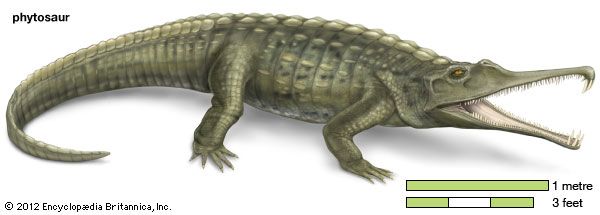
Phytosaurs were heavily armored, semiaquatic archosaurs that lived during the Late Triassic Period. While they resembled modern crocodiles in appearance and likely in habits, they were not ancestral to them.
Key characteristics include:
- Skull and Nostrils: A defining feature is the placement of the nostrils on a crest high on the skull, positioned in front of the eyes. This adaptation allowed them to float just beneath the water’s surface with only their nostrils exposed.
- Jaws and Diet: They possessed long, pointed jaws armed with numerous sharp teeth, suggesting they were primarily piscivorous (fish-eating) predators.
- Armor: Like crocodiles, they featured several rows of bony armor embedded in the skin along their backs.
- Classification: As members of the clade Crurotarsi, they possessed a unique “peg-in-socket” ankle joint that allowed for both a sprawling stance and a “high walk.”
- Naming: They were historically misidentified as herbivorous due to petrified mud filling their tooth grooves, which gave the teeth a flattened, grinding appearance.
What were the main differences between phytosaurs and true crocodiles?
While phytosaurs and true crocodiles share a common ancestry as archosaurs and exhibit similar semiaquatic lifestyles, they are distinct lineages with significant anatomical differences.
Key Differences
- Nostril Placement: The most striking difference is the position of the nostrils. In phytosaurs, the nostrils were located high on the skull, directly in front of the eyes. In contrast, crocodiles have their nostrils at the very tip of the muzzle.67
- Palate Structure: A defining characteristic of the crocodilian order is the development of a secondary bony palate, which encloses the nasal passage and allows the animal to breathe even when its mouth is open underwater. Phytosaurs lacked this specialized internal structure.107
- Evolutionary Lineage: Phytosaurs were an early, extinct lineage of the clade Crurotarsi that flourished during the Triassic Period. Modern crocodiles belong to the Crocodylomorpha lineage, which is the only crurotarsan group to survive to the present day.16
While both groups possess armored backs and long, tooth-filled jaws, these features are examples of convergent evolution rather than direct ancestry.6
Sources
- phytosaur — Encyclopædia Britannica
- Triassic Period - Paleoclimate — Encyclopædia Britannica
- phytosaur — Merriam-Webster
- phylogeny - Phenetics versus cladistics — Encyclopædia Britannica
- dinosaur - Modern studies — Encyclopædia Britannica
- crocodile - Paleontology — Encyclopædia Britannica
- crurotarsan — Encyclopædia Britannica
- archosaur — Encyclopædia Britannica
- dinosaur - Classification — Encyclopædia Britannica
- reptile - Skull and dentition — Encyclopædia Britannica
- crocodile - Form and function — Encyclopædia Britannica
Published on · 3 min read