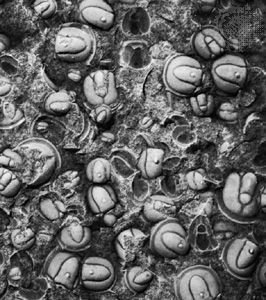
Rhynchotreta
Rhynchotreta is an extinct genus of brachiopods, commonly referred to as lamp shells. These organisms are characterized by a small, roughly triangular shell…
What is Rhynchotreta?
Rhynchotreta is an extinct genus of brachiopods, commonly referred to as lamp shells. These organisms are characterized by a small, roughly triangular shell that features distinct ridges running lengthwise to the shell margin.1
Because Rhynchotreta existed during a limited time range, specifically within the Silurian Period (approximately 444 million to 416 million years ago), it serves as a valuable index, or guide, fossil for identifying and dating Silurian marine rocks.1
What are index fossils and why are they useful to geologists?
An index fossil is any plant or animal preserved in the Earth’s rock record that serves as a marker for a specific span of geologic time or a particular environment.7
To be considered a useful index fossil, an organism must meet several criteria:
- Distinctive: It must be easily recognizable.7
- Abundant: It should be found in large numbers.7
- Wide distribution: It must have a broad geographic range.7
- Short temporal range: It must have evolved rapidly and existed for a relatively brief period.7
These fossils are essential to geologists because they provide the foundation for defining boundaries within the geologic time scale and allow for the correlation of rock strata across different regions. By identifying these specific organisms, scientists can determine the relative age of sedimentary layers. For example, while many trilobites are useful for regional correlation, pelagic species like Agnostida are prized for intercontinental correlation due to their wide distribution and rapid evolution.78
How do brachiopods differ from modern mollusks like clams?
Although brachiopods (often called lamp shells) superficially resemble mollusks like clams, they are not related and belong to a distinct phylum. Their differences are rooted in their fundamental anatomy and body organization.9
Structural Differences
- Symmetry: In bivalve mollusks, the two valves (shells) are typically left and right mirror images of each other. In contrast, the two valves of a brachiopod are usually dorsal (top) and ventral (bottom), and while the two valves may differ in size and shape, each individual valve is typically symmetrical along its own midline.1011
- Feeding Mechanism: Brachiopods possess a specialized organ called a lophophore—a complex, ciliated loop used for filter feeding—which occupies the mantle cavity. While bivalves also filter feed, they utilize gills (ctenidia) and labial palps to sieve food particles from water.1112
- Internal Anatomy: Brachiopods have an open circulatory system with a small heart situated over the gut. Their body is divided into a posterior visceral cavity and an anterior mantle cavity. Bivalves have more complex muscular systems, including specialized adductor muscles for closing their shells, and often feature siphons for water intake and waste expulsion, which are not present in brachiopods.9111012
What other types of marine life existed during the Silurian Period?
During the Silurian Period (443.4 to 419.2 million years ago), rising sea levels and the melting of glaciers created extensive shallow seas that supported a diverse array of marine life. The seafloor was characterized by mound-type coral reefs, or bioherms, which served as habitats for a variety of bottom-dwelling invertebrates.1415
Common marine life during this period included:
- Invertebrates: The seafloor was populated by brachiopods, gastropods, crinoids, and trilobites. Tabulate corals, such as Favosites and Halysites, and lamellar stromatoporoids (armoured sponges) were also significant, often forming flat-layered biostromes.1415
- Fishes: The Silurian saw a widespread distribution of fishes within tropical and subtropical latitudes. This included a wide variety of agnatha (jawless fishes) and the emergence of fishes with primitive jaws, such as members of the subclasses Acanthodii, Elasmobranchii, and Actinopterygii.1416
- Pelagic Predators: As suspension-feeders evolved rapidly, pelagic predators like nautiloids became increasingly abundant in the open ocean.17
Sources
- Rhynchotreta — Encyclopædia Britannica
- Rhynchonellidae — Merriam-Webster
- tuatara — Encyclopædia Britannica
- Rhynchotrema — Encyclopædia Britannica
- scorpion - Distinguishing taxonomic features — Encyclopædia Britannica
- Rhynchota — Merriam-Webster
- index fossil — Encyclopædia Britannica
- Cambrian Period - Correlation of Cambrian strata — Encyclopædia Britannica
- bivalve - Size range and diversity of structure — Encyclopædia Britannica
- Circulatory system - Brachiopoda — Encyclopædia Britannica
- lamp shells - Form and function — Encyclopædia Britannica
- bivalve - Internal features — Encyclopædia Britannica
- skeleton - Calcareous structures — Encyclopædia Britannica
- A Journey Through Time Since the Precambrian - Silurian Period: 443.4 million to 419.2 million years ago — Encyclopædia Britannica
- Silurian Period - Silurian life — Encyclopædia Britannica
- Devonian Period - Invertebrates — Encyclopædia Britannica
- Cambrian explosion — Encyclopædia Britannica
- Silurian Period - Reef mounds and coral biostromes — Encyclopædia Britannica
- Silurian Period - Brachiopods — Encyclopædia Britannica
- Silurian Period - Fishes — Encyclopædia Britannica
Published on · 3 min read