Right Whale
Right whales (family Balaenidae) are distinguished from other whales by several unique physical traits, most notably their massive heads, which account for…
What are the key physical characteristics that distinguish right whales from other whale species?
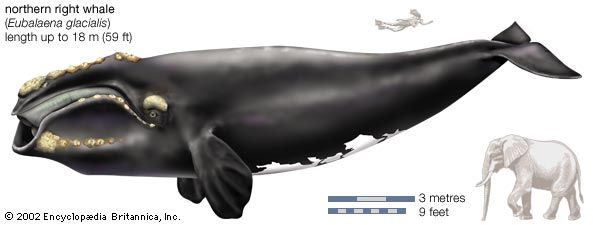
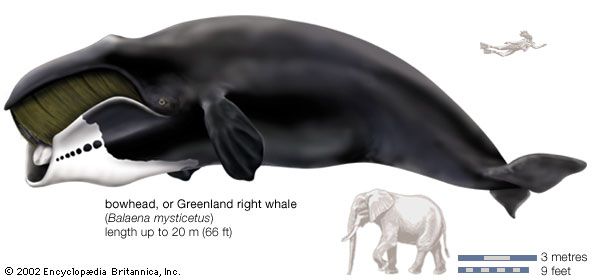
Right whales (family Balaenidae) are distinguished from other whales by several unique physical traits, most notably their massive heads, which account for one-quarter to one-third of their total body length. Unlike many other species, right whales lack a dorsal fin.12
Key physical characteristics include:
- Head and Jaw: They possess an arched upper jaw, a structural adaptation to accommodate their exceptionally long, narrow baleen plates. Northern right whales are further identified by a “bonnet,” a horny, parasite-infested growth on the snout.1
- Blowhole: They feature a distinct V-shaped blowhole.2
- Body and Flippers: These cetaceans have stout bodies, smooth throats, and short, broad, rounded flippers.12
- Baleen: Their baleen is long and narrow with fine bristles, specialized for filtering tiny copepods and pteropods.1
While the bowhead and Eubalaena species share these general forms, they differ in the degree of head arching and baleen length.1
How did right whales get their name, and what is their conservation status?
Right whales earned their name during the 17th to 19th centuries because they were considered the “right” whales to hunt. They were highly valued by whalers for their abundant oil and strong, elastic baleen, and because they were relatively easy to catch, their populations were nearly decimated by uncontrolled commercial hunting.1
Regarding their current conservation status, right whales have been protected by international agreement since 1946. Despite this, the International Union for Conservation of Nature and Natural Resources (IUCN) classifies two of the four species as endangered:1
- North Pacific right whale: Classified as endangered.1
- North Atlantic right whale: Classified as a critically endangered species, with a population numbering only in the hundreds.1
While populations of bowheads and southern right whales remain in the thousands, the northern species face ongoing threats, including entanglement in fishing gear and reduced reproductive success.1
How do right whales feed, and what is their main food source?
Right whales are specialized filter feeders that employ a method known as skim feeding to obtain their nutrition. To feed, they locate dense concentrations of prey and swim through them with their mouths held open, allowing water to flow through their oral cavity for several minutes at a time. Once the whale has gathered a sufficient amount of prey, it closes its mouth and uses its tongue to force the water out through the sides of its mouth, trapping the food against the fine, bristly edges of its long, narrow baleen plates.561
Their diet is highly restricted, consisting primarily of:
- Copepods: Tiny, free-swimming shrimplike crustaceans.6
- Pteropods: Small, snail-like mollusks.6
To accommodate this specialized diet, right whales have evolved unique structural adaptations, including an arched upper jaw that provides the necessary space for their exceptionally long baleen plates.6
What is a right whale?
A right whale is any of four stout-bodied species of baleen whales belonging to the family Balaenidae. These whales are characterized by an enormous head—measuring one-quarter to one-third of their total body length—a smooth throat, and the absence of a dorsal fin.21
The group includes the bowhead whale, which inhabits Arctic seas, and three species within the genus Eubalaena that live in temperate waters: the North Atlantic right whale, the North Pacific right whale, and the southern right whale. They are physically distinguished by their long, narrow baleen plates, which are used to filter copepods and pteropods from the water.1
The name “right whale” originated between the 17th and 19th centuries, as these animals were considered the “right” ones to hunt due to their high oil content, valuable baleen, and relative ease of capture. This intensive commercial exploitation nearly led to their extinction.1
Sources
- right whale — Encyclopædia Britannica
- right whale — Merriam-Webster
- whaling - Regulation — Encyclopædia Britannica
- whaling - Early commercial whaling — Encyclopædia Britannica
- What do whales eat? — Encyclopædia Britannica
- cetacean - Feeding — Encyclopædia Britannica
- baleen whale — Encyclopædia Britannica
Published on · 3 min read