Roadian Stage
The Roadian Stage is the first of three stages within the Middle Permian (Guadalupian) Series, representing all rock strata deposited during the Roadian Age…
What is Roadian Stage?
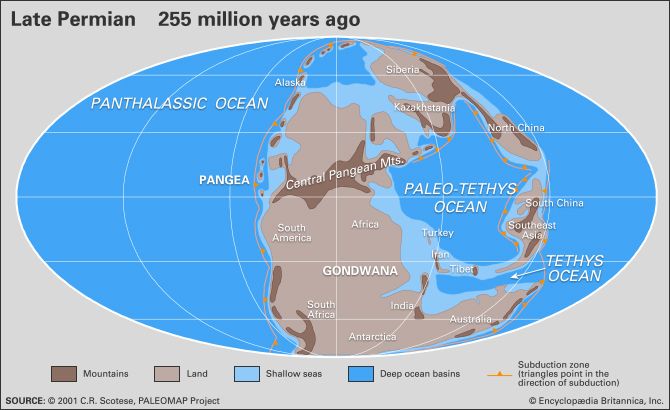
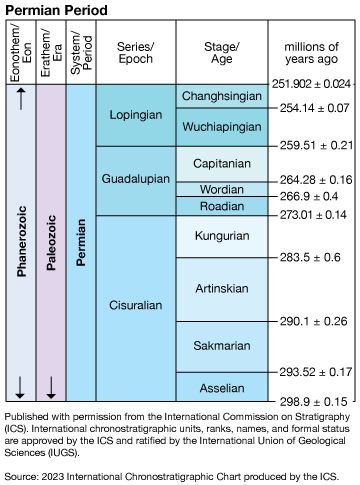
The Roadian Stage is the first of three stages within the Middle Permian (Guadalupian) Series, representing all rock strata deposited during the Roadian Age, which occurred approximately 272.3 million to 268.8 million years ago during the Permian Period.1
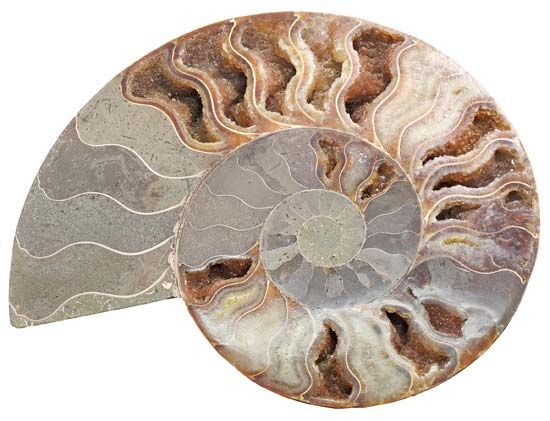
In 2001, the International Commission on Stratigraphy defined the base of this stage using a Global Stratotype Section and Point (GSSP) located in the Guadalupe Mountains of Texas. This boundary is marked by the first appearance of the conodont Jinogondolella nankingensis in the fossil record. Other characteristic fossils of the stage include ammonoids from the genera Demarezites and Waagenoceras.1
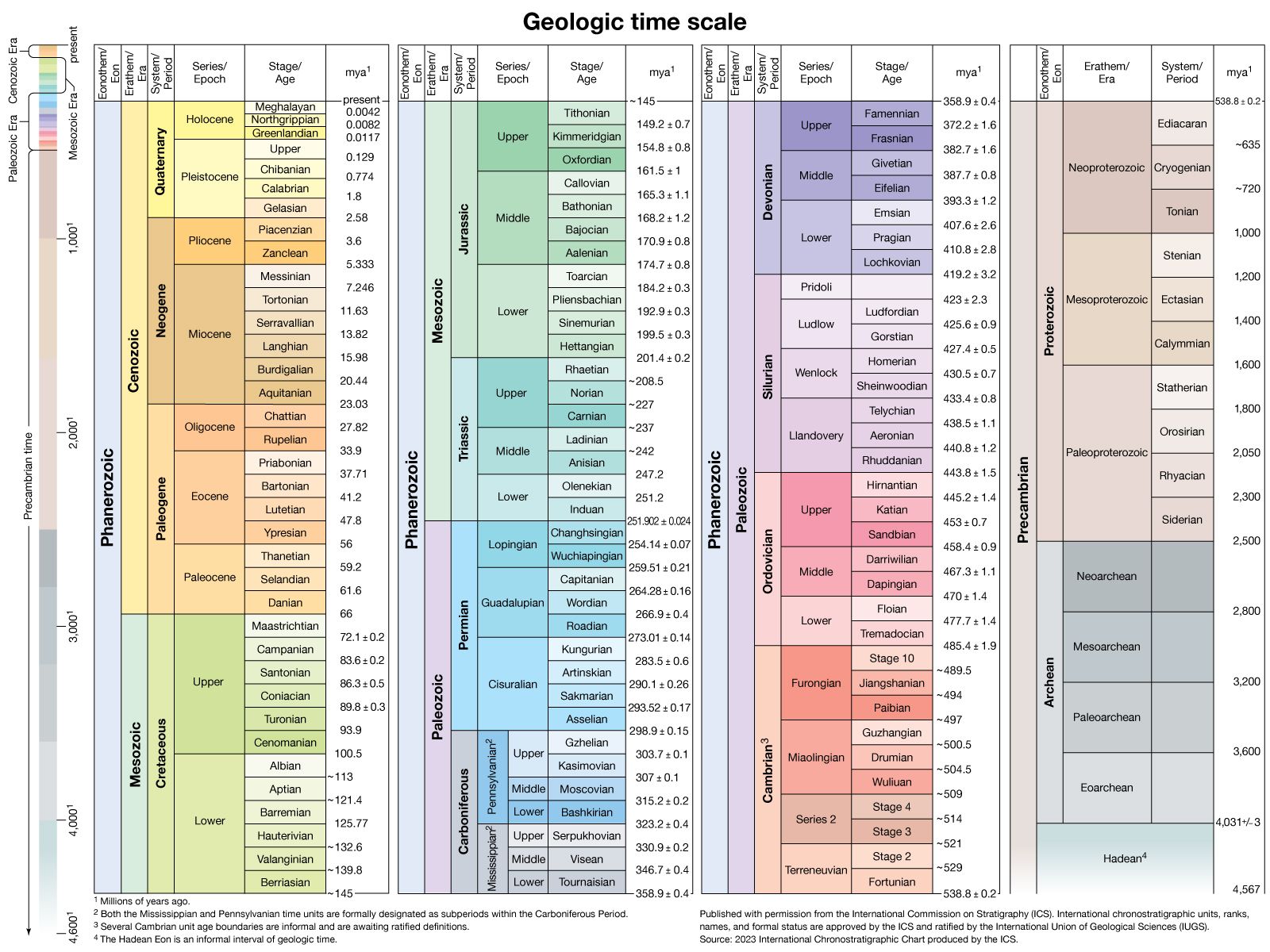
Geologically, the Roadian Stage sits above the Kungurian Stage and below the Wordian Stage. The study of such stages is a core component of stratigraphy, which helps scientists organize Earth’s history into a standardized time scale.12
What are conodonts and why are they important for dating rocks?
Conodonts are minute, toothlike microfossils composed of calcium phosphate (apatite) that represent the remains of small, extinct marine animals. Ranging from 0.2 mm to 6 mm in length, these fossils are found in sedimentary rock layers dating from the Cambrian Period to the end of the Triassic Period.4
They are exceptionally important for dating and correlating rock strata for several reasons:
- Rapid Evolution: Conodonts evolved quickly, meaning specific shapes and assemblages changed significantly over relatively short intervals of geologic time. This allows geologists to characterize successive layers of rock with distinct faunas.4
- Widespread Distribution: Because these animals were widespread in ancient oceans, identical or similar species are found globally, enabling the correlation of rock sequences across different continents.4
- Zonal Schemes: Scientists have established standardized “zones” based on specific conodont assemblages, providing a reliable reference for dating rocks in regions like North America, Europe, and Morocco.45
How do scientists define the different stages of the Permian Period?
Scientists define the stages of the Permian Period by establishing a standardized geologic time scale that correlates rock sequences globally. This process is managed by the International Commission on Stratigraphy (ICS), which designates specific rock layers as reference points to ensure consistent nomenclature and dating.67
Defining Stages with GSSPs
The primary method for defining a stage is the selection of a Global Stratotype Section and Point (GSSP). A GSSP is a specific, physically accessible location—often a continuous sequence of sedimentary rock—where the boundary between two stages is clearly defined. The base of a stage is typically marked by the first appearance of a specific fossil species in the rock record.64
The Role of Conodonts
Because many marine invertebrate faunas are localized, scientists rely heavily on conodonts to define these boundaries. Conodonts are minute, toothlike microfossils that evolved rapidly and were widely distributed in ancient oceans. Their presence allows geologists to correlate rock strata across different continents.68
For example:
- The base of the Roadian Stage is defined by the first appearance of Jinogondolella nankingensis.6
- The base of the Wuchiapingian Stage is marked by the emergence of Clarkina postbitteri.6
- The base of the Changhsingian Stage is identified by the first appearance of Clarkina wangi.64
While these conodont-based zones are highly effective in paleoequatorial regions, scientists use alternative zonations for colder waters or nonmarine successions where these specific fossils may be rare or absent.6
What major environmental changes occurred during the Guadalupian Epoch?
During the Guadalupian Epoch (approximately 272.3 million to 259.8 million years ago), the Earth experienced significant environmental shifts characterized primarily by dramatic fluctuations in sea level.1011
Key environmental changes included:
- Global Sea-Level Fluctuations: The epoch began with a major lowstand, where sea levels fell below the continental shelf. This was followed by four additional long lowstands within and at the top of the epoch.10
- Habitat Loss and Unconformities: The extended withdrawal of seas from continental shelves and platforms created significant gaps in the geologic record, known as unconformities.10
- Ecological Crisis: These disruptive environmental changes triggered extensive evolutionary turnovers and severe extinction events. Shallow warm-water marine invertebrates were particularly affected, with generic diversity declining by 12 to 70 percent by the beginning of the Capitanian Age.101211
These events set the stage for the even more catastrophic extinctions that occurred at the boundary between the Guadalupian and the subsequent Lopingian Epoch.1211
Sources
- Roadian Stage — Encyclopædia Britannica
- Permian Period - Correlation of Permian strata — Encyclopædia Britannica
- stratigraphy — Encyclopædia Britannica
- conodont — Encyclopædia Britannica
- Gzhelian Stage — Encyclopædia Britannica
- Permian Period - Early work — Encyclopædia Britannica
- Permian Period - Major subdivisions — Encyclopædia Britannica
- Changhsingian Stage — Encyclopædia Britannica
- Pleistocene Epoch - Pliocene–Pleistocene boundary — Encyclopædia Britannica
- Permian Period - Sea level — Encyclopædia Britannica
- Permian Period - Marine invertebrates — Encyclopædia Britannica
- Permian extinction - Marine invertebrates — Encyclopædia Britannica
Published on · 3 min read