Sable Antelope
The primary predators of the sable antelope include lions, spotted hyenas, wild dogs, and leopards. While adult sable antelopes are generally too large and…
What are the main predators of sable antelopes, and how do they defend themselves?
The primary predators of the sable antelope include lions, spotted hyenas, wild dogs, and leopards. While adult sable antelopes are generally too large and formidable for leopards to hunt, calves and yearlings are particularly vulnerable to predation.1
To defend themselves, sable antelopes rely on their physical attributes and social behavior. As members of the family Bovidae, they possess horns—simple, unbranched structures consisting of a bone core covered in keratin—which serve as essential weapons of defense against predators. Furthermore, their gregarious nature and social organization provide a collective advantage in detecting and responding to threats within their savanna and woodland habitats.123
What is the diet of sable antelopes and how does it change with seasons?
The sable antelope is both a grazer and a browser, meaning its diet consists of a variety of plant materials depending on the time of year. Its feeding habits are closely tied to the seasonal availability of vegetation within its savanna and woodland habitats.1
- Rainy Season (September to April): During this period, the sable antelope forages on grasses, forbs, and the foliage of trees and shrubs found within woodlands.1
- Dry Season: As the environment dries, the antelope shifts its focus to grasslands. It specifically seeks out flushes of green herbage that emerge following annual fires, which clear the landscape.1
In addition to these seasonal shifts, the sable antelope is water-dependent and must visit pools and pans daily during the dry season. It also frequently visits mineral licks to supplement its diet with salt and trace elements, which are often in short supply in the leached granitic soils of the African inland plateau.1
Where is the natural habitat of sable antelopes, and what is their preferred environment?
The sable antelope (Hippotragus niger) is native to the southern savanna regions of Africa, with a geographic range extending from central Tanzania down to South Africa.1
Regarding their preferred environment, sable antelopes are considered an “edge” species. They are closely associated with broad-leaved deciduous woodlands, specifically those known as miombo, and they favor the ecotone—the transitional zone—between wooded savanna and open grassland. While they are grazers, their habitat preference distinguishes them from other related species; for instance, they are often found at the edges of open areas or within savanna woodland, and their herds typically follow a cyclic annual route across large home ranges.14
How do male and female sable antelopes differ in appearance and behavior?
The sable antelope is one of the most sexually dimorphic species within the bovid family, exhibiting clear differences in both appearance and behavior between males and females.1
Appearance
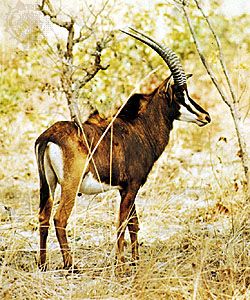
- Coloration: Adult bulls possess a striking, glossy black coat contrasted by white underparts, a white rump, and distinct white facial markings. In contrast, females and young are typically chestnut to sorrel in color, though females of the H. niger niger subspecies south of the Zambezi River also develop a very dark coat.1
- Size and Horns: While both sexes are large, bulls are slightly heavier, weighing approximately 235 kg (517 pounds) compared to the 220 kg (480 pounds) of females. Bulls are also distinguished by their impressive, large scimitar-shaped horns.1
Behavior
- Social Structure: Sable antelopes are highly sociable. Females and their young live in herds that can number up to 70 animals, or even hundreds in some regions, within large home ranges. These herds follow a dominance hierarchy based partly on seniority.1
- Territoriality: The species is territorial. Territorial males actively defend their property and will drive out subadult males in their fourth year—or sooner—due to the young males’ developing horns and darkening coats. Once expelled, these young males either join bachelor herds or live as “lodgers” on the property of established territorial males until they reach maturity at age five and can compete for their own territory.1
Sources
- sable antelope — Encyclopædia Britannica
- horn — Encyclopædia Britannica
- antelope — Encyclopædia Britannica
- artiodactyl - Food habits — Encyclopædia Britannica
- sable antelope — Merriam-Webster
- Chemoreception - Territorial behavior — Encyclopædia Britannica
Published on · 3 min read