Sacred Lotus
The sacred lotus (Nelumbo nucifera) is an edible aquatic plant native to tropical and subtropical Asia. It is a member of the Nelumbonaceae family and is…
What is the sacred lotus?
The sacred lotus (Nelumbo nucifera) is an edible aquatic plant native to tropical and subtropical Asia. It is a member of the Nelumbonaceae family and is distinguished by its large, fragrant flowers and round leaves that stand high above the water surface on strong stalks.12
Beyond its botanical characteristics, the sacred lotus holds profound cultural and religious significance. It is considered sacred in Hinduism and Buddhism, where its ability to flourish above muddy waters symbolizes the path to spiritual enlightenment. In ancient Egypt, it was used to represent rebirth. Its symbolic importance is also reflected in the Lotus Sutra, a foundational Mahayana Buddhist text.13
The entire plant is edible; its rhizomes are a common food source in many Asian countries, and its seeds are noted for their remarkable longevity, with some remaining viable for centuries.12

Where does the sacred lotus naturally grow?
The sacred lotus (Nelumbo nucifera) is naturally found throughout tropical and subtropical Asia.21
While it is often associated with various regions due to its widespread cultivation, it is distinct from the American lotus (N. lutea), which is native to the eastern United States and extends southward to Colombia. The sacred lotus thrives in aquatic environments, where its seeds can remain viable for centuries in river mud or peat bogs, eventually sinking to the bottom to establish new plants.21
What do the leaves and flowers of the sacred lotus look like?
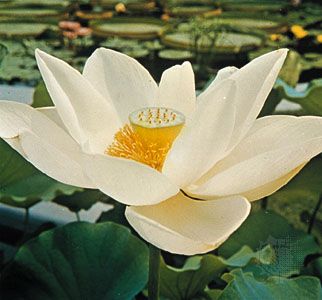
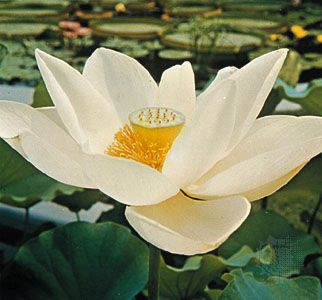
The sacred lotus (Nelumbo nucifera) is characterized by its distinct, elevated foliage and blossoms that rise well above the water surface rather than floating on it.21
Leaves
The leaves are circular, slightly hairy, and can grow up to 60 cm (2 feet) in diameter. They are typically funnel- or cup-shaped and are held on stalks that extend as much as 2 meters (6.5 feet) above the water.21
Flowers
The flowers are large, fragrant, and visually striking, reaching up to 25 cm (10 inches) in diameter. They are supported by strong, leafless stalks that stand as much as 1.8 meters (6 feet) above the water. While the classic variety features pink or rose-coloured petals, cultivated forms exist in a range of colours from white to red. A notable behavioral characteristic of these flowers is that they close at night.21
How is the sacred lotus important in different cultures or religions?
The sacred lotus (Nelumbo nucifera) holds profound symbolic significance across several major traditions, primarily representing spiritual growth and renewal.1
- Hinduism and Buddhism: In both religions, the plant is considered sacred. Because the flower flourishes above the muddy waters from which its roots grow, it serves as a powerful symbol for the rise to and spread of spiritual enlightenment.1
- Ancient Egypt: The lotus was used to represent the concept of rebirth. While the Nelumbo nucifera is the sacred lotus of the East, ancient Egyptian art frequently featured the blue lotus (Nymphaea caerulea) and white water lily (Nymphaea lotus), which were also held sacred and symbolized fertility, purity, and the rising sun.145
- Architectural and Cultural Legacy: Beyond its religious roles, the lotus has been a persistent ornamental motif in architecture since ancient times, influencing the design of column capitals and serving as the basis for the Assyrian sacred tree.4
Sources
- Sacred lotus — Encyclopædia Britannica
- Nelumbonaceae — Encyclopædia Britannica
- Lotus Sutra — Encyclopædia Britannica
- sacred lotus — Merriam-Webster
- lotus — Encyclopædia Britannica
- Egyptian lotus — Merriam-Webster
Published on · 3 min read