Scythebill
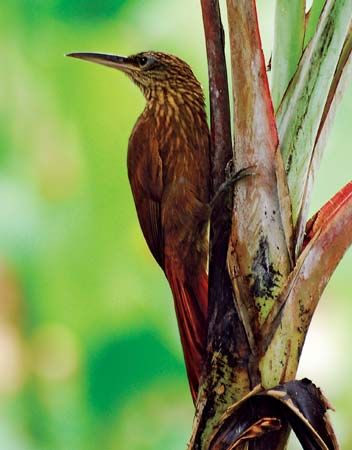
A scythebill is any of five species of birds native to the tropical forests of Central and South America. These birds belong to the genus Campylorhamphus and…
What is Scythebill?
A scythebill is any of five species of birds native to the tropical forests of Central and South America. These birds belong to the genus Campylorhamphus and are classified as woodcreepers within the family Dendrocolaptidae.1
They are characterized by their distinctively long, downcurved bills, which can measure up to one-third of the bird’s total body length of approximately 23 cm (9 inches).1
What are woodcreepers?
Woodcreepers are a group of approximately 50 species of tropical American birds belonging to the subfamily Dendrocolaptinae, often classified within the family Furnariidae or the family Dendrocolaptidae.2
These birds are primarily solitary forest dwellers known for their unique climbing behavior. They use their stiff, broad tail feathers as a prop to navigate tree trunks, where they probe bark and leaves for insects. While most species are arboreal, some also forage on the ground or follow marching ant columns to capture insects routed out by the ants.2
Physically, woodcreepers typically measure between 20 and 38 cm (8 to 15 inches) in length. They generally feature brownish plumage with pale streaks or bars, while their wings and tails often display a reddish-brown hue. Their bills vary by species, ranging from stout and moderately long to wedge-shaped or downcurved, as seen in the scythebill.2
How do birds use their bills to find food?
Birds have evolved a remarkable diversity of bill shapes, which serve as specialized tools for acquiring food. While bill shape can be an aid in identifying a bird’s relationships, it is primarily an evolutionary response to specific feeding habits and environmental pressures.3
Passerine bills are generally categorized into eight functional types based on how they are used to secure food:
- Insectivorous: Ranging from straight and pointed for gleaning to hooked for catching prey or wide-gaped for aerial feeding.3
- Omnivorous: Strongly built and unspecialized, suitable for a varied diet.3
- Toothed: Hooked with a notch on the cutting edge, designed for tearing soft prey.3
- Tearing: Light with a strong hook, used to open flowers to reach nectar or insects.3
- Probing: Narrow and often downcurved, used to reach into flowers or deep into tree bark.3
- Frugivorous: Wide or heavy, adapted for swallowing whole fruits or tearing apart tougher ones.3
- Serrated: Conical with fine edges for feeding on plant matter like buds and shoots.3
- Conical: Stout and blunt for cracking hard seeds or small and pointed for extraction.3
Beyond these categories, some birds use highly specialized methods, such as woodpeckers using chisel-like bills and long, sticky tongues to extract insects from wood. Most birds are opportunistic, meaning they may use their bills to exploit various food sources beyond their primary specialization.23
What other birds live in tropical forests?
Tropical forests are home to an extraordinary diversity of bird life, particularly in the Neotropical region, which hosts thousands of species across numerous families.5
Many birds in these environments have evolved specialized roles and behaviors:
- Toucans and Barbets: Members of the family Ramphastidae, toucans are iconic forest birds known for their large, lightweight bills used for feeding and species recognition. They play a vital role in forest health by dispersing seeds.6
- Parrots: Found in tropical forests worldwide, these intelligent birds include groups like macaws and Amazon parrots. They are often important seed dispersers and fruit eaters.7
- Antbirds and Ovenbirds: The family Formicariidae (antbirds) and the diverse Furnariidae (ovenbirds) are prominent in Neotropical forests, filling various ecological niches similar to wrens, thrushes, or creepers.8
- Manakins and Cotingas: These groups are well-known in tropical understories and canopies, contributing significantly to forest diversity through their feeding habits.65
- Broadbills: Primarily found in the forests of Indo-Malaysia and Africa, these chunky, often brightly colored birds are known for their wide gapes.8
Sources
- Scythebill — Encyclopædia Britannica
- Woodcreeper — Encyclopædia Britannica
- Passeriform - Bill — Encyclopædia Britannica
- Piciform - Annotated classification — Encyclopædia Britannica
- Toucan — Encyclopædia Britannica
- Passeriform - Annotated classification — Encyclopædia Britannica
- South America - Fish and bird life — Encyclopædia Britannica
- parrot — Encyclopædia Britannica
- Bird: Top Questions — Encyclopædia Britannica
- Pelecaniform - Physiological adaptations — Encyclopædia Britannica
Published on · 3 min read