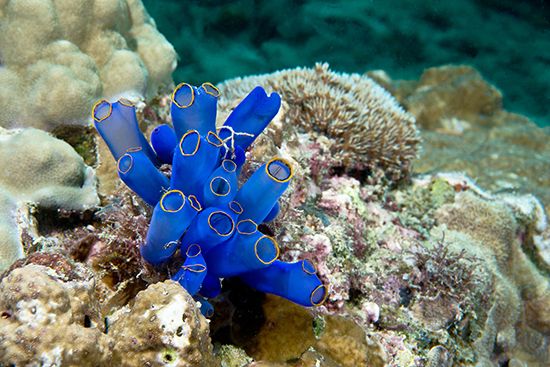
Sea Squirt
Sea squirts, or tunicates, undergo a dramatic transformation during their life cycle. The process begins with a brief, free-swimming tadpole larval stage…
How do sea squirts change during their life cycle, particularly from larval to adult stages?
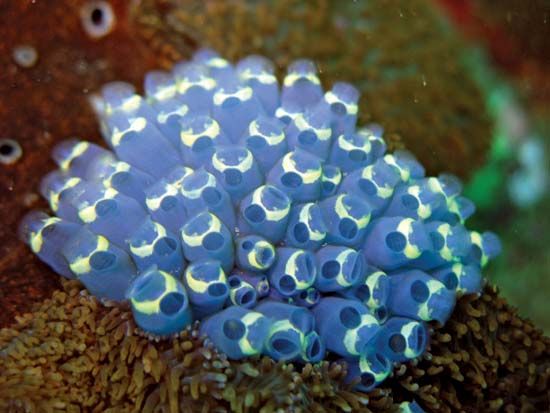
Sea squirts, or tunicates, undergo a dramatic transformation during their life cycle. The process begins with a brief, free-swimming tadpole larval stage, which does not feed but is equipped with a muscular tail, a notochord, and a nerve cord—features characteristic of chordates.123
Using sensory vesicles to orient itself, the larva searches for a suitable substrate. Once it finds a location, it attaches via anterior adhesive papillae. Upon attachment, the organism undergoes rapid metamorphosis: the tail, notochord, and nerve cord are resorbed, providing essential nutrients for the developing adult.231
The body proportions shift significantly as the animal matures into a sessile, potato-shaped adult. The mouth rotates to face away from the point of attachment, and the internal anatomy reorganizes to facilitate filter feeding, where water is drawn through the body to extract oxygen and nutrients. While most adults remain fixed to surfaces, some species exhibit limited movement.13
How do sea squirts reproduce and what is unique about their reproductive process?
Sea squirts, or tunicates, utilize both sexual and asexual reproduction. As simultaneous hermaphrodites, they possess both male and female reproductive organs, yet they generally avoid self-fertilization in favor of cross-fertilization with other individuals.234
A unique aspect of their reproductive process is the method of fertilization. Unlike many other hermaphroditic animals that engage in mutual copulation to exchange sperm, sea squirts typically shed both sperm and “naked” eggs directly into the surrounding water. Because they release gametes into the environment, they have evolved mechanisms to minimize self-fertilization, even though the proximity of their own eggs and sperm makes it difficult to avoid. In some species, embryos may be retained within the parent’s atrium until the larval stage is reached.42
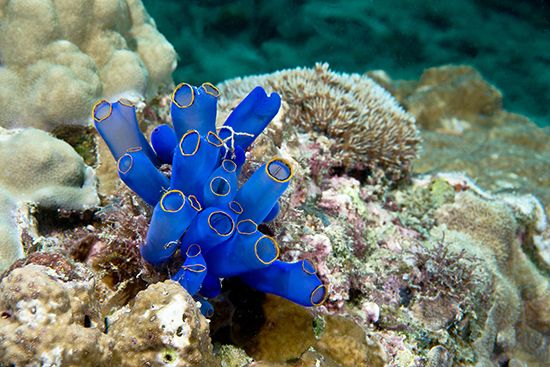
Asexual reproduction occurs through budding, which allows for the formation of colonies. In this process, lobes or outgrowths containing clusters of zooids break off from the adult and settle elsewhere to develop into new individuals. In “compound” colonial ascidians, these zooids remain embedded within a common tunic.23
How have sea squirts been used by humans throughout history?
Throughout history, sea squirts have primarily served as subjects of scientific interest rather than as a direct human resource. Their most significant contribution to humanity lies in their role as a model for understanding the evolutionary ancestry of vertebrates, given that their larval stage exhibits primitive chordate features like a notochord and a nerve cord.35
While they are rarely consumed by humans, they play a vital role in marine ecosystems as a link in the food chain, indirectly supporting human food sources. In maritime contexts, they are often viewed as fouling organisms that attach to ship hulls, which can be a nuisance for navigation and maintenance.53
In recent decades, sea squirts have gained importance in biomedicine and drug discovery. Scientists have identified unique chemical compounds within these organisms that show promise for medical treatments. For instance, the colonial sea squirt Ecteinascidia turbinata produces trabectedin, a substance utilized in the treatment of soft tissue sarcomas.35
What role do sea squirts play in marine ecosystems?
Sea squirts play a critical role in marine ecosystems primarily as efficient filter feeders. By using pharyngeal cilia to propel water through their bodies, they strain suspended organic material from the surrounding environment.3
Their ecological impact includes:
- Nutrient Cycling: Near shorelines, sea squirts consume debris from dead plants and animals, while in deeper waters, they feed on plankton. This process helps regulate the concentration of organic particles in the water column.3
- Habitat Provision: As sessile organisms that attach to pier pilings, rocks, and large seashells, they create complex surfaces that can support other marine life. Some species even attach to the backs of large crabs, demonstrating their integration into the broader marine community.3
- Biomedical Significance: Beyond their immediate environmental role, sea squirts are recognized for producing unique natural compounds. For instance, the colonial species Ecteinascidia turbinata produces trabectedin, a substance with significant anticancer properties used in treating soft tissue sarcomas.3
Sources
- tunicate - General features — Encyclopædia Britannica
- tunicate - Reproduction and life cycle — Encyclopædia Britannica
- sea squirt — Encyclopædia Britannica
- Sex - Sex patterns — Encyclopædia Britannica
- tunicate - Importance — Encyclopædia Britannica
- sea squirt — Merriam-Webster
- tunicate - Associations — Encyclopædia Britannica
- Filter feeding — Encyclopædia Britannica
Published on · 3 min read