Secondary Succession
Secondary succession is a form of ecological succession where plants and animals recolonize a habitat following a disturbance that significantly alters the…
What is secondary succession?
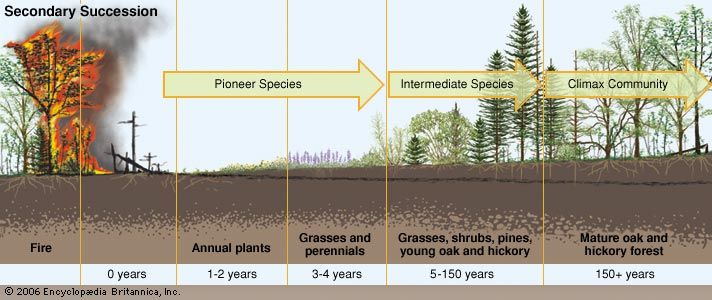
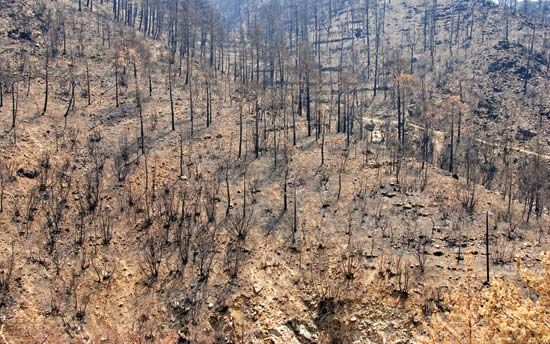
Secondary succession is a form of ecological succession where plants and animals recolonize a habitat following a disturbance that significantly alters the area but does not render it completely lifeless.1
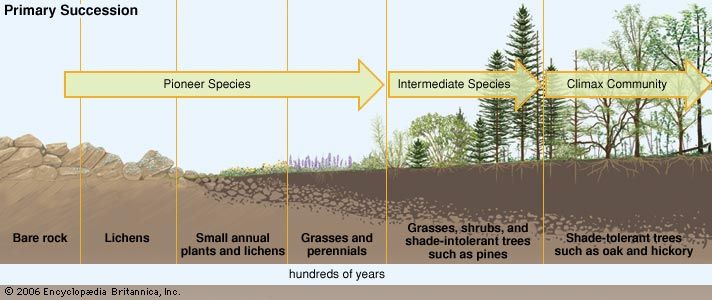
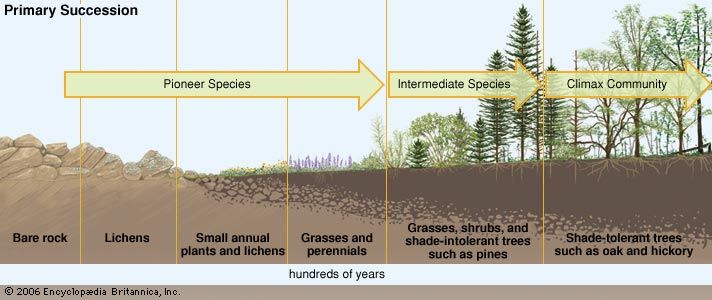
Unlike primary succession, which occurs in environments where no life previously existed, secondary succession takes place in areas where the soil retains nutrients and seeds from the former biological community. Common disturbances triggering this process include wildfires, floods, landslides, or human activities like farming.12
The process typically begins with pioneer species, such as insects and weedy plants, which are eventually replaced by intermediate species. If the area remains undisturbed, the community eventually stabilizes into a climax community.1
How does primary succession differ from secondary succession?
Primary succession and secondary succession are both forms of ecological succession, but they differ fundamentally in their starting conditions and the presence of existing biological resources.21
Key Differences
Feature
Primary Succession
Secondary Succession
Starting State
Begins in a barren, lifeless habitat with no
soil
.
Begins in an area where a
disturbance
has occurred but life remains.
Soil Presence
Soil must be created from scratch by
pioneer species
like
lichens
.
Soil already exists and retains
nutrients
and
seeds
.
Common Triggers
Lava
flows, retreating
glaciers
, or new
sand dunes
.
Wildfires
,
floods
,
landslides
, or human
farming
.
Recovery Speed
Generally slower, as it requires the formation of soil.
Generally faster, as the existing soil provides a foundation for new growth.
While both processes involve a transition from pioneer species to intermediate species and eventually a climax community, secondary succession benefits from the biological “memory” stored in the soil, allowing for a more rapid recovery compared to the initial colonization required in primary succession.21
What are pioneer species and why are they important?
Pioneer species are the first organisms to colonize barren or recently disturbed environments during primary succession and secondary succession. Common examples include lichens, mosses, fungi, and various bacteria.4
Why Pioneer Species Are Important
Pioneer species are essential because they act as the foundation for future life in an ecosystem. Their primary contributions include:
- Soil Formation: By releasing acids that break down rock, these species physically weather the substrate. When they die, their decomposing organic matter mixes with rock fragments to create the first layers of soil.4
- Nutrient Enrichment: Many pioneers improve soil fertility by fixing nitrogen and adding carbon to the environment.4
- Habitat Modification: By establishing a simple biological community, they create conditions—such as moisture retention and soil aeration—that allow more complex plants and animals to eventually colonize the area.4
These species are highly adapted for rapid growth and reproduction, allowing them to thrive in harsh, sterile conditions before being outcompeted by larger, more stable species as the ecosystem matures.4
What is a climax community in an ecosystem?
A climax community represents the final, relatively stable stage of ecological succession in a given area. At this stage, the community reaches a state of equilibrium where the species composition remains consistent because the resident species successfully reproduce and prevent invading species from gaining a foothold.256
This stability is thought to emerge when the web of biotic interactions within the community becomes so intricate that the ecosystem is effectively “closed” to new species. For example, in the eastern United States, forests may progress through various stages of colonizing shrubs and trees before reaching a climax community dominated by longer-lived, shade-tolerant tree species.6732
However, it is important to note that the climax stage is not permanent. Over very long periods, changes in climate, as well as ongoing ecological and evolutionary processes, can alter the environment and shift the community structure. Furthermore, not all ecosystems reach this specific type of equilibrium; some environments are defined by continual small-scale disturbances that maintain a diverse, shifting mix of species.6273
Sources
- secondary succession — Encyclopædia Britannica
- ecological succession: Top Questions — Encyclopædia Britannica
- primary succession — Encyclopædia Britannica
- pioneer species — Encyclopædia Britannica
- climax — Encyclopædia Britannica
- ecological succession — Encyclopædia Britannica
- community ecology - Community equilibrium and species diversity — Encyclopædia Britannica
Published on · 3 min read