Slug Caterpillar Moth
A slug caterpillar moth refers to any of approximately 1,800 species of insects belonging to the family Limacodidae. They are named for their caterpillars…
What is slug caterpillar moth?
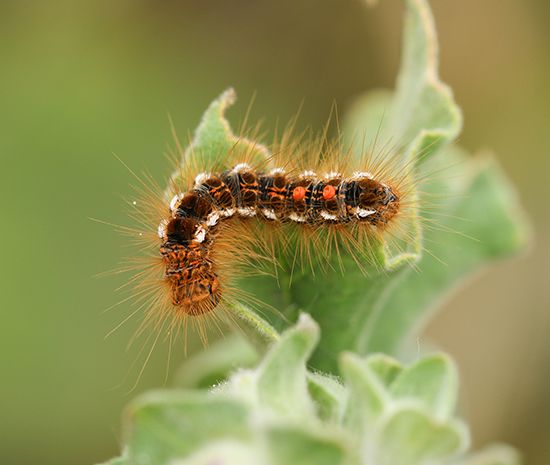
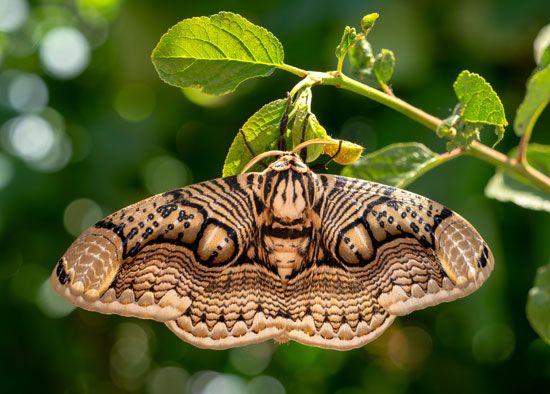
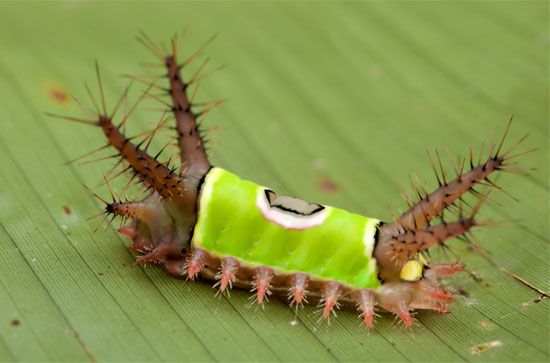
A slug caterpillar moth refers to any of approximately 1,800 species of insects belonging to the family Limacodidae1. They are named for their caterpillars, which possess suckers instead of the typical prolegs found in other species, causing them to appear to glide across surfaces.12
These moths are widely distributed globally, with a high concentration in tropical regions. The adult moths are generally small and hairy with fringed wings. Because they have reduced or absent mouthparts, the adults live for only a few days.1
Many of these larvae are brightly colored and feature stinging hairs that can cause painful rashes or, in some cases, anaphylactic shock in humans. Notable examples include the saddleback caterpillar and the hag moth, which uses its stinging appendages for protection and camouflage on its cocoon.1
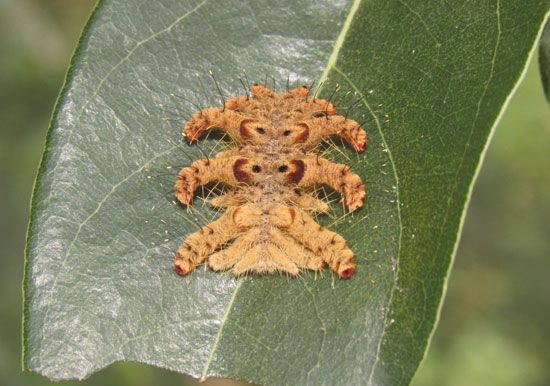
How do stinging hairs on caterpillars protect them from predators?
Stinging hairs serve as a highly effective defense mechanism for many caterpillars, primarily by acting as a chemical deterrent against predators such as birds. These specialized hairs are designed to break upon contact, releasing barbed fragments that contain poisonous substances. When a predator attempts to attack, these fragments cause intense irritation or pain, teaching the predator to avoid such prey in the future.4
In addition to this direct chemical defense, many caterpillars that possess these stinging appendages also exhibit aposematic, or warning, coloration. This conspicuous appearance serves as a visual “label” that predators quickly learn to associate with danger or a nauseous experience.4
Some species, such as the hag moth, utilize these stinging appendages even after they have pupated. By transferring the hairs to the exterior of their cocoons, they provide ongoing protection and camouflage for the developing insect.1
What are some other types of caterpillars that have unique movement patterns?
While most caterpillars move using a combination of true legs and fleshy prolegs, several species have evolved unique movement patterns to navigate their environments or escape danger:
- Inchworms and Loopers: Members of the families Geometridae and Noctuidae, such as the cabbage looper, possess a reduced number of prolegs (typically only two or three pairs). To move, they draw their hind end up to meet their front, creating a characteristic “looping” or “inching” gait before extending their anterior section forward again.36
- Slug Caterpillars: Larvae in the family Limacodidae lack traditional prolegs entirely. Instead, they utilize suckers to glide smoothly across surfaces, a movement pattern that distinguishes them from the crawling motion of most other lepidopteran larvae.3
- Snakefly Larvae: While not lepidopterans, these larvae exhibit a distinct defensive movement; they are known to wriggle rapidly backwards to escape potential threats.7
- Aquatic Larvae: Certain species, such as alderfly larvae, use specialized hairs or setae on their legs and abdominal filaments to propel themselves through water.7
Why do adult slug caterpillar moths have reduced mouthparts?
Adult slug caterpillar moths (family Limacodidae) possess reduced or absent mouthparts because their life cycle strategy shifts the burden of nutrition entirely to the larval stage.1213
In many lepidopterans, the adult stage is dedicated exclusively to reproduction and dispersal. While some moths rely on nectar or other liquids to fuel their flight, species with vestigial mouthparts have evolved to bypass adult feeding entirely. By obtaining all necessary energy and nutrients during their time as caterpillars, these moths can dedicate their short adult lives—which often last only a few days—solely to finding mates and laying eggs. This evolutionary trade-off, which has occurred independently across several insect lineages, allows the adult to focus its limited resources on the primary goal of continuing the species.12113
Sources
- slug caterpillar moth — Encyclopædia Britannica
- Limacodidae — Merriam-Webster
- How Many Legs Does a Caterpillar Have? — Encyclopædia Britannica
- insect - Protection from enemies — Encyclopædia Britannica
- Reproductive behaviour - Protective adaptations — Encyclopædia Britannica
- Did you know? — Merriam-Webster
- looper — Merriam-Webster
- neuropteran - Locomotion — Encyclopædia Britannica
- silkworm moth — Encyclopædia Britannica
- caterpillar — Encyclopædia Britannica
- loop — Merriam-Webster
- Lepidoptera - Head — Encyclopædia Britannica
- Lepidoptera - The adult — Encyclopædia Britannica
Published on · 3 min read