Somali Current
The Somali Current is a surface current in the western Indian Ocean that exhibits a unique seasonal reversal driven by the monsoon winds.
What is Somali Current?
The Somali Current is a surface current in the western Indian Ocean that exhibits a unique seasonal reversal driven by the monsoon winds.12
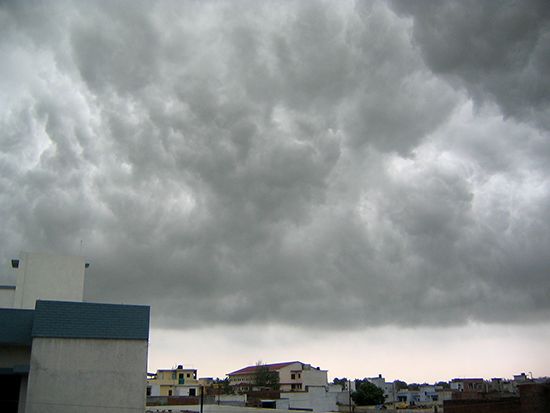
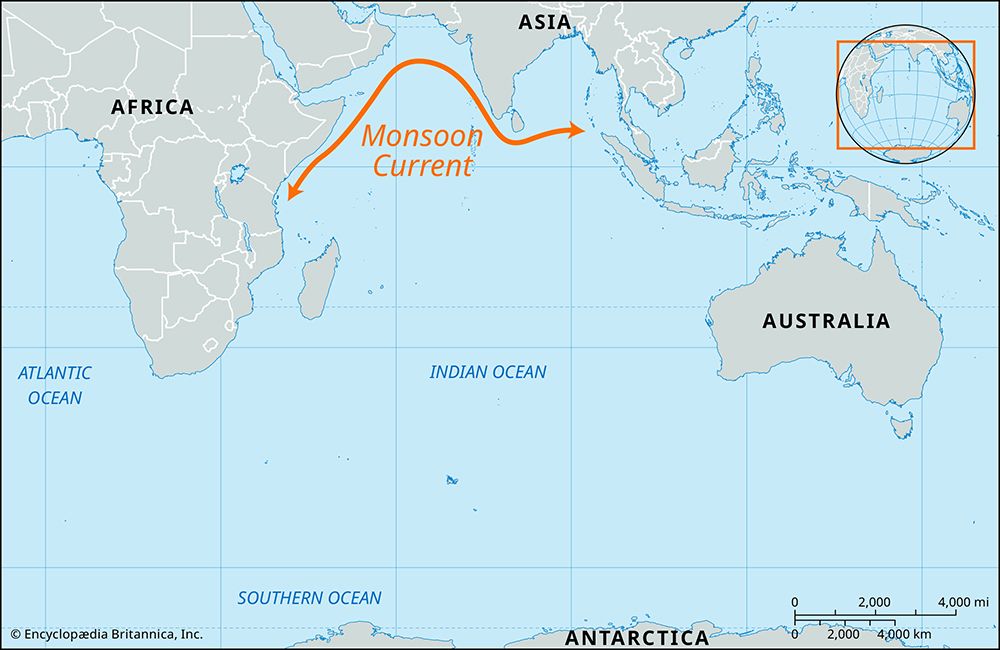
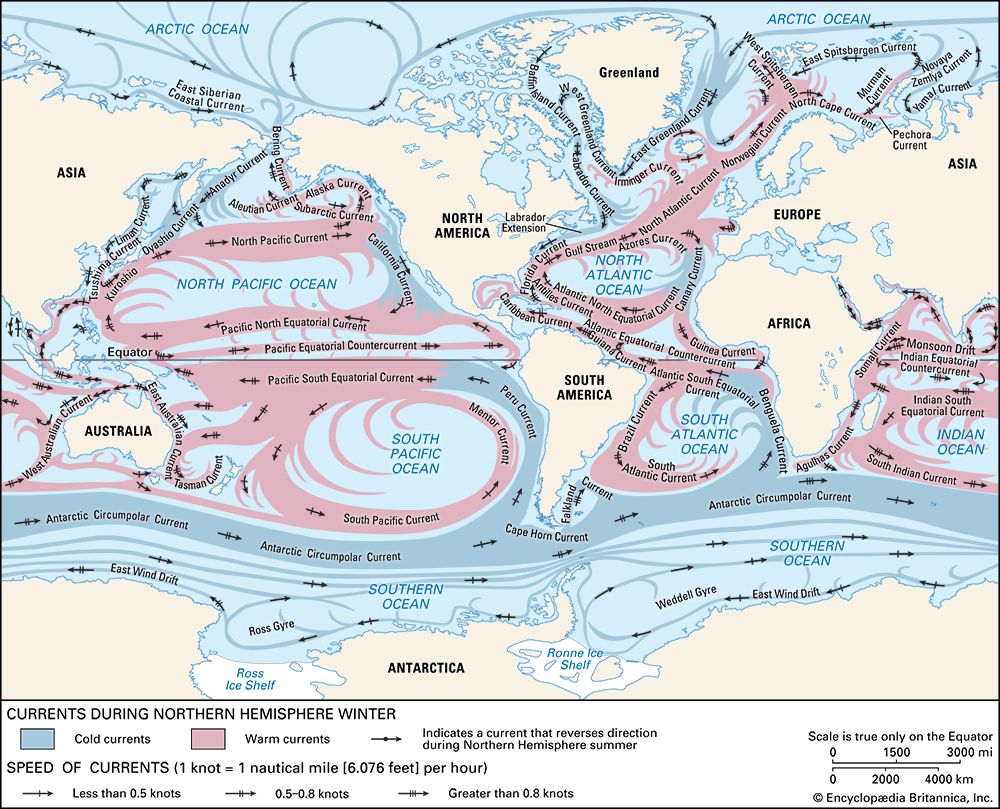
During the northern summer, the southwest monsoon pushes coastal waters northeastward along the coast of East Africa for approximately 950 miles (1,500 km). In this phase, the current is strong, reaching surface velocities of up to 9 miles (14 km) per hour and extending to a depth of about 2,600 feet (800 metres). Off the coast of Somalia, this flow turns eastward to become the Monsoon Current eastward to become the Monsoon Current.12
As the monsoon reverses in September, the current weakens. By winter, it disappears entirely and is replaced by a slow southwestward drift. This cold offshore current significantly influences the local climate, helping to moderate temperatures along the Indian Ocean coast compared to the extreme heat found further inland.13
How do ocean currents influence global weather patterns?
Ocean currents are powerful drivers of global weather and climate, acting as a global conveyor belt that redistributes heat, moisture, and energy across the planet.45
Heat Redistribution
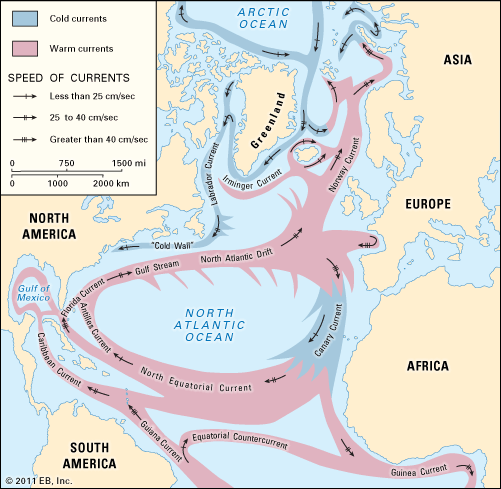
The most significant role of ocean currents is the transport of heat from the tropics toward the poles. A primary example is the Gulf Stream, which carries warm water from the Gulf of Mexico across the North Atlantic. As this water moves northeast, it releases heat into the atmosphere, which is then carried by prevailing westerly winds to moderate the climate of northwestern Europe, keeping it significantly warmer than other regions at similar latitudes.4567
Atmospheric Interaction and Climate Patterns
Ocean currents and surface temperatures exert a profound influence on atmospheric circulation through several mechanisms:
- Evaporation and Latent Heat: Changes in sea surface temperatures alter the rate of evaporation. Increased water vapor in the atmosphere releases latent heat when it condenses, providing energy that drives tropical circulation and influences global weather patterns.8
- ENSO (El Niño-Southern Oscillation): This system demonstrates the link between ocean and atmosphere. During El Niño, warmer-than-normal surface temperatures in the equatorial Pacific weaken trade winds, shifting rainfall patterns and causing unseasonable weather globally. Conversely, La Niña strengthens these winds, leading to different climatic impacts, such as increased precipitation in parts of Asia and Australia.98
- Thermohaline Circulation: Driven by density differences (temperature and salinity), the thermohaline circulation moves massive volumes of water globally, including the Atlantic Meridional Overturning Circulation (AMOC), which regulates long-term temperature and precipitation patterns.57
These interactions create a complex, interconnected system where anomalies in ocean temperatures can force shifts in storm tracks and jet streams, influencing seasonal weather far from the source of the temperature change.8
What is the difference between a monsoon and a regular seasonal wind?
A monsoon is a major wind system defined by a seasonal reversal of direction, typically blowing from one direction for approximately six months and the opposite direction for the remaining six months. In contrast, regular seasonal winds, such as prevailing winds, are generally dictated by semipermanent pressure systems and do not undergo this dramatic, large-scale directional shift.1112
The primary differences include:
- Directional Reversal: Monsoons reverse direction seasonally, typically blowing from sea to land in summer and from land to sea in winter. Regular prevailing winds, like the trade winds or westerlies, maintain a more consistent direction dictated by global pressure belts.1112
- Driving Mechanism: Monsoons are primarily caused by differential heating between land and sea; land heats and cools much faster than water, creating seasonal shifts in high and low-pressure areas. Regular prevailing winds are driven by broader atmospheric circulation patterns, such as the intertropical convergence zone (ITCZ) and the rotation of the Earth.1112
- Precipitation: Summer monsoons are often associated with heavy, consistent rainfall due to the condensation of moisture-laden air rising over land. Regular winds may bring varied weather, but they lack the specific, intense seasonal rainfall cycle characteristic of true monsoon systems.1112
Why does the Indian Ocean have a unique current system compared to other oceans?
The Indian Ocean possesses a unique current system that distinguishes it from the Atlantic and Pacific oceans, primarily due to its landlocked northern boundary and the influence of the seasonal monsoon.14
Semiannual Reversal
Unlike the Atlantic and Pacific, which feature relatively stable, clockwise-circulating gyres in the Northern Hemisphere, the northern Indian Ocean is the only ocean with a surface circulation that reverses semiannually. This phenomenon is driven by the monsoon winds:1415
- Northeast Monsoon (November–March): Surface currents generally flow southwest and west. During this period, a weak counterclockwise gyre develops in the Arabian Sea, while a strong clockwise gyre forms in the Bay of Bengal.215
- Southwest Monsoon (April–October): The winds reverse, pushing the Monsoon Current eastward. This creates a powerful western boundary current, including the Somali Current, which can reach velocities as high as 9 miles (14 km) per hour.215
Other Unique Characteristics
Beyond its reversing currents, the Indian Ocean is physically distinct in several ways:
- Asymmetry: It is landlocked in the Northern Hemisphere, preventing it from extending into Arctic waters or maintaining a temperate-to-cold zone in the north.14
- Water Properties: It lacks a local source of bottom water, meaning its deep water originates outside its boundaries. Additionally, it receives highly saline water from the Persian Gulf and the Red Sea, and its subsurface waters are notably low in oxygen.14
Sources
- Somali Current — Encyclopædia Britannica
- Indian Ocean - Surface currents — Encyclopædia Britannica
- Somalia - Climate — Encyclopædia Britannica
- How Do Ocean Currents Affect the Biosphere? — Encyclopædia Britannica
- What Is the Difference Between El Niño and La Niña? — Encyclopædia Britannica
- Gulf Stream — Encyclopædia Britannica
- thermohaline circulation — Encyclopædia Britannica
- Climate - The ocean surface and climate anomalies — Encyclopædia Britannica
- Climate - Influence on atmospheric circulation and rainfall — Encyclopædia Britannica
- Atlantic Meridional Overturning Circulation: Top Questions — Encyclopædia Britannica
- Monsoon — Encyclopædia Britannica
- monsoon — Merriam-Webster
- Climate - Zonal surface winds — Encyclopædia Britannica
- Monsoon Current — Encyclopædia Britannica
- Indian Ocean — Encyclopædia Britannica
- Indian Ocean - Origin — Encyclopædia Britannica
- Himalayas - Climate of the Himalayas — Encyclopædia Britannica
- climate of India - Factors affecting climate in India — Encyclopædia Britannica
Published on · 4 min read