Springbok
The scientific name of the springbok is Antidorcas marsupialis.
What is the scientific name of the springbok and what does it mean?
The scientific name of the springbok is Antidorcas marsupialis.12
The name is derived from two parts:
- Antidorcas: This genus name is New Latin, originating from the Greek anti- (meaning similar to or like) and dorkas (meaning gazelle), reflecting its close relationship to the gazelle tribe reflecting its close relationship to the gazelle tribe.2
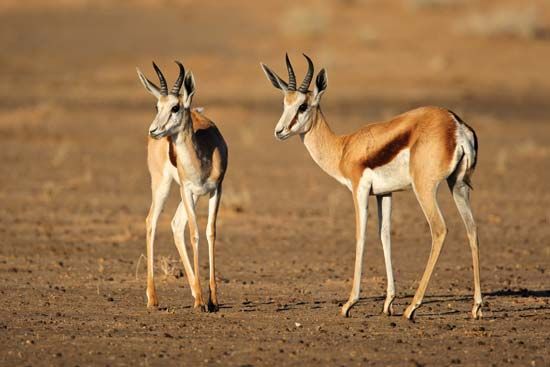
- marsupialis: This species name refers to a unique, pocket-like skin fold on the animal’s back. This concealed organ is lined with scent glands and contains a patch of white hair that the springbok displays during a specialized jumping behavior known as “pronking”.1
How do springboks adapt to their environment and what is their diet?
The springbok (Antidorcas marsupialis) is highly adapted to the arid, treeless plains of southern Africa, where it thrives in environments ranging from the Kalahari to the Karoo regions. Its primary survival strategies include:
- Dietary Flexibility: As a mixed feeder, the springbok grazes on grasses during the rainy season and shifts to browsing on foliage, forbs, and moisture-rich plants like tsama melons during the dry season. It is remarkably drought-tolerant, capable of subsisting indefinitely on browse that contains at least 10 percent water content.1
- Reproductive Plasticity: The timing of their rut and birth cycles can shift by up to two months, allowing the species to synchronize offspring arrival with the onset of the rainy season, an essential adaptation to unpredictable arid climates.1
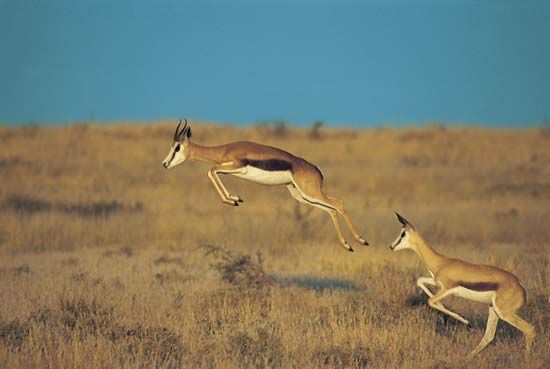
- Physical Speed: Capable of reaching speeds of 88 km (55 miles) per hour, the springbok uses its agility and the unique “pronking” display—a series of high, stiff-legged bounds—to signal fitness and evade predators.1
What role do springboks play in their ecosystem?
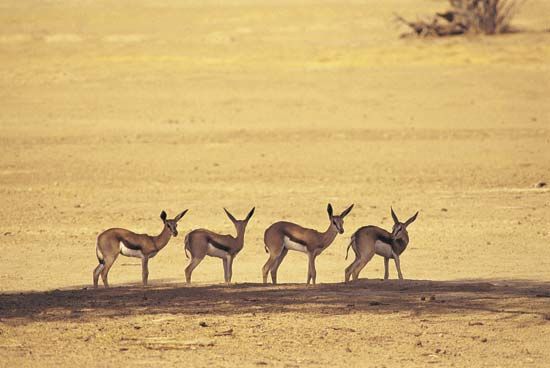
The springbok (Antidorcas marsupialis) serves as a vital component of the arid and semi-arid ecosystems of southern Africa, particularly within the Highveld, Karoo, and Kalahari regions. Its ecological role is defined by several key functions:1
- Dominant Herbivore: Historically, the springbok was a dominant migratory species that shaped the vegetation of vast, treeless plains. By acting as a mixed feeder—grazing on grasses during the rainy season and browsing on foliage and forbs during the dry season—it exerts a significant influence on plant community structure and nutrient cycling across its range.1
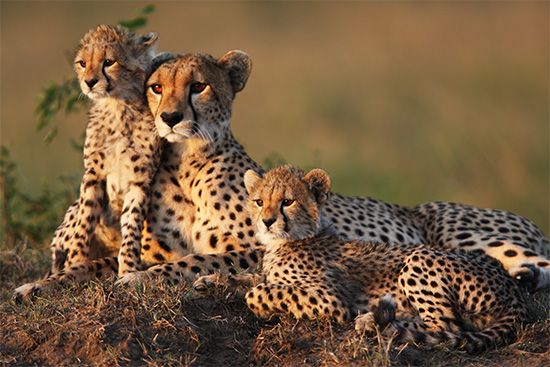
- Prey Base: As a highly abundant plains antelope, the springbok serves as a critical food source for major African predators, including cheetahs and wild dogs.1
- Ecosystem Indicator: The presence and movement of springbok herds, which aggregate at water holes and areas of fresh vegetation following local thunderstorms, help indicate the health and productivity of these volatile, water-scarce environments.1
While human land use, such as the subdivision of plains into fenced ranches, has curtailed their natural migratory patterns, the springbok remains a resilient symbol of the southern African landscape.14
Where are springboks typically found in the wild?
Springboks are native to the open, treeless plains of southern Africa. While they once roamed in enormous herds across the region, their range is now more fragmented due to human land use.5
Key areas where springboks are found include:
- South Africa: They are common on farms and ranches throughout the Highveld and Karoo regions, which were historically their primary habitat. Although the Springbok Flats are named for their historical abundance, wild populations there are now largely restricted to preserves.51
- Botswana: Migratory populations are still found within the Kalahari Desert.5
- Namibia and Angola: They inhabit the subdesert and desert regions of Namibia and southwestern Angola.5
These antelopes are highly adapted to these arid environments, with different subspecies thriving in specific climatic conditions, ranging from the smaller Highveld-Karoo variety to the larger Kaokoveld variety found in Namibia.5
Sources
- springbok — Encyclopædia Britannica
- Antidorcas — Merriam-Webster
- springbok — Merriam-Webster
- blesbok — Encyclopædia Britannica
- Springbok Flats — Encyclopædia Britannica
Published on · 3 min read